phone iconSpeak with our expert +1 410 936 4682

Delivered in collaboration with Great Learning

Learn more about the course

Get details on syllabus, projects, tools, and more

Name
Email
Mobile Number

By submitting this form, you consent to our Terms of Use & Privacy Policy and consent to be contacted via email, phone (including by AI-generated/pre-recorded voice calls), SMS, or WhatsApp.

Upskill Your Teams with Future-Ready Skills

Empower your workforce with programs from leading universities

  • Team Pricing

    Maximize ROI with exclusive cost-effective plans for group enrollments

  • Team Learning Dashboard

    Track progress & outcomes at the team level

  • Customized Learning Paths

    Tailor the program to align with your team's goals and drive meaningful outcomes.

Enter your organisation name

This will help us customise the proposal plans

Company Name
AI and Agentic AI in Healthcare

AI and Agentic AI in Healthcare

Application closes 30th Sep 2026

Why should you join this program?

  • List icon

    Healthcare-Focused AI Curriculum

    Learn from Johns Hopkins University faculty, and industry experts to leverage AI & Agentic AI to improve patient outcomes through real-world case studies, with no coding experience required.

  • List icon

    Learn from a Global Leader in Medical Research and Healthcare

    Ranked #1 in Biomedical Engineering, #7 National University, #10 Most Innovative Schools by U.S. News and World Report, JHU is a leader in healthcare research and innovation. (2026 Rankings)

PROGRAM OUTCOMES

What will you learn to build and apply?

Through a structured learning journey, you will build the capability to:

  • Apply the R.O.A.D. Management Framework to align AI initiatives with organizational clinical goals

  • Differentiate key algorithms and evaluate performance via accuracy and F1 score metrics

  • Analyze human baselines, prospect theory, status quo bias, and risk-based approaches in clinical workflows

  • Lead through the shift from manual task execution to human-in-the-loop and human-on-the-loop agent supervision

  • Distinguish reactive AI from goal-directed Agentic AI and evaluate use cases using an evidence-based rubric

  • Address PHI protection, regulatory fit, accountability, audit trail across EHR, payer, and clinical systems

Earn a Certificate from Johns Hopkins University

  • #7 National University Rankings

    #7 National University Rankings

    U.S. News & World Report, 2026

  • #2 Computer Information Technology

    #2 Computer Information Technology

    U.S. News & World Report, 2026

  • #10 Most Innovative Schools

    #10 Most Innovative Schools

    US News and World Report, 2026

  • #14 Best Global University

    #14 Best Global University

    U.S. News & World Report, 2026

  • #1 Biomedical Engineering Program

    #1 Biomedical Engineering Program

    US News and World Report, 2026

KEY PROGRAM HIGHLIGHTS

Why choose the AI in Healthcare Program?

  • List icon

    Learn from JHU Faculty

    Learn through recorded lectures and attend faculty-led masterclasses covering AI project management, healthcare AI trends, and AI-powered clinical risk assessment.

  • List icon

    Interactive Mentorship by Industry Experts

    Learn from healthcare AI practitioners through mentored sessions focused on practical applications, implementation challenges, and industry best practices.

  • List icon

    Healthcare-Focused AI Curriculum

    Build expertise in clinical decision support, predictive analytics, population health, healthcare AI strategy, and responsible AI.

  • List icon

    Real-World Healthcare Case Studies

    Analyze 8+ healthcare case studies covering disease prediction, clinical decision support, AI adoption, healthcare ethics, and patient care.

  • List icon

    Earn a Recognized Credential from JHU

    Earn a Certificate of Completion and 6 CEUs from Johns Hopkins University upon successful completion of the program.

  • List icon

    Personalized Program Support

    Get access to a dedicated program support team, and receive academic support from subject matter experts throughout your learning journey.

Skills you will learn

Applying AI Solutions in Healthcare

Predictive Analytics for Disease Management

Ethical AI Practices and Regulatory Compliance

AI-Driven Decision Support Systems

AI Project Management for Healthcare Initiatives

Large Language Models (LLMs) in Healthcare

Machine Learning Algorithms for Clinical Applications

Robotic Process Automation in Clinical Settings

Human-in-the-Loop & Human-on-the-Loop Operating Models

Change Management for AI Adoption

The R.O.A.D. Management Framework

Transition from Task Execution to Agent Supervision

Applying AI Solutions in Healthcare

Predictive Analytics for Disease Management

Ethical AI Practices and Regulatory Compliance

AI-Driven Decision Support Systems

AI Project Management for Healthcare Initiatives

Large Language Models (LLMs) in Healthcare

Machine Learning Algorithms for Clinical Applications

Robotic Process Automation in Clinical Settings

Human-in-the-Loop & Human-on-the-Loop Operating Models

Change Management for AI Adoption

The R.O.A.D. Management Framework

Transition from Task Execution to Agent Supervision

view more

  • Overview
  • Learning Journey
  • Curriculum
  • Projects
  • Certificate
  • Faculty
  • Mentors
  • Reviews
  • Fees
  • FAQ

Who is the program for?

Professionals Seeking to Harness AI in Healthcare

  • Business and Strategy Leaders in Healthcare

    Lead AI-driven healthcare initiatives, optimize operational efficiency, and drive strategic business outcomes.

  • Medical, Pharmaceutical and Biotech Professionals

    Apply AI to enhance diagnostics, personalize treatment plans, and accelerate medical research.

  • Technical Professionals and Healthcare Consultants

    Master AI techniques to analyze healthcare data, automate routine tasks, and enhance clinical decision-making.

  • Regulators and Healthcare Policymakers

    Leverage AI for policy analysis, data-driven decision-making, and effective resource allocation in public health.

How is the program learning experience?

Through a structured learning approach, develop the strategic judgment and intuition to scale AI

  • banner-image

    Learn from Experts

    Learn from JHU faculty and industry experts to build AI powered healthcare solutions

  • banner-image

    Learn By Doing

    Apply AI concepts through case studies focused on patient outcomes and healthcare innovation

  • banner-image

    Earn a University Credential

    Earn a certificate of completion and 6 CEUs from Johns Hopkins University

  • banner-image

    Get Support Throughout the Learning Journey

    Program managers will help you stay on track, navigate key milestones & complete the program

Elevate Your Skills with an Optional Paid Program

banner

Applications of AI and Agentic AI in Healthcare

Add this program to your portfolio to:

  • Learn from world-renowned JHU faculty and experts
  • Build AI applications across healthcare from deployment to governance
  • Work with tools like ChatGPT | Claude | Gemini | Codex | n8n
  • Earn 7 Continuing Education units upon program completion

Reach out to your Program Advisor for more details

*image for illustration purposes only.

What will you learn in the program?

Designed by the renowned Johns Hopkins University faculty, the AI and Agentic AI in Healthcare covers foundational AI concepts, clinical decision support, health and disease management, business strategy, plus 3 masterclasses on AI project implementation, future industry trends, and workflow automation. It requires no prior programming experience.

PRE-WORK - HISTORY OF AI IN HEALTHCARE

Participants will explore the evolution of AI in healthcare and its impact on medical practices. They will gain insights into AI's applications in radiology, precision medicine, and surgery, along with its role in enhancing diagnostics and patient care. Additionally, they will utilize predictive analytics to understand AI’s effectiveness in managing patient risks and examine ethical considerations to promote responsible AI adoption.

MODULE 1: FOUNDATIONS OF AI FOR HEALTHCARE

Participants in this module will learn the fundamentals of Artificial Intelligence and its core technologies, focusing on their application in healthcare. They will explore the R.O.A.D. Management Framework for AI integration, define algorithms, and differentiate key machine learning models. Additionally, they will evaluate model performance using metrics like accuracy and F1 score and assess the difference between pseudo-innovation and real innovation in healthcare.

WEEK 1: AI IN HEALTHCARE: FOUNDATIONS AND FRAMEWORKS

In this week, participants will explore the core technologies and terminology of Artificial Intelligence (AI) and its role in healthcare delivery. They will also learn about the importance of randomization in AI applications, as well as the reliability and validity of AI interventions. Additionally, the R.O.A.D. Management Framework will be introduced as a strategic tool to guide the effective integration of AI into healthcare systems, ensuring alignment with organizational goals and optimizing AI-driven outcomes.

WEEK 2: UNDERSTANDING THE BUILDING BLOCKS OF AI IN HEALTHCARE

This week, participants will gain an overview of different machine learning algorithms, exploring their core principles and primary use cases. They will define algorithms as step-by-step problem-solving procedures and examine their fundamental components, understanding how they function in various scenarios. Participants will learn to assess machine learning models using key metrics to evaluate their effectiveness. The module will also delve into the distinction between pseudo-innovation and real innovation in healthcare, highlighting the importance of evidence-based evaluation in identifying genuine advancements over passing trends.

MODULE 2: AI FOR INTELLIGENT DECISION SUPPORT

This module explores how AI has the potential to enhance decision-making in healthcare by leveraging predictive modeling, neural networks, and deep learning. Participants will analyze the human baseline concept in AI, risk-based approaches, and psychological factors such as prospect theory and status quo bias. The course also covers AI's role in managing information overload, the potential of Large Language Models (LLMs) in improving healthcare workflows, and the challenges associated with AI biases and human oversight.

WEEK 3: AI FOR CLINICAL DECISION SUPPORT

This week, participants will explore the concept of the human baseline in AI, comparing it to risk-based approaches while considering manual processes and the effects of prospect theory and status quo bias. They will evaluate the role of predictive modeling, neural networks, and deep learning in healthcare, and examine how these techniques can be applied to address healthcare challenges. Participants will evaluate predictive techniques for hospital complications, analyze the effectiveness of these techniques in real-world applications, and explore data-driven approaches for assessing risk factors and outcomes.

WEEK 4: LARGE LANGUAGE MODELS AND THE SHIFT TO AGENTIC AI

This week, participants examine how AI helps manage information overload in medical literature and supports data synthesis in clinical decision-making. They explore how Large Language Models (LLMs) and Agents automate administrative tasks, facilitate patient interactions, and reduce clinician burnout, while also evaluating LLM limitations such as reliability gaps, training-data bias, and the need for human oversight. The week then introduces the shift from reactive to agentic AI, covering goal-directed, multi-step, autonomous action, and how to match workflow types to the right approach. A case study on the move from ambient scribes to agentic documentation workflows shows how reactive tools evolve into agentic systems in practice.

WEEK 5: AUTOMATION, ROBOTICS, AND AGENTIC AI IN HEALTHCARE

This week, participants learn how robotic-assisted surgery uses automation to improve surgical precision and outcomes, examining current technologies, benefits, risks, and emerging trends. They also explore Robotic Process Automation and how it streamlines repetitive tasks and reduces errors in clinical settings. Using a structured evidence rubric, participants evaluate agentic deployments against accuracy thresholds, select appropriate oversight tiers, and work through the human-in-the-loop and human-on-the-loop spectrum, along with common failure modes and regulatory fit. A case study evaluating an agentic prior authorization deployment applies these frameworks to a real-world scenario.

MODULE 3: AI FOR POPULATION HEALTH AND DISEASE MANAGEMENT

Upon completion of this module, participants will analyze graph analytics related to comorbidity, identifying risk factors and social influences on health interactions for improved patient management. They will explore the cultural impacts on medication adherence and their implications for public health interventions. Participants will apply epidemiological models, such as Markov models and the SEIR framework, to assess disease spread and the effectiveness of AI tools during pandemics. Additionally, they will examine AI's role in precision medicine to enhance health screening, treatment protocols, and early disease detection, optimizing preventive healthcare strategies and improving patient outcomes.

WEEK 6: AI FOR IMPROVED HEALTH OUTCOMES

In this week, participants will analyze comorbidity data to identify key risk factors and assess how social and cultural influences impact health interactions and medication adherence. They will explore graph analytics and epidemiological models, such as Markov and SEIR, to understand disease spread and its impact on public health. The week will also cover the role of AI in enhancing health outcomes, especially in the context of pandemics, where AI tools can be used to improve response strategies. Participants will gain insights into how AI-driven approaches can identify risk factors, inform public health interventions, and support disease spread analysis for better management of health crises.

WEEK 7: LEARNING BREAK

WEEK 8: DESIGNING PREVENTIVE HEALTHCARE STRATEGIES

In this week, participants will analyze AI's role in precision medicine, focusing on how it has the potential to enhance health screening processes and personalized treatment protocols to improve patient outcomes. They will explore predictive models in healthcare, learning how these models can aid in early disease identification, leading to more effective preventive healthcare strategies. By assessing how AI can contribute to disease burden reduction and optimize treatment paths, participants will understand how AI can drive improvements in both individual patient care and broader healthcare practices.

MODULE 4: AI BUSINESS STRATEGY FOR HEALTHCARE

Upon completion of this module, participants will understand the R.O.A.D. Management Framework for AI integration in healthcare and identify common pitfalls in AI projects, proposing risk mitigation strategies. They will analyze ethical, regulatory, and privacy challenges, along with best practices for managing datasets in Electronic Health Records (EHRs). Participants will assess healthcare leadership styles and their impact on AI adoption, explore social network strategies for organizational change, and evaluate methods for scaling AI pilot projects to full hospital implementation. Lastly, they will investigate career paths in AI within healthcare, identify essential skills, and understand AI's role in optimizing pharmaceuticals and medical devices to enhance efficacy and patient safety.

WEEK 9: HEALTH DATA, ETHICS, AND AGENTIC AI GOVERNANCE

This week, participants analyze the ethical, regulatory, and privacy challenges of AI in healthcare, focusing on fairness, equitable access to AI-driven solutions, and robust patient data protection. They examine how to export Electronic Health Records (EHRs) and apply best practices for data cleaning, management, and integrating AI models into existing EHR systems. The week also covers accountability in multi-agent workflows, including how agents operate across EHR, payer, and clinical systems, the audit trails these systems require, and the safeguards needed to protect PHI. Participants consider why agentic AI regulation is still forming and why it remains hard to solve. A case study on governing multi-agent AI across healthcare systems applies these principles to a real-world scenario.

WEEK 10: CHANGE MANAGEMENT AND THE SHIFT TO AGENT SUPERVISION

This week, participants distinguish between formal and informal leadership styles in healthcare and evaluate how each shapes team dynamics, decision-making, and AI implementation. They explore social network-based approaches to change management, examining how interpersonal connections drive AI adoption, and evaluate strategies for scaling AI pilots across health systems, including the challenges of hospital-wide rollout and best practices for sustainable adoption. The week also covers the workforce shift from task execution to agent supervision, including trust-building in human-agent teams, override protocols, and monitoring the performance of deployed agents. A case study on this transition guides participants in developing a practical care team transition plan.

MASTERCLASS 1: AI PROJECT MANAGEMENT AND DESIGN

Participants will understand the R.O.A.D. Management Framework for integrating AI in healthcare and explore key components essential for successful implementation. The session covers strategic AI integration, common pitfalls in AI projects, and the impact of data issues on success of AI projects. Participants will examine the role of stakeholder engagement, the influence of change management, and factors that contribute to successful AI project outcomes. Additionally, the masterclass will provide mitigation strategies to address risks and challenges, increasing the probability of the effective deployment of AI-driven solutions in healthcare.

MASTERCLASS 2: FUTURE TRENDS IN AI AND HEALTHCARE

Participants will explore career paths in AI within the healthcare sector, by developing the skills and competencies required for success. The session will cover strategies for personal career advancement and the growing role of AI in pharmaceuticals and medical devices. They will assess how AI has the potential to enhance efficacy, reduce time-to-market for new treatments, and improve patient safety. Additionally, the masterclass will teach the specific skills to determine whether AI-driven solutions truly optimize medical devices and provide greater precision and reliability in healthcare applications.

MASTERCLASS 3: AI-POWERED PRE-VISIT CLINICAL RISK ASSESSMENT USING n8n

Participants will understand how AI can streamline pre-visit clinical workflows by organizing unstructured patient data, identifying early risk patterns, and improving clinical efficiency. The session covers the challenges of fragmented clinical data, fundamentals of AI-driven pre-visit risk assessment, and core principles such as structured data, visibility, and decision support. Participants will also explore workflow automation using no-code tools like n8n, including an end-to-end patient intake to pre-visit summary pipeline. Additionally, the masterclass examines NLP and AI techniques for clinical data organization, rule-based risk detection, and patient prioritization. It will also highlight the impact of AI-powered pre-visit assessments on patient safety, operational efficiency, and future healthcare innovations, while emphasizing how intelligent workflows can support clinician decision-making.

Note: The curriculum listed above are indicative and subject to updates as technology evolves.

What case studies will you solve?

Work on healthcare AI case studies covering disease prediction, diagnostics, and patient care

project icon

Sample Case Study

AI-Assisted COVID-19 Detection Using Chest X-Rays

Description

Explore how AI-assisted chest X-rays addressed global testing bottlenecks during COVID-19, enabling rapid, scalable screening while uncovering challenges of explainability, bias, and Integration.

Skills you will learn

  • Medical image analysis
  • AI model evaluation (DeepCOVID-XR
  • COVID-Net
  • Qure.ai)
  • Explainability methods (Grad-CAM)
  • Ethical and responsible AI adoption
project icon

Sample Case Study

From Ambient Scribes to Agentic Documentation Workflows

Description

Explore how documentation AI is evolving from passive ambient scribes that transcribe encounters into agentic workflows that draft notes, place orders, and route tasks, while examining accuracy thresholds, human oversight, and safe rollout.

Skills you will learn

  • Agentic workflow design
  • ambient documentation
  • human oversight tiers
  • deployment risk evaluation
project icon

Sample Case Study

Evaluating an Agentic Prior Authorization Tool

Description

Learn how to assess a real agentic prior authorization system using a structured evidence rubric, weighing accuracy thresholds, oversight tier, failure modes, and regulatory fit before deployment.

Skills you will learn

  • Structured evidence rubric
  • agentic use case evaluation
  • oversight tier selection
  • regulatory fit assessment
project icon

Sample Case Study

Governing Multi-Agent AI Across Healthcare Systems

Description

Understand how to govern autonomous agents acting across EHR, payer, and clinical systems, covering accountability, audit trails, PHI protection, and why agentic AI regulation is still forming.

Skills you will learn

  • Multi-agent governance
  • audit trail design
  • PHI protection
  • agentic accountability frameworks
project icon

Sample Case Study

From Task Execution to Agent Supervision

Description

Explore how care teams shift from executing tasks to supervising agents, covering trust-building in human-agent teams, override protocols, and performance monitoring of deployed agents.

Skills you will learn

  • Agent supervision
  • human-agent trust
  • override protocol design
  • deployed agent monitoring

Note: The projects listed above are indicative and subject to updates to the curriculum.

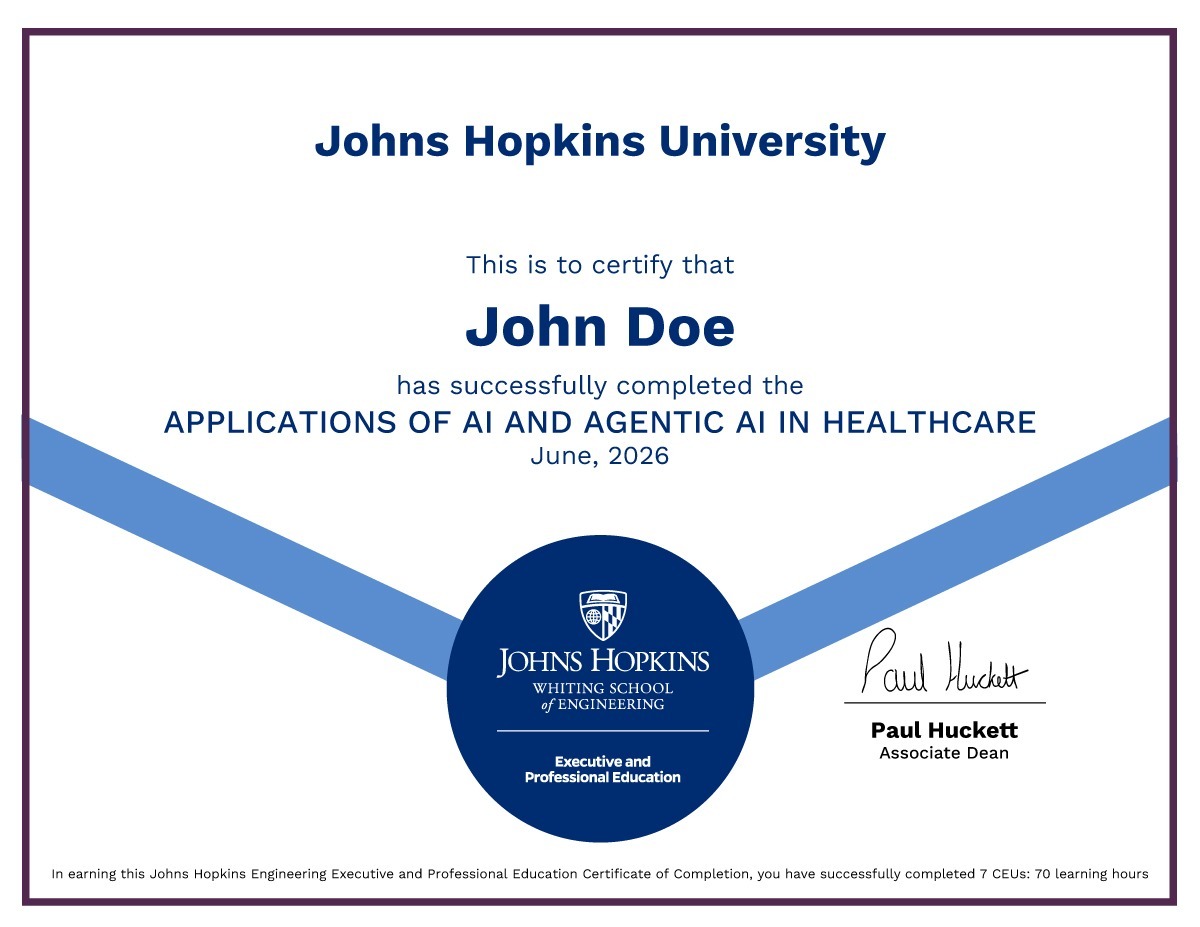
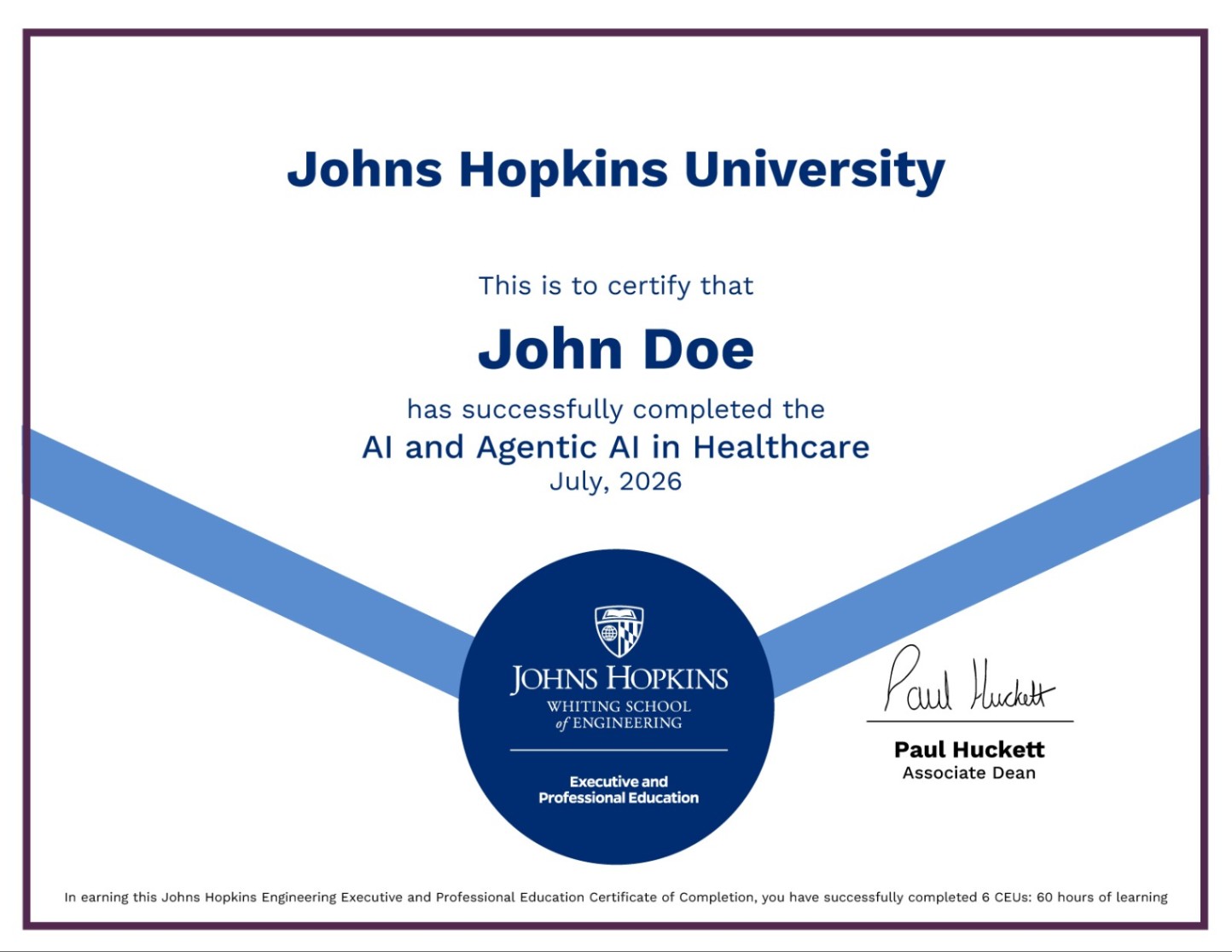
Earn a Professional Certificate from Johns Hopkins University

Stand out in a competitive market with a Certificate of Completion in AI in Healthcare that formally recognizes the expertise developed through rigorous, practical assessments.

  • thumbs-up

    Biomedical Leadership

    #1 Biomedical Engineering Program by U.S. News & World Report, 2026

  • thumbs-up

    National Recognition

    #7 National University by U.S. News & World Report, 2026

  • thumbs-up

    Global Standing

    #14 Best Global University by U.S. News & World Report, 2026

certificate image

* Image for illustration only. Certificate subject to change.

Who are the faculty for the program?

Learn from renowned JHU faculty and build the expertise to evaluate and implement AI in healthcare settings.

  • Ian McCulloh, Ph.D.

    Ian McCulloh, Ph.D.

    Director, AI Executive & Professional Education, Johns Hopkins University

    Served as Chief Data Science and MD of AI, Accenture Federal Services

    Author of three books and over 100 peer-reviewed papers

    Know More
    Company Logo
  • Daniel Byrne

    Daniel Byrne

    Award-winning author, Teacher, and Faculty member, Johns Hopkins University

    40+ years in AI, predictive modeling, and healthcare.

    Published 165+ scientific papers on AI and patient outcomes

    Know More
    Company Logo

Who are the mentors for weekly live sessions?

Learn from seasoned AI healthcare mentors to apply concepts and build practical skills.

  •  G Anthony Reina  - Mentor

    G Anthony Reina linkin icon

    Head of Machine Learning, Stealth BioTech Startup
    Company Logo
  •  Sharath M S  - Mentor

    Sharath M S linkin icon

    Staff AI Engineer, GE HealthCare
    Company Logo
  •  Rishov Chatterjee  - Mentor

    Rishov Chatterjee linkin icon

    Director of Data Science and AI, Integra Connect
    Company Logo

Note: The mentors listed above are indicative and subject to change based on availability and scheduling.

Course Fees

The program fee is USD 2,990

Lead AI Innovation in Healthcare

  • benifits-icon

    Build expertise in applying AI to clinical decision support and predictive analytics for better patient care.

  • benifits-icon

    Apply the R.O.A.D. Management Framework to align AI initiatives with organizational clinical goals

  • benifits-icon

    Learn from healthcare AI practitioners through live online sessions focused on industry applications.

  • benifits-icon

    Receive a Certificate of Completion and 6 CEUs from Johns Hopkins University.

project icon

Easy payment plans

Avail our EMI options & get financial assistance

  • INSTALLMENT PLANS

    Upto 12 months Installment plans

    Explore our flexible payment plans

    View Plans

Third Party Credit Facilitators

Check out different payment options with third party credit facility providers

affirm splitit

*Subject to third party credit facility provider approval based on applicable regions & eligibility

Take the next step

timer
00 : 00 : 00

Apply to the program now or schedule a call with a program advisor

Unlock exclusive course sneak peek

Application Closes: 30th Sep 2026

Application Closes: 30th Sep 2026

Talk to our advisor for offers & course details

Admission Process

Admissions close once the required number of participants enroll. Apply early to secure your spot

  • steps icon

    1. APPLY

    Fill out an online application form.

  • steps icon

    2. REVIEW

    Your application will be reviewed by a panel from Great Learning to determine if it is a fit with the program

  • steps icon

    3. JOIN PROGRAM

    After a final review, you will receive an offer for a seat in the upcoming cohort of the program.

Batch start date

Frequently Asked Questions

Program Details
Faculty, Curriculum, and Projects
Eligibility and Admissions
Fee and Payment Details
Career-related Queries
General Queries
Program Details

Why do professionals in healthcare choose Johns Hopkins University for AI education?

Professionals in healthcare choose Johns Hopkins University for its global reputation in
medicine and research, world-class faculty, and industry-relevant AI curriculum. Ranked
among the world's leading universities, JHU combines expertise in medicine, engineering,
computer science, and public health to deliver practical AI learning for healthcare
professionals. The program also integrates real-world case studies, industry mentorship,
and AI-powered learning support to help professionals evaluate AI opportunities and apply
AI in clinical and operational settings.

How is this program designed for busy healthcare professionals?

Johns Hopkins University’s AI and Agentic AI in Healthcare program is designed for working
healthcare professionals, with a flexible 10-week online format requiring just 6–8 hours per
week. It combines recorded lectures, interactive mentoring sessions, and live
masterclasses, allowing you to learn at your own pace. The program also offers a dedicated
program support team, industry mentorship, and an AI-powered learning assistant (GL Coach)
and requires no prior programming experience, making it easy to balance learning with a
full-time role.

How will an AI and Agentic AI in Healthcare course help me apply AI in real healthcare settings?

An AI and Agentic AI in Healthcare course helps healthcare professionals move beyond AI
theory and apply it to real clinical and operational challenges. You will learn how to use AI
for clinical decision support, predictive analytics, workflow automation, population health,
and AI strategy through 8+ real-world case studies. Like the AI and Agentic AI in Healthcare
program by Johns Hopkins University, which also covers Large Language Models (LLMs),
no-code automation with n8n, and frameworks for scaling AI solutions across healthcare
organizations.

Will I earn a certificate from Johns Hopkins University if I complete this healthcare program?

Yes, upon successful completion of the program, you will receive a Certificate of
Completion from Johns Hopkins University and 6 Continuing Education Units (CEUs).
What role does Great Learning play in delivering the Johns Hopkins

What role does Great Learning play in delivering the Johns Hopkins University AI and Agentic AI in Healthcare Program?

Great Learning is the program delivery partner for the Johns Hopkins University AI and
Agentic AI in Healthcare Program. Great Learning handles the application review process,
provides each participant with a dedicated program support team and access to GL Coach, an
AI-powered learning assistant built into the learning platform.
The curriculum and faculty are provided by Johns Hopkins University; Great Learning
manages the operational and learner support infrastructure.

Will this program help me evaluate AI tools before implementing them

Yes, a core component of the curriculum is teaching participants how to critically evaluate
AI tools to ensure they are effective, reliable, and appropriate before integrating them into
healthcare settings. The program equips you with several frameworks and analytical skills
to assess AI technologies prior to implementation.
Furthermore, the program covers change management and adoption strategies, allowing
you to evaluate the best methods for scaling AI pilot projects to full hospital
implementation while maintaining sustainable best practices and navigating regulatory
challenges.

How do the 6 Continuing Education Units (CEUs) from Johns Hopkins University work?

Upon successfully fulfilling all program completion requirements, participants earn a Certificate of Completion from Johns Hopkins University along with 6 CEUs (equivalent to 60 hours of structured learning). These credentials demonstrate professional development and mastery in AI adoption to employers and regulatory bodies.

What practical AI tools and platforms will I learn to evaluate during the program?

You will explore a broad range of AI technologies, including Machine Learning classification models (SVM, Random Forest, Neural Networks), Large Language Models (LLMs), Robotic Process Automation (RPA), and no-code automation platforms like n8n for pre-visit clinical triage. Additionally, participants gain hands-on experience using an AI-powered learning assistant, GL Coach.

Faculty, Curriculum, and Projects

Does this AI and Agentic AI in Healthcare program cover Generative AI, Machine Learning, predictive analytics, and clinical decision support?

Yes. The Johns Hopkins University AI and Agentic AI in Healthcare program covers
Generative AI, Machine Learning, Predictive Analytics, and clinical decision support
through a combination of live masterclasses, expert-led mentorship sessions, and
real-world case studies.
You'll learn how to use Large Language Models (LLMs) in Healthcare, evaluate machine
learning models, build predictive analytics solutions for disease risk and population health,
and assess AI opportunities and integrate AI into clinical and operational workflows using
techniques such as deep learning and neural networks. The curriculum also includes
practical healthcare use cases, helping you apply these technologies to real clinical and
operational challenges.

What are the key AI tools used in Healthcare?

Common AI tools in healthcare include:
● Machine learning models (e.g., Random Forest, SVM) for prediction and risk analysis
● Natural Language Processing (NLP) for medical documentation and data extraction
● Large Language Models (LLMs) for clinical assistance and workflow automation
● Robotic Process Automation (RPA) for administrative tasks
● Computer vision tools for medical imaging and diagnostics
The program also explores how LLMs and predictive analytics help manage information
overload and enhance clinical workflows.

What kind of learning support will I receive during the program?

Yes, the program offers comprehensive learning support, including:
● Personalized assistance from a dedicated program support team throughout your learning journey to stay on track and
manage your learning effectively.
● Mentorship from industry experts in healthcare AI who will guide you through
real-world applications and case studies.
● Access to GL Coach, an AI-powered learning assistant built by Great Learning, is
available for on-demand support between sessions.

Who will be the faculty teaching the AI and Agentic AI in Healthcare program?

The program is taught by Dr. Ian McCulloh and Professor Daniel Byrne, distinguished Johns
Hopkins University faculty with extensive expertise in AI, healthcare, engineering, and data
science. They combine academic excellence with decades of industry, research, and
leadership experience in applying AI to healthcare.

What are the three masterclasses included in the Johns Hopkins University AI and Agentic AI in Healthcare Program?

The program includes three live masterclasses. Two are conducted by Johns Hopkins
University faculty and one by an industry expert:
● AI Project Management and Design
● Future Trends in AI and Healthcare
● AI-Powered Pre-Visit Clinical Risk Assessment Using n8n

What is the R.O.A.D. Management Framework for AI integration in healthcare?

The R.O.A.D Management Framework is a core, practical methodology woven throughout
the program. It provides healthcare professionals with a step-by-step strategic blueprint to
integrate AI technologies into healthcare delivery, manage datasets safely within Electronic
Health Records (EHRs), mitigate project risks, and effectively scale AI pilot projects into
hospital-wide clinical workflows.

What kind of AI and Agentic AI in Healthcare case studies will learners work on?

The program includes 8+ real-world healthcare case studies. The named case studies cover:
● AI-Assisted COVID-19 Detection Using Chest X-Rays
● From Ambient Scribes to Agentic Documentation Workflows
● Evaluating an Agentic Prior Authorization Tool Before Rollout
● Governing Multi-Agent AI Across Healthcare Systems
● From Task Execution to Agent Supervision: A Care Team Transition Plan
Each case study is paired with a defined skills list. Participants also complete structured
assessments and receive personalized feedback throughout the program.

Eligibility and Admissions

Who is eligible to apply for JHU’s AI and Agentic AI in Healthcare program?

This program is ideal for professionals in healthcare who want to leverage Artificial
Intelligence to address challenges and enhance decision-making in the healthcare domain.
This program is for:
● Medical, Pharmaceutical, Biotech Professionals or Researchers
● Business and Strategy Leaders in Healthcare and HealthTech
● Technical Professionals or Healthcare Consultants
● Regulators or Healthcare Policymakers

Can nursing and non-technical healthcare professionals enroll in this AI and Agentic AI in healthcare program?

Yes. The program is designed for healthcare professionals across roles, including nursing,
clinical support, pharmacy, and hospital operations. No prior programming experience is
required. It starts with foundational AI concepts and gradually builds applied skills in healthcare
use cases such as decision support, predictive analytics, and patient risk assessment.

What is the admission process for this program?

Admissions for the program close once the required number of participants enroll. Apply
early to secure your spot. Here are the steps for admissions:
1. APPLY
Fill out an online application form.
2. REVIEW
Your application will be reviewed by a panel from Great Learning to determine if it fits the
program.
3. JOIN PROGRAM
After a final review, you will receive an offer for a seat in the upcoming cohort of the
program.

Do I need programming or coding experience to enroll in this program?

No, prior programming or coding experience is not required. The program is specifically designed for healthcare executives, clinicians, administrators, and consultants. It emphasizes strategic decision-making, framework application (such as R.O.A.D.), governance, and no-code workflow automation tools like n8n.

Fee and Payment Details

What is the total fee for the AI and Agentic AI in Healthcare program?

For information on fee structure, offers, payment plans, and eligibility for financial assistance, contact your Program Advisor.

Are payment plans or financing options available?

Yes, flexible EMI options and financial assistance may be available to eligible candidates.
Please check with the admissions team during your application process.

Career-related Queries

Can an AI and Agentic AI in Healthcare course help me implement AI in clinical practice?

Yes. An AI and Agentic AI in Healthcare course helps you understand how AI can support
clinical decision-making, improve patient outcomes, automate healthcare workflows, and scale
AI adoption responsibly. Johns Hopkins University’s AI and Agentic AI in Healthcare program
includes hands-on healthcare case studies, Agentic AI, AI governance, Large Language Models
(LLMs), and no-code automation with n8n.

What is the role of AI in Healthcare?

Artificial Intelligence (AI) plays a critical role in modern healthcare by improving
diagnostics, enabling precision medicine, and enhancing clinical decision-making. It helps
healthcare professionals analyze large datasets, predict disease risks, and streamline
workflows, ultimately improving patient outcomes and operational efficiency.

How can AI skills help healthcare professionals advance into leadership and innovation roles?

AI skills enable healthcare professionals to lead digital transformation, improve clinical and
operational decision-making, and drive innovation across healthcare organizations. Johns
Hopkins University’s AI and Agentic AI in Healthcare program equips learners with
expertise in AI strategy, change management, predictive analytics, and AI project
implementation, preparing them to lead AI initiatives in hospitals, health systems,
pharmaceutical companies, and HealthTech organizations. As demand for AI-skilled
healthcare leaders continues to grow, these capabilities can support career advancement
into leadership and innovation-focused roles.

What are some real-world examples of AI in Healthcare?

Artificial Intelligence in healthcare is already transforming multiple areas through
real-world applications, such as:
● AI-Assisted COVID-19 Detection Using Chest X-Rays
● From Ambient Scribes to Agentic Documentation Workflows
● Evaluating an Agentic Prior Authorization Tool Before Rollout
● Governing Multi-Agent AI Across Healthcare Systems
● From Task Execution to Agent Supervision: A Care Team Transition Plan
These examples demonstrate how AI improves diagnostics, reduces clinician workload, and
supports public health interventions.

How can I feature the Johns Hopkins University certificate on LinkedIn and my professional CV?

Graduates receive a verified digital Certificate of Completion issued by Johns Hopkins University Whiting School of Engineering Executive and Professional Education. This certificate can be directly embedded into the License & Certifications section of your LinkedIn profile and highlighted on your resume to signify specialized executive capability in healthcare AI strategy and governance.

General Queries

What is Agentic AI and how is it used in healthcare?

Agentic AI is a type of artificial intelligence that can plan, make decisions, and take actions
autonomously to achieve a goal. In healthcare, it supports documentation, prior
authorization, patient navigation, clinical decision support, and hospital operations. Its
adoption also requires strong governance, human oversight, audit trails, and robust
protection of patient data.

Can AI effectively reduce administrative burnout for clinical teams?

Yes, significantly. The curriculum highlights how AI-driven solutions can automate routine
processes and reduce a physician's administrative workload. By learning how to transition
workflows from "ambient scribes" to autonomous "agentic documentation," you will
understand how to leverage AI to free up critical time, allowing clinical staff to focus back
on direct patient care

How are AI and Machine Learning in Healthcare used?

AI is transforming Healthcare by enabling faster and more personalized care.
● Disease Prediction and Risk Categorization
Machine learning models help identify high-risk patients early and forecast
potential complications.
● Medical Imaging and Diagnostics
AI-powered tools assist in analyzing X-rays, MRIs, and CT scans to improve
diagnostic accuracy and speed.
● Clinical Decision Support
AI systems provide real-time recommendations based on patient data, helping
clinicians make more informed treatment decisions.
● Predictive Analytics and Population Health
AI is used to forecast disease trends, track outbreaks, and support preventive care
strategies.
● Drug Discovery and Development
AI accelerates the identification of new compounds and streamlines clinical trials.
● Administrative Automation
Robotic Process Automation (RPA) helps streamline billing, patient scheduling, and
EHR management.
● Personalized Medicine
AI analyzes genetic, lifestyle, and medical data to tailor treatment plans for
individual patients.
● Natural Language Processing (NLP)
Used to extract insights from unstructured medical records and enable virtual
assistants or chatbots.

How is Generative AI in healthcare being used?

Generative AI, particularly through the use of Large Language Models (LLMs), is transforming
healthcare by streamlining operations and patient care. Based on the program curriculum,
Generative AI is primarily being used to:
Manage Information Overload: Synthesize vast amounts of medical literature to support
healthcare decision-making.
Automate Administrative Tasks: Streamline clinical documentation and routine workflows to
significantly reduce clinician burnout.
Enhance Medical Assistance: Facilitate better patient interactions through intelligent
assistants and chatbots.
Furthermore, utilizing Generative AI safely requires understanding its limitations, which is why
professionals are also trained to evaluate where LLMs currently lack reliability and require
crucial human oversight

What are the benefits of Artificial Intelligence in Healthcare?

The benefits of AI in healthcare include the following:
● Improved diagnostics: Faster and more accurate disease detection
● Personalized treatment: Tailored care using patient-specific data
● Operational efficiency: Reduced paperwork and streamlined workflows
● Better decision-making: AI-driven clinical insights and predictions
● Cost reduction: Optimized hospital operations and resource allocation
AI also helps reduce inefficiencies and allows healthcare professionals to focus more on
patient care, leading to better overall outcomes.

Delivered in Collaboration with:

Johns Hopkins University is collaborating with online education provider Great Learning to offer the AI and Agentic AI in Healthcare program. Great Learning is a professional learning company with a global footprint in 14+ countries. Its mission is to make professionals around the globe proficient and future-ready. This program leverages JHU's leadership in innovation, science, engineering, and technical disciplines developed over years of research, teaching, and practice. Great Learning manages the enrollments and provides industry experts, student counselors, course support and guidance to ensure students get live personalized mentorship on the application of concepts taught by the JHU faculty.

Got more questions? Talk to us

Connect with our advisors and get your queries resolved

Speak with our expert +1 410 936 4682 or email to office-aihc-gl@jhu.edu

career guidance