phone iconSpeak with our expert +14106326604

Delivered in collaboration with Great Learning

Learn more about the course

Get details on syllabus, projects, tools, and more

Name
Email
Mobile Number

By submitting this form, you consent to our Terms of Use & Privacy Policy and consent to be contacted via email, phone (including by AI-generated/pre-recorded voice calls), SMS, or WhatsApp.

Upskill Your Teams with Future-Ready Skills

Empower your workforce with programs from leading universities

  • Team Pricing

    Maximize ROI with exclusive cost-effective plans for group enrollments

  • Team Learning Dashboard

    Track progress & outcomes at the team level

  • Customized Learning Paths

    Tailor the program to align with your team's goals and drive meaningful outcomes.

Enter your organisation name

This will help us customise the proposal plans

Company Name
Certificate Program in Agentic AI

Certificate Program in Agentic AI

Application closes 19th Nov 2026

Why should you join this program?

  • List icon

    Build Single- and Multi-Agent Systems using Python

    Build single- and multi-agent systems from scratch using Python, LangChain, and LangGraph, with RAG, MCP, and hands-on projects.

  • List icon

    Learn from JHU, a Leading US Research University

    Ranked #7 National University, #14 Best Global University, #2 in Computer Information Technology, reflecting JHU's leadership in research and innovation. (2026 Rankings)

PROGRAM OUTCOMES

What will you learn to build and apply?

Through a structured learning journey, you will build the capability to:

  • Understand Agentic AI, LLM architecture, RAG, and ReAct/CoT to differentiate from traditional AI and GenAI

  • Apply agent architectures and types to design single- and multi-agent systems with coordination patterns

  • Develop agents using Python, LangChain, and LangGraph with integrations across APIs and vector databases

  • Assess task success, reasoning quality, and tool execution; use LLM-as-a-Judge evaluation methods

  • Implement guardrails, human-in-the-loop mechanisms, and compliance frameworks; address ethical challenges

  • Create end-to-end agentic AI applications integrating LLMs, RAG, multi-agent coordination, and evaluation

Earn a Certificate of Completion from Johns Hopkins University

  • #9 National University Rankings

    #9 National University Rankings

    U.S. News & World Report, 2027

  • #2 Computer Information Technology

    #2 Computer Information Technology

    U.S. News & World Report, 2027

  • #11 Most Innovative Schools

    #11 Most Innovative Schools

    US News and World Report, 2027

  • #17 Best Global University

    #17 Best Global University

    U.S. News & World Report, 2027

  • #1 Biomedical Engineering Program

    #1 Biomedical Engineering Program

    US News and World Report, 2027

KEY PROGRAM HIGHLIGHTS

Why choose this program?

  • List icon

    Learn from Johns Hopkins University Faculty

    Learn from Johns Hopkins University faculty via recorded lectures and live faculty-led masterclasses.

  • List icon

    Interactive Mentorship by Industry Experts

    Learn from AI experts through mentorship sessions focused on Python implementation, architecture challenges, and best practices.

  • List icon

    Hands-On Python Learning

    Build an industry-ready e-Portfolio of hands-on Python projects, real-world case studies, and benefit from OpenAI LLM access via Great Learning.

  • List icon

    In-Depth Technical Curriculum

    Learn from a comprehensive curriculum that covers RAG pipelines, ReAct, MCP, LangGraph multi-agent orchestration, LLM-as-a-Judge evaluation, including 6 bonus self-paced courses.

  • List icon

    15+ Industry-Relevant Tools & Frameworks

    Build proficiency in 15+ tools including Python, LangChain, LangGraph, MCP, and OpenAI. Learners new to programming can complete a Python prework assessment to determine readiness.

  • List icon

    Prefer a No-Code Pathway?

    Connect with a program advisor to learn more about the No-Code Track, implemented through visual, no-code platforms and requiring no prior programming experience.

  • List icon

    Elite Credentials

    Earn a Certificate of Completion and 10 CEUs from Johns Hopkins University upon successful completion of the program.

  • List icon

    Personalized Program Support

    Receive guidance from a dedicated Program Support Team and Academic Learning Support, including the Great Learning Community, project discussion forums, and peer groups.

Skills You Will Learn

AGENTIC AI ARCHITECTURE

RETRIEVAL-AUGMENTED GENERATION (RAG)

SINGLE-AGENT & MULTI-AGENT SYSTEMS

PROMPT ENGINEERING & OPTIMIZATION

AGENT EVALUATION & LLM-AS-A-JUDGE

RESPONSIBLE AI & SAFETY GUARDRAILS

MODEL CONTEXT PROTOCOL (MCP) INTEGRATION

AGENT-TO-AGENT (A2A) COORDINATION

AI-ASSISTED CODING WITH PYTHON

VECTOR DATABASE INTEGRATION

view more

  • Overview
  • Learning Journey
  • Curriculum
  • Projects
  • Tools
  • Certificate
  • Faculty
  • Mentors
  • Reviews
  • Fees

Who is this program for?

Professionals from a STEM or technical background with prior familiarity with programming or math/data.

  • Data Professionals

    For data analysts, data scientists, and AI/ML engineers creating agentic systems from scratch that make decisions autonomously

  • Technical and Product Managers

    Lead your team in translating current business process workflows into agentic workflows

  • STEM and Technology Professionals

    For technical professionals with a foundation in programming, math, or data. Develop Python skills, work with APIs and frameworks, and build AI agents

How is the program learning experience?

Our pedagogy is designed to ensure a holistic learning experience

  • banner-image

    Learn from Experts

    Learn from JHU faculty and industry experts to build practical expertise in agentic workflows

  • banner-image

    Learn By Doing

    Apply Agentic AI concepts through hands-on Python projects and real-world case studies

  • banner-image

    Earn a University Credential

    Earn a certificate of completion and 10 CEUs from Johns Hopkins University

  • banner-image

    Get Support Throughout the Learning Journey

    A Program Support Team will help you stay on track and navigate key milestones

Elevate your skills with an optional paid program

banner

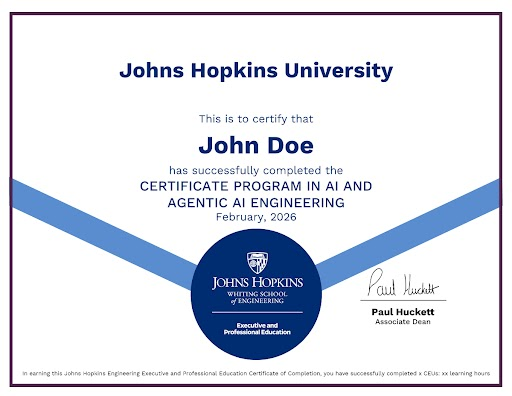
Certificate Program in AI and Agentic AI Engineering

  • Learn from world-renowned JHU faculty and experts
  • Deploy and manage AI systems with MLOps and LLMOps
  • Scale and lead AI initiatives with confidence
  • Earn Continuing Education Units upon program completion

Reach out to a program advisor for more details.

*image for illustration purposes only.

What will you learn in the program?

The Agentic AI program curriculum, crafted by the expert faculty at Johns Hopkins University and leading industry practitioners, covers everything from AI-assisted Python coding, LLMs, and advanced RAG to ReAct and MCP single-agent systems, LangGraph multi-agent orchestration, responsible AI guardrails, and LLM-as-a-Judge evaluation.

  • Practice With

    OpenAI API

  • Real-World

    Case Studies

  • 6 Bonus

    Self-Paced Courses

Preparatory Module

This module gets learners set up with all the tools needed for the learning journey, builds a solid foundation in Agentic AI concepts and evolution, and familiarizes learners with development environments and platforms (Python/VS Code).

Concepts Covered

  • The AI and Agentic AI Landscape
  • Python Fundamentals
  • Applications of AI and Agentic AI (Live Session)
  • Tool Setup Session (Live Session)
  • Python Essentials for Building Agentic AI Solutions (Live Session)

Module 01: Generative AI Foundations

This module covers Large Language Model architecture, prompt engineering techniques (Chain-of-Thought, few-shot, zero-shot), and Retrieval-Augmented Generation (RAG) to ground AI in real data. Learners apply evaluation frameworks to measure and improve system quality, culminating in Project 1, a functional GenAI application solving a real business problem.

Week 01: AI-Assisted Coding with Python

  • Understand how AI coding assistants work and explain the “Generate → Review → Refine” workflow for sustainable AI-assisted development.
  • Evaluate AI-generated code for correctness, logic errors, and security vulnerabilities; identify when to trust, modify, or rewrite AI code.
  • Assess practical applications of AI-assisted coding for rapid prototyping, debugging, and solving Agentic AI problems.

Week 02: LLMs and Prompt Engineering

  • Understand how Large Language Models work internally, including tokenization, embeddings, attention mechanisms, and inference, to inform prompt design and model selection.
  • Explain core prompting techniques (zero-shot, few-shot, Chain-of-Thought, Tree-of-Thought) and when to apply each for different problem types.
  • Evaluate trade-offs between models (GPT-4, Claude, Gemini) on capability, speed, and cost; select appropriate models for specific tasks.
  • Demonstrate the ability to optimize prompts iteratively and implement prompt management at scale using Python APIs.

Week 03: Retrieval-Augmented Generation (RAG) and Advanced RAG

  • Understand the RAG pipeline architecture, including document ingestion, chunking, embedding, vector storage, retrieval, and generation, to ground LLMs in real data.
  • Explain trade-offs between chunking strategies (fixed-size, semantic, overlapping) and vector databases (ChromaDB, Pinecone, FAISS) on retrieval quality and speed.
  • Assess advanced RAG techniques, including hybrid search, query expansion, reranking, and knowledge graphs, and determine which to apply for specific use cases.
  • Demonstrate the ability to build and evaluate end-to-end RAG pipelines using LangChain, vector databases, and RAGAS evaluation frameworks.

Week 04: Prompt Optimization and Evaluation

  • Understand evaluation metrics and frameworks (RAGAS, DeepEval, DSPy, LLM-as-a-Judge) to measure GenAI system quality across dimensions such as accuracy, hallucination rate, and consistency.
  • Assess hallucination detection and mitigation strategies, including identifying false claims and improving LLM reliability through prompt refinement and RAG grounding.
  • Evaluate trade-offs between models through A/B testing; design iterative evaluation loops (baseline, test, score, refine) for continuous improvement.
  • Demonstrate the ability to build comprehensive test sets, implement evaluation judges, and track improvements using quantitative metrics and monitoring.

Week 05: Project 01

Week 06: Learning Break

Module 02: Introduction to Agentic AI Design

This module transitions from responsive to autonomous AI, exploring agent architectures and building both single-agent and multi-agent systems. Learners design agents that perceive, reason, plan, and act using industry frameworks and platforms. The module embeds safety, ethics, and responsible AI practices throughout, culminating in Project 2, a coordinated multi-agent system solving complex challenges.

Week 07: Core Concepts of Agentic AI Systems

  • Understand what makes an agent “agentic,” including autonomy, goal-directed behavior, reasoning, planning, tool use, and learning capabilities.
  • Explain different agent architectures and classify agent types (simple-reflex, goal-based, utility-based) to determine which fits specific problem types.
  • Assess memory systems for agents, including short-term (context), long-term (retrieval), episodic, and semantic, and design appropriate memory strategies.
  • Classify agent types (simple-reflex, goal-based, utility-based, learning-based) and identify which architecture fits different business challenges.

Week 08: Single-Agent Systems

  • Understand the ReAct (Reasoning + Acting) pattern and Model Context Protocol (MCP) for agent decision-making and tool integration.
  • Design and implement a complete single-agent system for an end-to-end task using LangChain, LangGraph, and agent frameworks.
  • Build agents with custom tools, memory systems, and error recovery; manage state transitions and agent behavior.
  • Evaluate agent performance using task-completion metrics, reasoning trajectory analysis, and LLM-as-a-Judge methods; identify areas for improvement.

Week 09: Ethics, Safety, Alignment and Responsible AI

  • Understand the AI alignment problem and explain agentic-specific risks, including specification gaming, reward hacking, negative side effects, and autonomous decision-making failures.
  • Apply responsible AI principles (fairness, transparency, accountability, privacy) to agent design; identify potential bias, discrimination, and ethical concerns.
  • Assess safety techniques, including rule-based guardrails, neuro-symbolic approaches, human-in-the-loop mechanisms, monitoring, and anomaly detection.
  • Demonstrate the ability to implement guardrails in agent code, design evaluation for safety compliance, and document governance and audit trails.

Week 10: Project 02

Week 11: Learning Break

Module 03: Building Agentic AI Systems

This module covers sophisticated multi-agent orchestration and rigorous evaluation frameworks. Learners design comprehensive test suites, implement governance and compliance, and validate system behavior end-to-end, culminating in Project 3, an end-to-end agentic solution addressing complex organizational challenges.

Week 12: Multi-Agent Systems

  • Understand Multi-Agent Systems (MAS) architecture and explain coordination challenges when multiple agents interact and collaborate.
  • Compare multi-agent architectures, including hierarchical (manager-worker), flat/peer-based, market-based, and conversational, and determine which fits specific business problems.
  • Design Agent-to-Agent (A2A) communication patterns; implement data hand-offs, message passing, and conflict resolution between specialized agents.
  • Demonstrate the ability to build collaborative multi-agent systems using LangGraph; coordinate agents toward shared goals and manage system state.

Week 13: Evaluation of Agentic AI Systems

  • Understand evaluation dimensions for agents, including task success, reasoning quality, tool execution, efficiency, and safety compliance.
  • Apply evaluation methodologies (LLM-as-a-Judge, rule-based testing, human-in-the-loop review) to assess multi-agent system behavior and performance.
  • Design comprehensive test suites covering happy path, edge cases, adversarial scenarios, and regression testing for agent robustness.
  • Demonstrate the ability to build neuro-symbolic evaluation judges, identify system bottlenecks, and propose optimizations based on evaluation results.

Week 14: Project 03

Self-Paced Module: Foundations of AIML

Learn how the AI lifecycle works, from framing a business problem to deploying and monitoring a model, and compare core algorithms such as Logistic Regression, SVM, Decision Trees, Random Forests, and Neural Networks.

Self-Paced Module: NLP Foundations and Transformers

Learn how machines process language, from tokenization and TF-IDF to Word2Vec and modern embeddings. See how the Transformer architecture and self-attention replaced RNNs and LSTMs to power today’s LLMs.

Self-Paced Module: AI-Assisted Coding for ML Workflows

Build prediction models with Codex in VS Code, using a Generate, Review, Refine workflow. Work through exploratory data analysis, leakage detection, preprocessing pipelines, and baseline model evaluation, while retaining full ownership of every implementation decision.

Self-Paced Module: Fine-Tuning Small Language Models

Understand when a small language model (SLM) is a better choice than a large one, and fine-tune an SLM to reduce cost and latency. This module pairs well with multi-agent systems, where SLMs can power fast, low-cost sub-agents.

Self-Paced Module: Reinforcement Learning

Learn the core reinforcement learning concepts of agent-environment loops, rewards, and policies, and compare value-based and policy-based algorithms. Judge when an agent should learn its behavior and when it should simply follow instructions.

Self-Paced Module: Claude-Based AI Workflows

This module is designed to build practical capability in applying Generative AI and Agentic AI using the Claude ecosystem in real-world contexts. Participants build the ability to design, execute, and evaluate AI-driven workflows for real-world applications, supported by structured learning. *Disclaimer: Access to tools within the Claude ecosystem is not included as part of the program. Participants may choose to explore advanced capabilities independently.

Design and Execute AI Workflows

  • Model selection and prompt engineering using Claude Chat
  • Agentic workflow design and orchestration using Claude CoWork
  • Plan → Approve → Execute → Iterate framework
  • Designing workflows with reasoning, tools, and multi-step execution
  • Applying concepts through real-world case studies

Build and Deploy AI Systems at Scale

  • API integration and model usage using Claude Code
  • Tool integration using the Model Context Protocol
  • Designing agentic systems with memory, tools, and orchestration
  • Performance optimization, cost considerations, and system reliability
  • Responsible AI principles, including alignment approaches such as Constitutional AI

Anthropic Masterclass

This masterclass covers the Anthropic AI landscape, exploring Claude models, Constitutional AI, and key safety and alignment principles. Learners apply effective prompt engineering techniques, use the Claude API for tasks and integrations, generate structured outputs, build simple applications, compare Claude with other AI models, and evaluate ethical considerations for deploying AI systems.

Note: The curriculum listed above is indicative and subject to updates as technology evolves.

What activities will you learn from?

Work on hands-on projects and case-studies covering finance, healthcare, legaltech, and e-commerce.

  • Cutting-Edge

    Tools and Techniques

  • 3 Projects

    Hands-On Python Builds

  • 5+

    Industries

project icon

Sample Project | Finance

DualLens Analytics: Financial Insight with AI Intelligence

Description

Build an AI-powered investment research system that combines market data and company documents to generate ranked investment recommendations with confidence scores. Learners implement RAG for document grounding, LLM-as-a-Judge for quality evaluation, DSPy GEPA for prompt optimization, and quantitative-qualitative analysis to deliver trustworthy, actionable intelligence.

Skills you will learn

  • LangChain
  • RAG
  • Prompt Optimization
  • LLM-as-a-Judge
  • DSPy
  • Structured Reasoning
project icon

Sample Project | Finance

Sentinel Finance: Financial Intelligence Agent

Description

Build a financial intelligence agent that integrates real-time market data, news sentiment, private reports, and MCP-connected tools to deliver explainable investment analysis. Learners combine RAG for document grounding, multi-agent coordination, responsible AI principles, and LLM-as-a-Judge evaluation to create a trustworthy financial decision-support system.

Skills you will learn

  • LangChain
  • LangGraph
  • RAG
  • MCP
  • Responsible AI
  • LLM-as-a-Judge
  • Real-Time Data Integration
project icon

sample project | HEALTHCARE, PHARMACEUTICAL RESEARCH

Clinical Evidence Synthesis Agent for Research Teams

Description

Build a multi-agent research assistant that pulls literature from PubMed and clinical trial registries, combines it with a private library of study protocols and internal reports, and uses MCP-connected tools to produce structured, source-cited evidence summaries. Learners use RAG to ground answers in documents, coordinate agents for search, screening, extraction, and synthesis, and apply responsible AI principles such as clear disclaimers, bias and conflict-of-interest flags, and a rule that the system never gives patient-specific medical advice. Evaluation metrics are used to verify that each claim is traceable to a source and that the summary does not overstate study findings.

Skills you will learn

  • LangChain
  • LangGraph
  • RAG
  • MCP
  • Responsible AI
  • LLM-as-a-Judge
  • Real-Time Data Integration
  • DeepEval’s Agent Evaluation Metrics
project icon

sample project | LEGAL, COMPLIANCE

Contract Risk Review Agent

Description

Build a multi-agent system that reviews contracts against a legal playbook and regulatory updates. Agents use RAG to ground each finding in the contract text, and MCP tools for document and ticketing systems. Learners evaluate the system using DeepEval agent metrics, including Task Completion and Tool Correctness for the workflow, Faithfulness and Contextual Relevancy for retrieval grounding, and Hallucination and PII Leakage for safety. A human lawyer makes the final call.

Skills you will learn

  • LangChain
  • LangGraph
  • RAG
  • MCP
  • Responsible AI
  • LLM-as-a-Judge
  • Real-Time Data Integration
project icon

SAMPLE CASE STUDY | PRODUCT INTELLIGENCE, E-COMMERCE

AI-Powered Customer Review Summarization for Novatech

Description

Learn how AI-powered workflows can transform thousands of customer reviews into structured summaries for Product Managers. Explore approaches ranging from naive baselines and Zero-Shot structured prompting to Few-Shot prompting and GEPA prompt optimization, and examine how faithfulness, sentiment balance, and actionability can be evaluated to inform automated approval and human review decisions.

Skills you will learn

  • DeepEval
  • Prompt Optimization
  • GEPA
  • ROUGE-L
  • Evaluation Frameworks
  • Pandas
project icon

SAMPLE CASE STUDY | CONSULTING, MARKET RESEARCH

Agentic RAG for Competitive Intelligence

Description

Explore how LangGraph can be used to orchestrate competitive intelligence workflows, including company information validation, sector and competitor identification, and retrieval from internal knowledge bases. Learn how conditional graph execution, web-search routing, and self-correction can help agents synthesize structured competitive intelligence when internal knowledge is insufficient.

Skills you will learn

  • LangGraph
  • Agentic RAG
  • LangChain
  • ChromaDB
  • Agent Reasoning
  • Dynamic Routing
project icon

SAMPLE CASE STUDY | LEGALTECH

LexAgent: AI-Powered Rental Law Reasoning System

Description

Explore how agentic AI can support legal reasoning by interpreting rental regulations, retrieving relevant legal documents and case law, reviewing lease agreements for compliance, and explaining tenant and landlord rights. Learn how LangGraph, Model Context Protocol (MCP), and RAG can be combined to support jurisdiction-aware legal assistance, and examine agent performance using task-completion metrics and LLM-as-a-Judge.

Skills you will learn

  • LangGraph
  • ReAct
  • MCP
  • RAG
  • Legal Document Retrieval
  • LLM-as-a-Judge
project icon

SAMPLE CASE STUDY | E-COMMERCE, FINANCIAL SERVICES

Responsible AI for Autonomous Returns & Refunds Agent

Description

Explore how responsible AI techniques can be applied to e-commerce returns and refunds workflows. Learn how LangGraph and MCP can support agentic workflows while examining guardrails for risks such as prompt injection, PII exfiltration, toxicity, and over-refund attempts. Understand how neuro-symbolic architectures, safety checks, conditional routing, and policy enforcement can support trustworthy AI governance.

Skills you will learn

  • LangGraph
  • ReAct
  • MCP
  • Safety Guardrails
  • Responsible AI
  • Presidio
  • Detoxify
  • Neuro-Symbolic Reasoning
project icon

SAMPLE CASE STUDY | RESEARCH, ACADEMIA

AI Research Multi-Agent System

Description

Explore how specialized AI agents can collaborate across an end-to-end research workflow, from retrieving academic literature and analyzing evidence to synthesizing findings and generating structured reports. Learn how Agent-to-Agent communication using LangGraph and MCP enables coordinated multi-agent workflows and examine how these approaches can address complex research tasks compared with single-agent systems.

Skills you will learn

  • LangGraph
  • Multi-Agent Systems
  • A2A Communication
  • MCP
  • LangChain
  • Collaborative Reasoning
project icon

SAMPLE CASE STUDY | HEALTHCARE, MEDICAL INTELLIGENCE

Healthcare Intelligence Assistant with Human-in-the-Loop

Description

Explore how an AI assistant can translate natural-language questions into SQL queries over healthcare databases while maintaining human oversight for critical decisions. Learn how LangGraph interrupts and state persistence can support differentiated handling of READ and WRITE operations, human approval gates, unsafe-operation blocking, and audit trails for compliance and review.

Skills you will learn

  • LangGraph
  • Human-in-the-Loop
  • SQL Query Generation
  • State Management
  • Audit Trails
  • Safety Gates
project icon

SAMPLE CASE STUDY | CUSTOMER SUPPORT, OPERATIONS

Triage Bench: Evaluating Planning & Self-Correction

Description

Evaluate how planning and self-correction can influence customer support ticket triage by comparing reactive and planning-based LangGraph agents on a frozen golden dataset. Explore structured arguments, self-correction, and agent evaluation across reasoning, action, and execution metrics using DeepEval and LLM-as-a-Judge.

Skills you will learn

  • LangGraph
  • DeepEval
  • Agent Evaluation
  • Planning vs. Reactive Approaches
  • LLM-as-a-Judge
project icon

SAMPLE CASE STUDY | SUPPLY CHAIN & LOGISTICS

Global Supply Chain Disruption Impact Assessment

Description

Explore how LangChain and LLM prompting techniques can transform structured supply chain disruption data into executive-ready business reports. Learn how Zero-Shot, Few-Shot, Chain-of-Thought, and Tree-of-Thought prompting strategies, along with prompt parameter tuning, can generate stakeholder-specific insights and compare the impact of different approaches on report quality.

Skills you will learn

  • LangChain
  • Prompt Engineering
  • Zero-Shot
  • Few-Shot
  • CoT
  • ToT
  • Prompt Parameter Tuning
project icon

SAMPLE CASE STUDY | FINANCE

Document Q&A Using Retrieval-Augmented Generation

Description

Explore how RAG enables question-answering over business documents through techniques such as PDF ingestion, content chunking, embedding generation, and context retrieval. Learn how LLM-as-a-Judge evaluation can be used to assess groundedness, context relevance, and answer relevance and understand key considerations for reliable RAG applications.

Skills you will learn

  • RAG
  • LangChain
  • ChromaDB
  • LLM-as-a-Judge
  • Embeddings

Note: The projects and case-studies listed above are indicative and subject to updates to the curriculum.

Which tools will you learn and apply?

Learn 15+ tools and frameworks like Python, LangChain, LangGraph, MCP, ChromaDB, OpenAI, DeepEval, and RAGAS.

  • tools-icon

    Python

  • tools-icon

    Google Colab

  • tools-icon

    VS Code (Visual Studio Code)

  • tools-icon

    RAG (Retrieval Augmented Generation)

  • tools-icon

    Vector Databases

  • tools-icon

    LangChain

  • tools-icon

    LangGraph

  • tools-icon

    React

  • tools-icon

    MCP

  • tools-icon

    A2A

  • tools-icon

    OpenAI

  • tools-icon

    Codex

  • tools-icon

    DeepEval

  • tools-icon

    RAGAS

  • tools-icon

    DSPy

Note: The tools listed above are indicative and subject to updates as technology evolves.

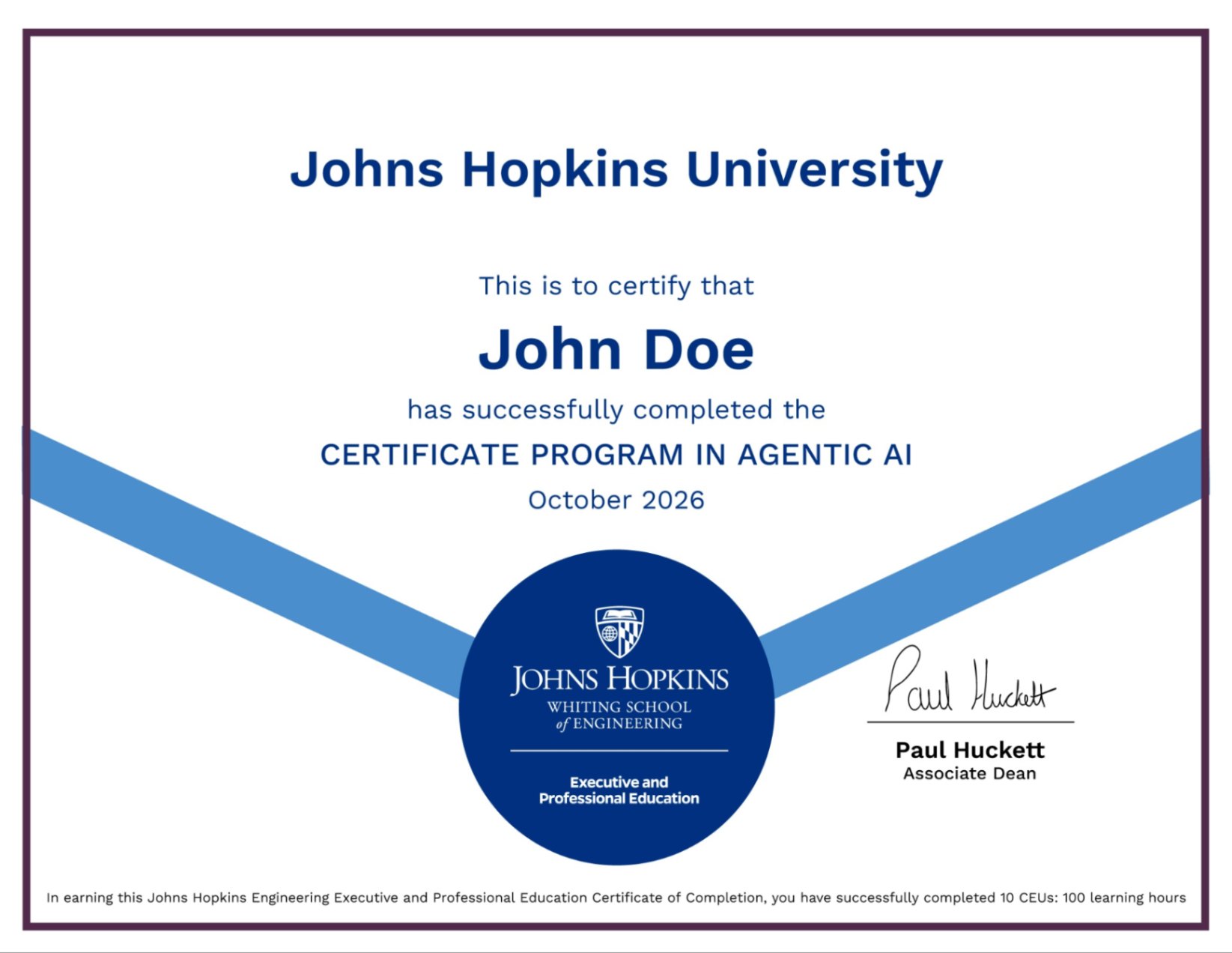
Earn a Certificate of Completion from Johns Hopkins University

Stand out in a competitive market with a Certificate of Completion in Certificate Program in Agentic AI that validates the expertise developed through rigorous, practical assessments.

  • thumbs-up

    Please Note

    The certificate awarded to learners enrolled in the Code Track of this program will be labeled “Developer Track.”

certificate image

* Image for illustration only. Certificate subject to change.

Who are the faculty for the program?

Learn from renowned JHU faculty and build expertise in AI agents, autonomous systems, and AI implementation

  • Dr. Shelby Wilson

    Dr. Shelby Wilson

    Senior Data Scientist - The Johns Hopkins University Applied Physics Laboratory

    Expert in applied mathematics, computational epidemiology, and ML.

    Over a decade of experience solving real-world problems with mathematical and AI tools.

    Know More
    Company Logo
  • Ian McCulloh, Ph.D.

    Ian McCulloh, Ph.D.

    Director, AI Executive & Professional Education, Johns Hopkins University

    Served as Chief Data Scientist & MD of AI, Accenture Federal Services

    Author of three books and over 100 peer-reviewed papers

    Know More
    Company Logo
  • Dr. William Gray-Roncal

    Dr. William Gray-Roncal

    Principal Research Scientist - Johns Hopkins University Applied Physics Laboratory

    Expert in data science, neuroscience, AI, and precision medicine.

    Leads cutting-edge research in brain network mapping and analysis.

    Know More
    Company Logo
  • Dr. Iain Cruickshank

    Dr. Iain Cruickshank

    Faculty Member, Johns Hopkins University

    ML expert applying AI to intelligence, cybersecurity, and social data

    Ph.D., Carnegie Mellon University School of Computer Science

    Know More
    Company Logo
  • Dr. Pedro Rodriguez

    Dr. Pedro Rodriguez

    Faculty, Johns Hopkins University AI Program

    Leads the Information Science Branch at the JHU's Applied Physics Lab

    20+ years of expertise in AI/ML algorithms

    Know More
    Company Logo

Who are the mentors for weekly live sessions?

Learn from seasoned AI industry mentors to apply concepts and build practical skills

  •  Bhaskarjit Sarmah  - Mentor

    Bhaskarjit Sarmah linkin icon

    Head of AI Research for Financial Services, Domyn
    Company Logo
  •  Kalle Bylin  - Mentor

    Kalle Bylin linkin icon

    Data Engineer, Workday
    Company Logo
  •  Tanya Glozman  - Mentor

    Tanya Glozman linkin icon

    Applied Science - AI/ML, Apple
    Apple Logo
  •  Bridget Huang-Gregor  - Mentor

    Bridget Huang-Gregor linkin icon

    GenAI/ML Engineer at Amazon Web Services (AWS)
    Company Logo
  •  Vinicio Desola Jr  - Mentor

    Vinicio Desola Jr linkin icon

    Staff Data Scientist, Newmark
    Company Logo

Note: The mentors listed above are indicative and subject to change based on availability and scheduling.

What are the fees for the program?

The course fee is USD 3,050

Invest in your career

  • benifits-icon

    Build proficiency in Python, LangChain, LangGraph, RAG, MCP, and multi-agent systems

  • benifits-icon

    Dedicate 8-10 hours weekly to faculty-led learning, industry mentorship, projects, and case studies

  • benifits-icon

    Learn from AI experts in live online sessions focused on real-world implementation and production-grade AI

  • benifits-icon

    Receive a Certificate of Completion and 10 CEUs from Johns Hopkins University

Take the next step

timer
00 : 00 : 00

Apply to the program now or schedule a call with a program advisor

Learn more about the program

Application Closes: 19th Nov 2026

Application Closes: 19th Nov 2026

Talk to our advisor for offers & course details

Application process

Admissions close once the required number of participants enroll. Apply early to secure your spot

  • steps icon

    Fill application form

    Apply by filling out a simple online application form.

  • steps icon

    Review process

    A panel from Great Learning will review your application to determine your fit for the program.

  • steps icon

    Join program

    Receive an offer for a seat in the upcoming cohort of the program post a final review.

Course Eligibility

  • A STEM or technical background
  • Prior familiarity with a programming language or technical subject matter in math/data
  • Readiness to write Python, work with APIs and frameworks, and build agents from scratch

Batch start date

  • Online · 21st Nov 2026

    Admission closing soon

Delivered in collaboration with:

Johns Hopkins University is collaborating with online education provider Great Learning to offer the Certificate Program in Agentic AI. Great Learning is a professional learning company with a global footprint in 170+ countries. Its mission is to make professionals around the globe proficient and future-ready. This program leverages JHU's leadership in innovation, science, engineering, and technical disciplines developed over years of research, teaching, and practice. Great Learning manages the enrollments and provides industry experts, student counselors, course support and guidance to ensure students get hands-on training and live personalized mentorship on the application of concepts taught by the JHU faculty.

Got more questions? Talk to us

Connect with our advisors and get your queries resolved

Speak with our expert +14106326604 or email to jhu-agentic-ai@mygreatlearning.com

career guidance