I am a physician by training, and much of my professional experience has been at the point where healthcare systems meet real people: patients, families, junior medical staff, and the operational realities of hospitals. Over the years, I began noticing a recurring problem. Healthcare does not necessarily fail because information is unavailable. It can fail because the right information, in the right context, does not reach the right person at the right moment.

That observation changed the questions I was asking. I became particularly interested in informed consent. I have seen consent administered countless times in both elective and emergency settings. The process can vary considerably depending on the clinician, the time available, and the circumstances. A form may be correctly completed, signed, and filed, while the patient may still not fully understand the procedure, its alternatives, its material risks, or what the decision actually means. In other words, the documentation can be complete while the communication remains incomplete.
That led me to begin developing the concept of ConsentPod: a bedside system intended to transform consent from a document-signing event into a process of education, communication, comprehension, and shared decision-making. But I quickly encountered a limitation in my own thinking. Having an idea for an AI-enabled healthcare product was not enough. I needed to understand what actually happens beneath an AI system if I wanted to build something responsibly. I did not want to become merely a better user of ChatGPT. I wanted to understand agents.
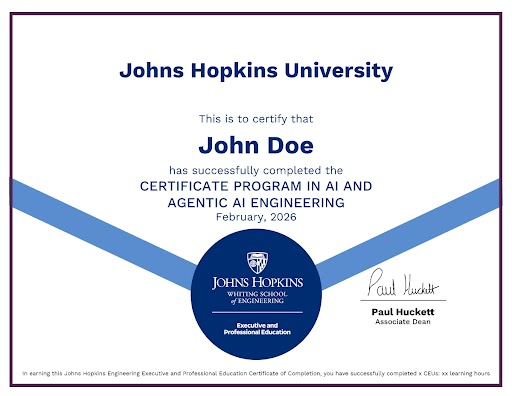
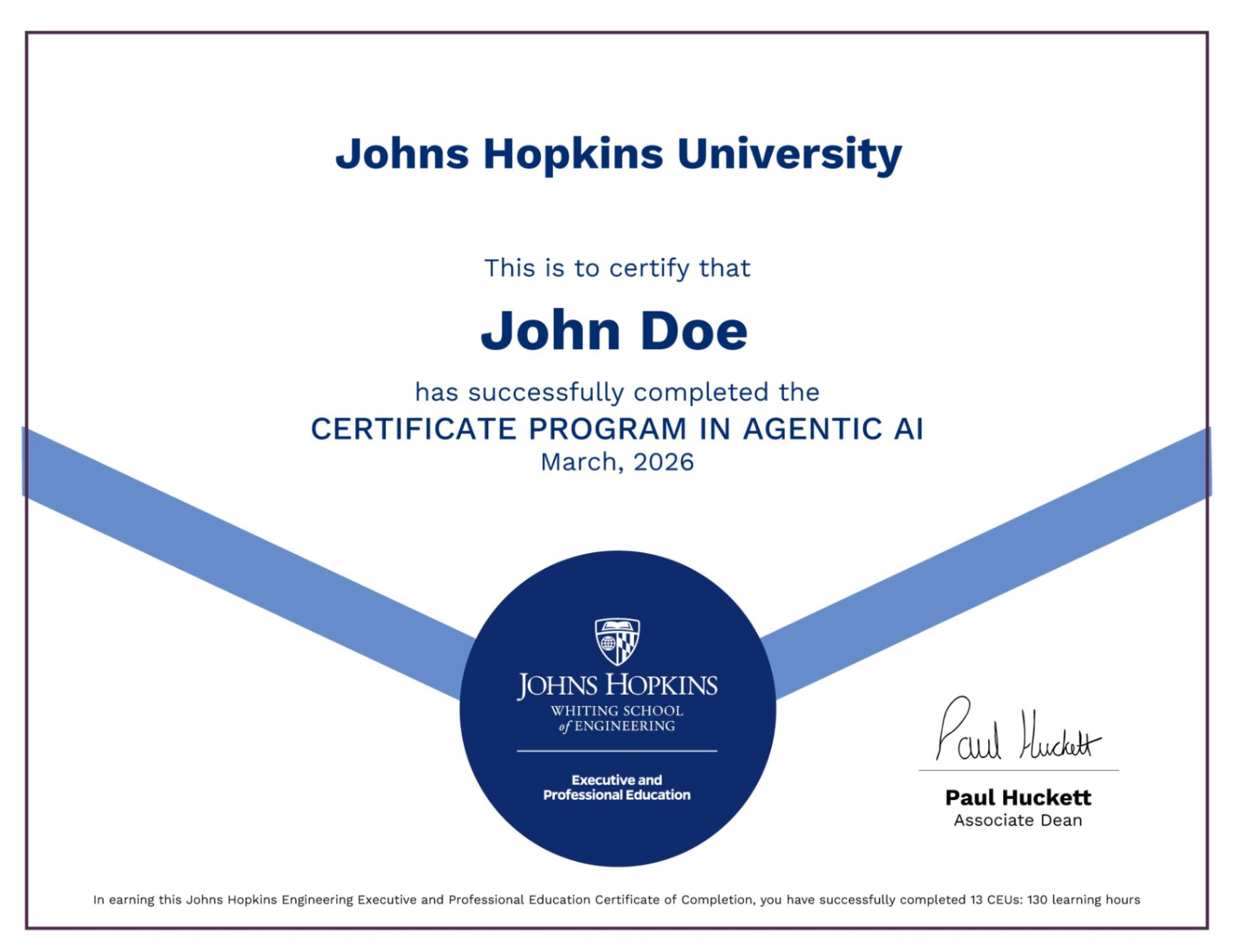
Those questions motivated me to undertake the Johns Hopkins Agentic AI program. I entered the program as a doctor trying to understand technology. I came out thinking much more like a systems designer.
The most valuable shift was conceptual. I began to move from thinking about AI as a model to thinking about AI as a system operating within an environment. That distinction became particularly meaningful when I applied it to healthcare. One concept I kept returning to was context. An AI system may be able to access enormous amounts of information, but access to information is not the same as understanding. I increasingly believe the future of AI is not about making the context window larger, but about making the context better.
This connected many of the technical concepts from the program, including retrieval-augmented generation, tool use, orchestration, memory and state, evaluation, and human-in-the-loop systems, to problems I had already encountered clinically. The program therefore gave me something more valuable than a collection of technologies. It gave me a framework for decomposing complex human problems into intelligent, evaluable workflows without losing sight of the human decision at the center.
The clearest application has been my continued development of ConsentPod. Agentic AI gave me a way to think about how such a workflow could be constructed. Rather than building one general-purpose chatbot, I began decomposing the problem into responsibilities: explaining information in the patient’s preferred language, retrieving authoritative clinical and institutional information, checking comprehension, verifying that workflow requirements have been addressed, documenting the interaction, and escalating situations that require human attention.
The physician would still make the clinical judgment. The patient would still make the decision. The AI would not become the doctor. It would become an orchestration, communication, and context layer around the decision. That distinction has become central to how I think about healthcare AI.
My most obvious challenge was that I came to the program as a physician rather than as a computer scientist. But the deeper challenge was learning how to translate a clinical problem into a computational problem without stripping away the human complexity that made the problem important in the first place. Healthcare is not a clean software environment. It contains incomplete information, interruptions, uncertainty, hierarchy, time pressure, emotional vulnerability, legal accountability, and decisions whose consequences can be irreversible.
My clinical background became an advantage here. Whenever I encountered a technical concept, I tried to translate it back to the bedside. That way of translating between technical architecture and clinical reality helped me overcome the initial learning curve. More importantly, it changed the way I approach technology. I no longer begin with where can I put AI. I increasingly begin with what is the human problem, what decision is being made, what context is missing, what workflow surrounds that decision, and where an intelligent system could responsibly improve it.
For me, the greatest value of the Johns Hopkins Agentic AI program is not the certificate. It is the change in the way I think. I entered with a collection of healthcare problems and a growing fascination with artificial intelligence. I leave with a more structured way of thinking about how intelligent systems might participate in solving those problems.
Most importantly, I have begun to see AI not as a destination, but as infrastructure for solving human problems. That is the perspective I hope to carry forward as I continue working at the intersection of medicine, technology, and healthcare delivery.
Read More