Combat Cyber Threats With Industry-Ready Cybersecurity Skills
Professional Certificate in Cybersecurity: IT and Data Security in the Age of AI
 Application closes on
17th Sep 2026
Application closes on
17th Sep 2026

 Speak with our expert
+1 410 835 4326
Speak with our expert
+1 410 835 4326




Learn more about the course
Get details on syllabus, projects, tools, and more
Upskill Your Teams with Future-Ready Skills
Empower your workforce with programs from leading universities
-
Team Pricing
Maximize ROI with exclusive cost-effective plans for group enrollments
-
Team Learning Dashboard
Track progress & outcomes at the team level
-
Customized Learning Paths
Tailor the program to align with your team's goals and drive meaningful outcomes.

Enter your organisation name
This will help us customise the proposal plans

Professional Certificate in Cybersecurity: IT and Data Security in the Age of AI
Application closes 17th Sep 2026
PROGRAM OUTCOMES
Elevate your career
With actionable cybersecurity skills
-
Understand foundational and core cybersecurity principles
-
Learn to implement security controls for protecting enterprise networks
-
Evaluate cloud security and develop comprehensive strategies for cloud data security
-
Learn how AI-driven tools are used in cybersecurity through practical use cases
-
Learn how to implement unified control programs that cover multiple compliance standards
Earn a certificate from Johns Hopkins University
-

#7 National University Rankings
U.S. News & World Report, 2026
-
#2 Computer Information Technology
U.S. News & World Report, 2026
-
#10 Most Innovative Schools
US News and World Report, 2026
-
#14 Best Global University
U.S. News & World Report, 2026
-
#1 Biomedical Engineering Program
US News and World Report, 2026


KEY PROGRAM HIGHLIGHTS
Why choose this program
-
Industry-focussed curriculum
Master network and infrastructure security, cloud security posture improvement, learn about AI solutions for cybersecurity and more.
-
Prepare for top certification exams
Gain a strong knowledge base and practical grounding for certifications like (ISC)² CISSP and CompTIA Security+ .
-
Flexible learning format
Learn through recorded lectures, monthly live masterclasses by JHU faculty, interactive mentored sessions, and AI-powered learning tools.
-
Hands-on learning
Work on real-world case studies, projects, and hands-on lab activities to build practical cybersecurity skills that employers look for.
-
Get expert mentorship
Gain insights from industry practitioners in cybersecurity, refine your projects and set yourself up for success in the field.
-
Personalized program support
Receive 1:1 guidance from a dedicated Program Manager and academic support from cybersecurity experts.


Skills you will learn
RISK ASSESSMENT AND MANAGEMENT
NETWORK SECURITY
CLOUD SECURITY
MALWARE ANALYSIS
SECURE SOFTWARE DEVELOPMENT
IDENTITY AND ACCESS MANAGEMENT (IAM)
INCIDENT RESPONSE AND FORENSICS
MANAGING SECURITY ASSESSMENTS
FEDERAL FRAMEWORK COMPLIANCE READINESS
RISK ASSESSMENT AND MANAGEMENT
NETWORK SECURITY
CLOUD SECURITY
MALWARE ANALYSIS
SECURE SOFTWARE DEVELOPMENT
IDENTITY AND ACCESS MANAGEMENT (IAM)
INCIDENT RESPONSE AND FORENSICS
MANAGING SECURITY ASSESSMENTS
FEDERAL FRAMEWORK COMPLIANCE READINESS
view more
- Overview
- Learning Journey
- Curriculum
- Tools
- Certificate
- Faculty
- Mentors
- Reviews
- Fees
- FAQ
This program is ideal for
Professionals looking to advance their careers with cybersecurity skills
-
Mid-senior IT professionals & engineers
Seeking to upskill in cybersecurity and prepare for roles like cybersecurity architects, senior engineers, or those on a CTO track
-
Early to mid-career cyber professionals
Who want to upskill, stay ahead of evolving threats, and transition into mid-senior cybersecurity roles
-
Technology leaders and decision-makers
Including CISOs, aiming to strengthen cybersecurity and AI-power teams for threat detection, risk management, and automation
-
Architects & technology consultants
Suited for professionals with strong technical backgrounds seeking comprehensive cybersecurity expertise in their domain
Experience a unique learning journey
Our pedagogy is designed to ensure career growth and transformation
-
Learn with self-paced videos
Learn critical concepts from video lectures by faculty & AI experts
-
Engage with your mentors
Clarify your doubts and gain practical skills during the weekend mentorship sessions
-
Work on hands-on projects
Work on projects to apply the concepts & tools learnt in the module
-
Get personalized assistance
Our dedicated program managers will support you whenever you need




Syllabus designed for professionals
Learn from world-renowned Johns Hopkins University faculty who designed and deliver this curriculum. The program aligns with CompTIA Security+ and CISSP, covering core domains like risk management and cloud security. While not official certification training, it builds the essential competencies needed to pursue these global exams with confidence.
PRE-WORK: PREPARATORY MODULE
The outcome of this module is to get set up with all the tools you need for the learning journey and build a solid foundation in three essential domains: operating systems, applications & APIs, and cloud computing. Pre-work 1: Getting Set Up for the Learning Journey Pre-work 2: Operating Systems Pre-work 3: Application Basics and API Pre-work 4: Foundations of AI and Cloud
MODULE 01: FOUNDATIONS OF INFORMATION SECURITY
In this module, learners will explore the foundational principles of cybersecurity, including key frameworks, types of risks and how to manage them, and core protection mechanisms for the enterprise infrastructure. They will understand how cryptography, authentication, and security standards safeguard data while gaining insight into the evolving threat landscape and common cyberattacks that shape modern defense strategies. Sample Project: Practicing Cryptography with CyberChef Sample Project: Ransomware Threat Analysis Using Reverse Engineering Sample Lab Activity: Attacking Passwords With Various Tools
WEEK 1: CORE CYBERSECURITY PRINCIPLES
WEEK 2: RISK MANAGEMENT FRAMEWORKS
WEEK 3: CYBER ATTACKS AND THREAT LANDSCAPE
WEEK 4: LEARNING BREAK
MODULE 02: NETWORK & INFRASTRUCTURE SECURITY
In this module, learners will explore secure network design using Zero Trust and next-generation firewalls, supported by a refresher on network basics and incident response. They will gain hands-on skills in vulnerability management with tools like Nessus and ACAS, assess risks, apply patch management practices, and ensure compliance using SRGs and STIGs. Sample Project: Analyzing Network Traffic with Wireshark Sample Lab Activity: Vulnerability Management Using Nessus Sample Project: Assessing Risks Identified During the Pentest Sample Lab Activity: Configuring a pfSense Firewall
WEEK 5: SECURITY ARCHITECTURE
WEEK 6: VULNERABILITY MANAGEMENT
MODULE 03: CLOUD AND DATA SECURITY
In this module, learners will gain a solid understanding of secure cloud design, including core architecture principles, identity management, and best practices for data protection. They will explore cloud security posture, resilience strategies, and modern approaches to automated, compliant cloud deployments, equipping them to build and secure scalable cloud environments across public and government cloud platforms. Sample Lab Activity: Deploying and Securing Assets in AWS Sample Project: Using S3 Buckets for Secure Storage of Sensitive Data
WEEK 7: CLOUD FUNDAMENTALS & SECURE CLOUD DESIGN
WEEK 8: CLOUD POSTURE AND SECURITY
WEEK 9: CLOUD DATA SECURITY
WEEK 10: LEARNING BREAK
MODULE 04: GOVERNANCE, RISK, AND COMPLIANCE (GRC)
In this module, learners will gain a foundational understanding of governance in cybersecurity, focusing on key compliance standards and their role in risk reduction. They will also learn the essentials of audit management to ensure accountability, control effectiveness, and regulatory alignment within organizations. Sample Project: Perform a Compliance Scan with Nessus Sample Project: Conduct a Risk Assessment according to NIST RMF
WEEK 11: FUNDAMENTALS OF GRC
WEEK 12: AUDIT MANAGEMENT
MODULE 05: AI-POWERED CYBER DEFENCE
In this module, learners will build a foundational understanding of artificial intelligence and explore its transformative applications in cybersecurity, including threat detection, automated defense, and secure AI system design. Sample Project: Using GenAI for Cyber Offense and Defense
WEEK 13: FUNDAMENTALS OF AI AND GENERATIVE AI
WEEK 14: APPLICATIONS OF AI IN CYBERSECURITY
Note: The curriculum listed above are indicative and subject to updates as technology evolves.
Master in-demand cybersecurity tools
Tools and techniques you will learn in this cybersecurity course
-
Nessus
-
Wireshark
-
CyberChef
-
shodan.io
-
OpenAI
-
pfsense
-
Gemini Notebook




Note: The tools listed above are indicative and subject to updates as technology evolves.
Earn a professional cybersecurity certificate from Johns Hopkins University
Get a certificate of completion from Johns Hopkins University (with 11 Continuing Education Units - CEUs)
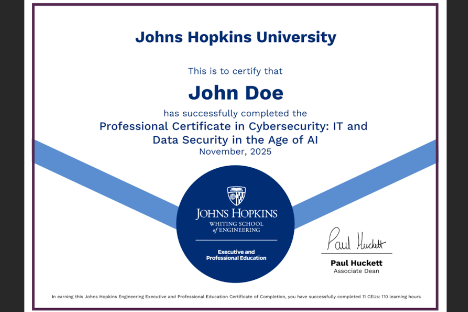
* Image for illustration only. Certificate subject to change.
Meet your faculty
Learn from world-renowned JHU faculty
-
Thomas Byrd, JD.
Professor – Johns Hopkins University
Ex-VP & Enterprise Security, Senior Cybersecurity Manager – T. Rowe Price
Cyber leader at the FBI and Department of Defense, he has played a key role in advancing US government cyber capabilities.
Know More
-
Dr. Lanier Watkins
Principal Cybersecurity Research Professor - Johns Hopkins University
Holds a PhD in Computer Science and 3 MS degrees (Biotechnology, Computer Science, and Physics)
Published over 60 papers and journals, teaches 4 courses, and holds several patents.
Know More
.jpg "Thomas Byrd, JD.")



 LinkedIn Profile
 University Link
Interact with our mentors
Learn from experts to apply security techniques that drive business resilience and advance your career.
-
Aniket Amdekar
General Manager - Cyber Defence Education Great Learning
-
Amin Mansouri
Cloud Security Architect | Security & DevOps
-
Ivan Marchany
SOAR Engineer







Note: The mentors listed above are indicative and subject to change based on availability and scheduling.
Learners review our program
Learners share their feedback on the faculty, mentors, hands-on projects, and overall learning experience
-
Building a Better Understanding of Modern Cybersecurity
I am Riccardo Cast from Miami, Florida, and I work at Cleveland Clinic Foundation as an Enterprise Infrastructure Support Manager. I recently completed the JHU Professional Certificate in Cybersecurity Program. I wanted to gain a wider knowledge of Cybersecurity and better understand how AI can play a significant role in this field. I now have a broader understanding of Cybersecurity and the technologies shaping the industry. While I am not responsible for the cybersecurity division in my company, I can now better understand what they do and why they do it.
Read More
Riccardo Cast
Enterprise Infrastructure support manager, Cleveland Clinic
Jun 2026
-
Strengthening My Cybersecurity Profile
Hi, I am Qadsia Javed from New Jersey. I work in the Information Technology department of a non-profit organization and hold both an MSc in Cybersecurity and an MBA. I recently completed the JHU Professional Certificate in Cybersecurity Program. I pursued the program to build a stronger professional profile. The program provided good exposure to Azure and included Google and Amazon projects.
Read More
Qadsia Javed
Support Engineer, Volunteers Of America
Jun 2026
-
Building Cybersecurity Awareness Beyond Technical Roles
My name is Kurt Demeyere, and I am based in Brussels, Belgium. I am a Senior Lawyer and Head of Knowledge with more than 25 years of experience. I recently completed the Professional Certificate in Cybersecurity. My learning experience was wonderful, and the program provided a valuable introduction to Cybersecurity. The preparatory course helped me build a strong foundation, while the projects allowed me to discover new tools and better understand how Cybersecurity works in practice. I also appreciated the platform, the weekly content, and the support provided throughout the program. Through the seven modules, I learned Cybersecurity vocabulary, developed a better understanding of security concepts, and increased my awareness of Cybersecurity. While I do not intend to become a Cybersecurity Specialist, the program helped me bridge the gap between IT and legal, allowing me to communicate more effectively with technical teams and apply what I learned in my current role.
Read More
Kurt Demeyere
Tax Lawyer - Head of Knowledge, Arteo Law
Jun 2026
-
Learning New Skills in Cybersecurity
I learned a lot about the different aspects of Cybersecurity. I wanted to learn new skills and maybe start a career in the cybersecurity space. I learned how to analyze viruses, set up a Cloud Container, and gained my first look into Penetration Testing.
Read More
Tobias Reetz
Freelancer
Jun 2026
-
Learning Cybersecurity Through Real-World Projects
My name is Chad Waltz from Des Moines, Iowa. I work at an insurance company as a Software Engineer and currently work with .NET programming while preparing to start with Node.js. I enjoyed the weekly Saturday sessions, and the projects exposed me to new technologies. I have always been interested in security and protecting computers and personal information. I learned by creating Virtual Machines and working on projects focused on viruses and security. We are also starting a central logging system to help troubleshoot issues.
Read More
Chad Waltz
Lead IT SOlutions Developer, Wellmark Blue Cross Blue Shield
Jun 2026
-
From the Classroom to Cybersecurity: Building a New Career Path
I am Kojo O. Acheampong from New York City, and I work as an elementary school teacher at Laboratory Charter School. I recently completed the JHU Professional Certificate in Cybersecurity Program and am proud of this experience. I am hopeful about securing a new role as a Cybersecurity Specialist. My journey into cybersecurity was a mix of problem-solving and challenges, but it was rewarding when concepts came together. I chose this program because I wanted a new intellectual challenge, a fresh start, and the opportunity to build a career in cybersecurity. I learned a great deal about Cloud Security, hacking, and using Kali Linux. I am confident that I will apply the skills and knowledge gained from this program in my future endeavors.
Read More
Kojo O. Acheampong
Teacher, The Laboratory Charter School
Jun 2026


Course Fees
The course fee is USD 2,950
Invest in your career
-
High-quality learning content from JHU faculty.
-
Live mentored learning in micro-classes (up to 30 learners).
-
Build an impressive, industry-ready portfolio with hands-on projects.
-
Get personalized assistance with a dedicated Program Manager.


Easy payment plans
Avail our EMI options & get financial assistance
-
INSTALLMENT PLANS
Upto 12 months Installment plans
Explore our flexible payment plans
View Plans
-
discount available
USD 2,950 USD 2,750
USD 2,950 USD 2,800
Third Party Credit Facilitators
Check out different payment options with third party credit facility providers


*Subject to third party credit facility provider approval based on applicable regions & eligibility

Admission process
Admissions close once the required number of participants enroll. Apply early to secure your spot
-
1. APPLY
Fill out an online application form.
-
2. REVIEW
Your application will be reviewed by a panel from Great Learning to determine if it is a fit with the program
-
3. JOIN PROGRAM
After a final review, you will receive an offer for a seat in the upcoming cohort of the program.


Batch start date
-
Online · To be announced
Admissions Open
Frequently Asked Questions
Why should I choose the JHU Professional Certificate in Cybersecurity?
The Professional Certificate in Cybersecurity: IT and Data Security in the Age of AI offers a cutting-edge, industry-driven curriculum designed to equip you with the skills needed to address today’s cybersecurity challenges. Here’s why you should consider this program:
- Industry-Relevant Curriculum: The program curriculum is built on the latest research and developments in AI and cybersecurity, ensuring you gain up-to-date, relevant knowledge to stay ahead of evolving threats.
- Hands-On Learning: Engage in real-world case studies, projects, and lab activities that provide practical experience in cybersecurity, allowing you to apply what you have learned to actual security challenges.
- Best-in-Class Faculty: The curriculum is designed and taught by world-renowned Johns Hopkins University faculty, who bring both academic rigor and industry experience to the program.
- Flexible Online Format: Delivered online, featuring comprehensive recorded video lectures, live sessions with global industry experts, and live masterclasses led by Johns Hopkins University faculty.
- Learning Support: Get personalized assistance from a dedicated Program Manager and academic support through the Great Learning community, project discussion forums, and peer groups.
- Recognition: Earn a Certificate of Completion from Johns Hopkins University, along with 11 Continuing Education Units (CEUs) and a shareable e-Portfolio.
- Preparation for Top Cybersecurity Certification Exams: Prepare for industry certifications such as (ISC)2 CISSP and CompTIA Security+.
- Coverage of Federal Compliance Standards: Gain an understanding of key U.S. federal regulations and compliance frameworks relevant to data security and AI applications.
What are the learning outcomes of this program?
After completing this Cybersecurity program, you will be able to:
- Understand foundational and core cybersecurity principles
- Learn to implement security controls for protecting enterprise networks
- Evaluate cloud security and develop comprehensive strategies for cloud data security.
- Learn how AI-driven tools are used in cybersecurity through practical use cases.
- Learn how to implement unified control programs that cover multiple compliance standards.
- Understand how to manage compliance operations that build trust, meet evolving regulations/frameworks, and drive resilience into every layer of technology and processes.
Can I pursue this course while working full-time?
Yes, this program is designed for working professionals. Its flexible online format, structured learning journey, and dedicated program support allow you to balance learning with your job, enabling you to upskill at a steady pace without putting your career on hold.
What is the Professional Certificate in Cybersecurity program?
The Professional Certificate in Cybersecurity program is a rigorous, 14-week online program designed and delivered by world-renowned faculty from Johns Hopkins University. It combines intensive, hands-on cybersecurity training with a foundational understanding of AI, preparing you for frontline roles and industry certifications.
What is the format of this Certificate Program in Cybersecurity?
This Cybersecurity Certificate program is designed to be flexible for busy professionals with technical skills. It features hands-on labs, live mentored learning sessions, and academic support to help you master practical cybersecurity and AI skills. Delivered fully online, learners benefit from the guidance of seasoned industry experts who provide mentorship and support throughout the program.
What is the duration of this Johns Hopkins University Cybersecurity certificate program?
The program’s duration is 14 weeks.
What topics are covered in the curriculum of this Cybersecurity program?
The curriculum covers a comprehensive set of cybersecurity domains, including:
- Foundations of Information Security: Principles of Cybersecurity, like the CIA Triad, Cryptography, Risk Management Frameworks, and evolving cyberattack techniques.
- Network & Infrastructure Security: Secure architecture, Zero Trust, next-generation firewalls, incident response, and vulnerability management using tools like Nessus and ACAS.
- Cloud and Data Security: Secure cloud design, cloud security posture monitoring, identity and access management (IDAM), cloud resilience, and data protection using encryption, masking, and anonymization.
- Governance, Risk, and Compliance (GRC): Key frameworks such as GDPR, PCI DSS, FedRAMP, CMMC, audit processes, and third-party risk management.
- AI-Powered Cyber Defense: Fundamentals of AI and Generative AI, Agentic AI for security, LLM firewalls, OWASP Top 10 for LLMs, and responsible AI practices.
What skills does this program cover?
The skills covered in this Cybersecurity program are
- Risk Assessment and Management
- Network Security
- Cloud Security
- Managing Security Assessments
- Federal Framework Compliance Readiness
- Malware Analysis
- Secure Software Development
- Identity and Access Management (IAM)
- Incident Response and Forensics
Does this Cybersecurity program cover U.S. federal compliance standards?
Yes. The program provides a dedicated focus on key U.S. federal regulations and compliance frameworks that are essential for cybersecurity and AI-driven environments. You will gain an understanding of standards such as FedRAMP, CMMC, and other regulatory frameworks that guide data security, risk management, and responsible AI applications across industries. This prepares you to manage compliance requirements effectively within modern enterprise security programs.
Who are the faculty for this program?
This program is led by a team of highly experienced Cybersecurity professionals and academic experts who bring a wealth of knowledge and real-world insights to your learning journey:
Thomas Byrd, JD
- Professor – Johns Hopkins University
- Ex-VP & Enterprise Security, Senior Cybersecurity Manager – T. Rowe Price
- Cyber leader at the FBI and Department of Defense, he has played a key role in advancing US government cyber capabilities.
Dr. Lanier Watkins
- Holds a PhD in Computer Science and 3 MS degrees (Biotechnology, Computer Science, and Physics)
- Published over 60 papers and journals, teaches 4 courses, and holds several patents.
Who are the mentors for this online Cybersecurity program?
During the course of this program, you will engage with leading cybersecurity experts who will guide you in applying cybersecurity techniques to drive business resilience and advance your career in cybersecurity. Mentors for the Johns Hopkins Professional Certificate in Cybersecurity program:
- Aniket Amdekar –General Manager, Cyber Defence Education
- Ivan Marchany –SOAR Engineer
- Amin Mansouri –Cloud Security Architect, Security & DevOps
*Note: This is an indicative list and is subject to change based on the availability of faculty and mentors
Which industry-relevant tools and techniques will I learn to use?
You will gain hands-on experience with a wide range of industry-relevant cybersecurity tools and techniques used across network security, cloud security, threat analysis, and compliance. These include:
Nessus – Vulnerability scanning and compliance assessment
Wireshark – Network traffic capture and analysis
CyberChef – Cryptographic operations and data transformation
Shodan – Internet-wide asset discovery and exposure analysis
ANY.RUN – Malware detonation, sandboxing, and threat behavior analysis
pfSense – Firewall configuration, perimeter defense, and VPN setup
AWS Security Hub – Cloud security monitoring and best-practice assessments
Grayhat Warfare – Public storage exposure and data discovery analysis
NotebookLM – Research synthesis and knowledge support for cybersecurity tasks
OpenAI Tools – Applying Generative AI for threat detection, analysis, and secure AI practices
What practical experience will I gain?
This is a learning-by-doing program where you will work on real-world case studies, projects, and lab activities such as
Is this course aligned with any industry certifications?
Yes, the program prepares you for top cybersecurity certifications like CISSP and CompTIA Security+. The curriculum is designed to build strong foundational knowledge and practical experience relevant to both of these globally respected credentials.
What is the role of Great Learning in this program?
Great Learning is the program partner for the Professional Certificate in Cybersecurity offered by Johns Hopkins University. As a global ed-tech company for professional and higher education, Great Learning delivers industry-relevant programs in collaboration with leading academic institutions, including Johns Hopkins University.
In this program, Great Learning:
- Delivers the program in an online format with recorded lectures, live sessions, and masterclasses.
- Supports learning through expert mentors and highly qualified faculty.
- Provides personalized assistance via a dedicated Program Manager.
- Enables academic support through the Great Learning community, discussion forums, and peer groups.
- Manages the admissions process, including application review and learner onboarding.
What is the ranking of Johns Hopkins University’s programs?
This program is offered by Johns Hopkins University (JHU), a prestigious, top‑ranked U.S. institution.
- #6 National University (U.S. News & World Report 2025)
- #1 in Computer Information Technology (U.S. News & World Report 2025)
- #13 Best Global University (U.S. News & World Report 2025)
Will I earn a certificate upon completing this program?
Yes, you will receive a prestigious Certificate of Completion from Johns Hopkins University, 11 CEUs, and a shareable e-Portfolio.
Who is this program ideal for?
- Early to mid‑career Cybersecurity professionals aiming to upskill and move into mid‑senior roles.
- Mid‑ to senior‑level IT professionals and engineers looking to cross‑skill into Cybersecurity.
- Architects and technology consultants seeking comprehensive Cybersecurity knowledge.
- Technology leaders and decision‑makers are aiming to strengthen organizational Cybersecurity strategy.
What is the admission process for the Professional Certificate in Cybersecurity Program?
Admissions close once the required number of participants enroll. Apply early to secure your spot.
1. APPLY
Fill out an online application form.
2. REVIEW
Your application will be reviewed by a panel from Great Learning to determine if it is a fit with the program.
3. JOIN THE PROGRAM
After a final review, you will receive an offer for a seat in the upcoming cohort of the program.
What is the total fee for the Professional Certificate in Cybersecurity program?
Please contact your Program Advisor for the fee details of this Cybersecurity program.
Where can I find more information on fees and payment plans?
For the most current fee structure and to explore payment options, connect with your Program Advisor or visit the official program website.
Are payment plans or financing options available?
Yes, you can contact your Program Advisor from Great Learning for details on available offers, payment plans, and eligibility for financial assistance.
What are CEUs, and how are they useful?
Upon successful completion of the program, you will earn 11 Continuing Education Units (CEUs) along with a certificate of completion from Johns Hopkins University. CEUs are a measure of instructional time and reflect the estimated time an average student will spend completing the mandatory components of a course. CEUs are awarded upon successfully completing all course requirements, which may include assessments, assignments, evaluations, or a final project. Earning CEUs allows professionals to demonstrate their commitment to continuous learning and skill advancement.
Which career paths and job roles will this Cybersecurity certificate program online prepare me for?
The Professional Certificate in Cybersecurity program is designed to equip professionals for advancement or transition into key Cybersecurity positions, including:
- Cybersecurity Architect
- Senior Cybersecurity Engineer
- Technology Consultant (specializing in Cybersecurity)
- IT Leader / Technology Decision-Maker focused on strengthening organizational Cybersecurity strategy
- Mid-to-Senior Level IT Professional cross-skilling into Cybersecurity
Ideal for:
- Early to Mid‑Career Cybersecurity Professionals aiming for mid‑senior roles
- Professionals on a CTO track with a focus on security leadership
Where can I contact for more queries?
Contact: Email cyber.jhu@mygreatlearning.com or call +1 410 835 4326 for queries about the Professional Certificate in Cybersecurity program by Johns Hopkins University.
Delivered in Collaboration with:

Johns Hopkins University is collaborating with online education provider Great Learning to offer the Professional Certificate in Cybersecurity: IT and Data Security in the Age of AI. Great Learning is a professional learning company with a global footprint in 14+ countries. Its mission is to make professionals around the globe proficient and future-ready. This program leverages JHU's leadership in innovation, science, engineering, and technical disciplines developed over years of research, teaching, and practice. Great Learning manages the enrollments and provides industry experts, student counselors, course support and guidance to ensure students get hands-on training and live personalized mentorship on the application of concepts taught by the JHU faculty.
 Application Closes
17th Sep 2026
Application Closes
17th Sep 2026