Leverage AI to Automate Financial Workflows Using No-Code Tools
AI and Agentic AI in Finance
 Application closes on
30th Sep 2026
Application closes on
30th Sep 2026

 Speak with our expert
+14434863780
Speak with our expert
+14434863780




Receive Your Brochure Copy
Get details on syllabus, projects, tools, and more

AI and Agentic AI in Finance
Application closes 30th Sep 2026
Why should you join this program?
-

Lead Modern Finance with AI
Build capability across financial analysis, compliance, risk management, underwriting, and autonomous financial workflows through real-world case studies and hands-on projects using leading AI tools.
-
Learn from JHU, a Leading US Research University
Ranked #7 National University, #14 Best Global University, #2 in Computer Information Technology, reflecting JHU's leadership in research and innovation. (2026 Rankings)


PROGRAM OUTCOMES
What will you learn to build and apply?
Through a structured learning journey, you will build the capability to:
-
Cut through the AI hype in Finance by assessing which use cases deliver real business value
-
Get reliable results from AI tools by structuring prompts for financial text and data
-
Read sentiment in financial documents by analysing earnings calls, filings, and market commentary
-
Build smarter regulatory research tools and automate multi-step financial compliance workflows
-
Evaluate Proofs of Concept (POCs) against regulatory guidelines, compliance, and best practices
-
Design AI agents that work independently and coordinate teams of AI agents across complex financial workflows
Earn a Certificate of Completion from Johns Hopkins University
-
#7 National University Rankings
U.S. News & World Report, 2026
-
#2 Computer Information Technology
U.S. News & World Report, 2026
-
#10 Most Innovative Schools
US News and World Report, 2026
-
#14 Best Global University
U.S. News & World Report, 2026
-
#1 Biomedical Engineering Program
US News and World Report, 2026


KEY PROGRAM HIGHLIGHTS
Why choose this program?
-
Learn from Johns Hopkins University Faculty
Learn through recorded lectures and faculty-led masterclasses to build practical AI expertise and design autonomous agents for complex financial workflows.
-
Interactive Mentorship by Industry Experts
Learn from AI experts through mentorship sessions focused on practical applications, implementation challenges, and industry best practices.
-
AI Curriculum Tailored for Finance Use Cases
Move beyond AI awareness to develop practical capability across workflows defining modern finance through a structured learning experience.
-
Real-World Finance Case Studies and Projects
Apply AI to real-world challenges via finance case studies and projects on compliance, credit decisioning, portfolio monitoring, investment research, and multi-agent workflows.
-
Earn a Recognized Credential from Johns Hopkins University
Earn a Certificate of Completion and 10 CEUs from Johns Hopkins University upon successful completion of the program.
-
Personalized Program Support
Receive guidance from a dedicated Program Manager and academic support from subject matter experts.


What skills will you learn?
Financial Data Analysis
Financial Text Analysis (NLP)
Sentiment Analysis for Finance
Risk Management & Risk Monitoring
Fraud Detection & Investigation
Credit Risk & Underwriting
KYC/AML Compliance & Due Diligence
AI Governance & Model Risk Management
Regulatory Compliance
Portfolio Risk Analysis
Financial Data Analysis
Financial Text Analysis (NLP)
Sentiment Analysis for Finance
Risk Management & Risk Monitoring
Fraud Detection & Investigation
Credit Risk & Underwriting
KYC/AML Compliance & Due Diligence
AI Governance & Model Risk Management
Regulatory Compliance
Portfolio Risk Analysis
view more
- Overview
- Learning Journey
- Curriculum
- Projects
- Tools
- Certificate
- Faculty
- Mentors
- Fees
- FAQ
Who is the program for?
Ideal for finance professionals seeking to leverage AI tools in high-stakes financial environments
-
FP&A, Finance, and Treasury Professionals
Who want to apply AI to forecasting, financial analysis, reporting, enterprise AI initiatives, and evaluate AI outputs critically without coding
-
Investment, Asset, and Fintech Professionals
Who want to use AI for research, portfolio monitoring, and decision support while building fluency to evaluate and lead AI adoption
-
Risk, Compliance, and Credit Professionals
Who want to automate regulated workflows with explainable, audit-ready AI while applying governance for responsible deployment
-
Finance Leaders
Who want to build the strategic judgment needed to lead AI adoption across their organizations with confidence
-
Strategy Professionals
Who want to move beyond AI awareness and evaluate AI opportunities through the lens of business value and operational feasibility
-
Financial Consultants and Advisors
Advising financial institutions on AI strategy, evaluating vendors and proofs of concept, and meeting business and regulatory needs
How is the program learning experience?
Our pedagogy is designed to ensure a holistic learning experience
-
Learn from Experts
Learn from JHU faculty and industry experts to build practical expertise in agentic workflows
-
Learn By Doing
Apply Agentic AI concepts through hands-on projects and real-world case studies
-
Earn a University Credential
Earn a certificate of completion and 10 CEUs from Johns Hopkins University
-
Get Support Throughout the Learning Journey
Program managers will help you stay on track, navigate key milestones & complete the program




What will you learn in the program?
The comprehensive curriculum, designed and delivered by Johns Hopkins University faculty and industry practitioners, equips learners with the skills and judgment to automate financial workflows, critically evaluate AI outputs, and design, implement, and govern AI systems that meet the standards of a regulated industry.
-
Monthly Live
Faculty-Led Masterclasses
-
Weekly
Mentorship Sessions
-
Self-Paced
Masterclass on Anthropic
Pre-Work Module
Refresh core finance concepts while establishing a baseline understanding of AI, Generative AI, and Agentic AI. Learners will also set up the tools and frameworks required throughout the program.
Week 01: AI In Finance- Signal Vs. Noise
Develop a practical understanding of the AI landscape in financial services and distinguish proven use cases from emerging opportunities. Learn where AI delivers value today, where adoption remains experimental, and how human oversight remains critical in financial workflows.
Topics Covered
Week 02: Making Sense Of Financial Text With Natural Language Processing
Learn how AI extracts actionable insights from financial text and regulatory content. Explore sentiment analysis, evaluation techniques, and practical applications across investment research, market intelligence, and risk management.
Topics Covered
Week 03: Data Done Right: From Infrastructure to AI Insights
Learn how to transform structured and unstructured financial information into usable insights through prompt engineering, data validation, and reasoning frameworks.
Topics Covered
Week 04: Compliance AI With Retrieval-Augmented Generation (RAG)
Learn to build grounded compliance solutions using Retrieval-Augmented Generation (RAG) and understand how AI can support regulatory interpretation while maintaining traceability and reliability.
Topics Covered
Week 05: Know Your Customer & Anti-Money Laundering Due Diligence
Learn to design auditable AI workflows for customer due diligence and sanctions screening while understanding how multi-step prompt chains support compliance operations.
Topics Covered
Week 06: Project 1
Week 07: Learning Break
Week 08: AI-Assisted Fraud Detection and Evaluation
Explore anomaly detection approaches and evaluation frameworks used to support fraud monitoring and investigation workflows.
Topics Covered
Week 09: Credit Decision in the AI Era
Understand how AI supports credit assessment while maintaining transparency, explainability, and regulatory compliance.
Topics Covered
Week 10: Autonomous Workflows I: Portfolio Risk Monitoring Agent
Learn to design autonomous agents capable of monitoring portfolio risk and generating structured assessments using tools, memory, and reasoning.
Topics Covered
Week 11: Autonomous Workflows II: Multi-Agent + Agentic RAG
Learn how multiple AI agents collaborate to execute complex financial workflows and extend traditional RAG systems with reasoning and monitoring capabilities.
Topics Covered
Week 12: Governance And Responsible Proof of Concepts Design
Develop the ability to evaluate AI initiatives against governance requirements, operational risks, and financial viability before deployment.
Topics Covered
Week 13: Learning Break
Optional Module: Upgrade Your Excel and Sheets Workflows with AI
Use AI-assisted tools, including the Claude Excel Plugin, to automate repetitive spreadsheet tasks, generate formulas, summarize data, and surface insights faster, enabling you to spend less time building models and more time acting on insights.
Self-Paced: Anthropic Masterclass
This masterclass covers the Anthropic AI landscape, exploring Claude models, Constitutional AI, and key safety and alignment principles. Learners will apply effective Prompt Engineering techniques, use the Claude API for tasks and integrations, generate structured outputs, build simple applications, compare Claude with other AI models, and evaluate ethical considerations for deploying AI systems.
Self-Paced Module: Claude-Based AI Workflows
This module is designed to build practical capability in applying Generative AI and Agentic AI using the Claude ecosystem in real-world contexts. Participants build the ability to design, execute, and evaluate AI-driven workflows for real-world applications, supported by structured learning. *Disclaimer: Access to tools within the Claude ecosystem is not included as part of the program. Participants may choose to explore advanced capabilities independently.
Design and Execute AI Workflows
Build and Deploy AI Systems at Scale
Note: The curriculum listed above is indicative and subject to updates as technology evolves.
What are the projects and case studies?
Apply AI to real-world financial services challenges through hands-on projects and case studies

INVESTMENT RESEARCH
Earnings Call Sentiment Analysis
Description
Learn how to analyze earnings call transcripts using AI-powered NLP techniques to identify shifts in executive sentiment, confidence, and forward-looking guidance. Understand how sentiment signals can support investment and credit analysis workflows.
Skills you will learn
- Natural Language Processing (NLP)
- Sentiment Modeling
- Financial Text Analysis
- LLM-Based Evaluation
COMPLIANCE
KYC/AML Compliance Pipeline
Description
Learn how to automate customer due diligence and sanctions screening workflows using auditable AI workflows. Understand how structured prompt chains improve traceability, consistency, and compliance oversight.
Skills you will learn
- Natural Language Processing (NLP)
- Sentiment Modeling
- FinancialText Analysis
- LLM-Based Evaluation

CREDIT RISK
AI-Augmented Credit Memo on a Real Dataset
Description
Work with actual PII-redacted loan data from a commercial bank to build a credit risk model and generate LLM-powered credit underwriting memos. Learn how to translate model outputs into regulator-ready credit narratives using explainable AI techniques and generative AI
Skills you will learn
- Explainable AI
- SHAP Analysis
- Narrative Generation
- Credit Risk Communication.

PORTFOLIO MANAGEMENT
Portfolio Risk Monitoring Agent
Description
Learn how to design autonomous agents that continuously monitor portfolio risk exposures, detect threshold breaches, and generate actionable risk summaries for decision-makers.
Skills you will learn
- Agentic AI
- Risk Surveillance
- Tool-Augmented Agents
- Automated Reporting
RISK ASSESSMENT
Bank-in-a-Box
Description
Learn how to orchestrate multiple AI agents that collaborate across investment analysis, risk assessment, and compliance review to generate comprehensive financial recommendations and decision memos.
Skills you will learn
- Multi-Agent Systems
- Agent Orchestration
- Workflow Design
- Financial Decision Support
Note: The projects listed above are indicative and subject to updates to the curriculum.
Which tools will you learn and apply?
Explore leading AI tools that you can add to an industry-ready portfolio to showcase skills and proficiency
-
Claude
-
Claude Code
-
Gemini Notebook


Note: The tools listed above are indicative and subject to updates as technology evolves.
Earn a Certificate of Completion from Johns Hopkins University
Stand out in a competitive market with a Certificate of Completion that validates the expertise developed through rigorous, practical assessments.
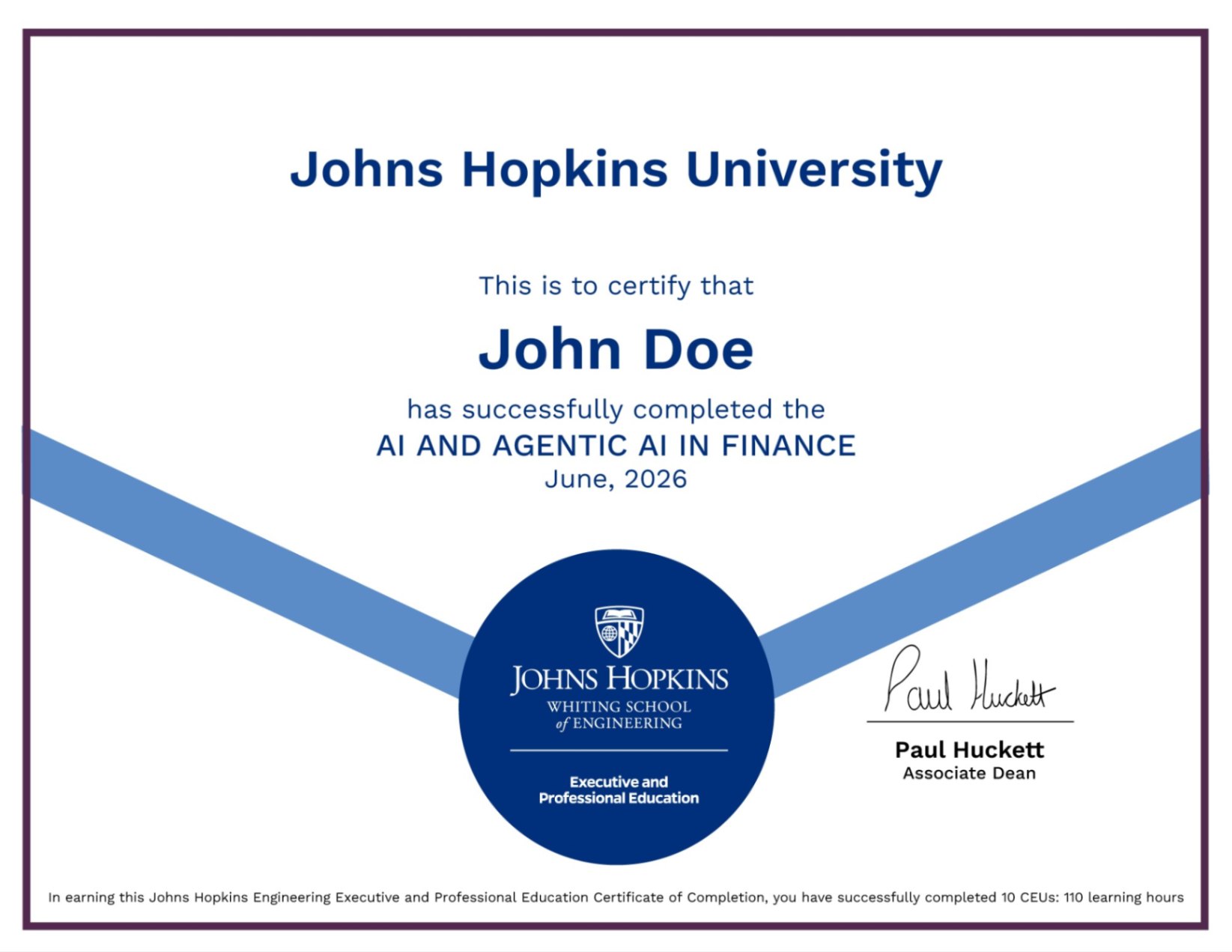
* Image for illustration only. Certificate subject to change.
Who are the faculty for the program?
Learn from renowned JHU faculty and build expertise in AI agents, autonomous systems, and AI implementation
-
Ian McCulloh, Ph.D.
Director, AI Executive & Professional Education, Johns Hopkins University
Served as Chief Data Scientist & MD of AI, Accenture Federal Services
Author of three books and over 100 peer-reviewed papers
Know More
-
Dr. Jim Kyung-Soo Liew
AI transformation leader, Founder and President of SoKat
A leader in building production-grade AI systems
Founder and president of SoKat
Know More




 LinkedIn Profile
 University Link
Who are the mentors for weekly live sessions?
Learn from seasoned AI and Finance industry mentors to apply concepts and build practical skills
-
Benito Lopez
Quantitative Finance Analyst
-
Ashutosh Pandey
Vice President - Investment Data & Analytics, Citi Global Wealth
-
Mirata Hosseini
Vice President, AI Governance Lead, BMO Capital Markets
-
Anuj Saini
Principal Data Scientist, RPX Corporation







Note: The mentors listed above are indicative and subject to change based on availability and scheduling.
What are the fees for the program?
The course fee is USD 2,900
Invest in your career
-
Build hands-on capabilities in financial analysis, decision-making, automation, and risk monitoring using AI
-
Explore leading AI tools that you can add to an industry-ready portfolio to showcase skills and proficiency
-
Learn from AI experts in weekly live online sessions focused on real-world implementation
-
Receive a Certificate of Completion and 10 CEUs from Johns Hopkins University


Application process
Admissions close once the required number of participants enroll. Apply early to secure your spot
-
Fill application form
Apply by filling out a simple online application form.
-
Review process
A panel from Great Learning will review your application to determine your fit for the program.
-
Join program
Receive an offer for a seat in the upcoming cohort of the program post a final review.


Prerequisites
- This program is designed for professionals with a foundational understanding of Finance. No prior background in Artificial Intelligence or Machine Learning is necessary
Batch start date
-
Online · November 2026
Admission closing soon
Frequently asked questions
What makes JHU’s AI and Agentic AI in Finance program different from other AI in finance courses?
Unlike other AI in finance courses, this program emphasizes the strategic judgment, governance, and compliance needed to deploy AI responsibly in finance. Here are the key factors that differentiate the Johns Hopkins University (JHU) AI and Agentic AI in Finance program:
● Strategic Judgment > Technical Skills: With technical barriers dropping, the curriculum focuses on developing the human intuition and critical thinking needed to evaluate AI outputs.
● Practical Execution: It moves past basic "AI awareness" into hands-on application, using no-code tools to build AI-powered workflows for credit decisioning, financial analysis, and compliance.
● Built for Regulation: Designed specifically for highly regulated financial environments, the program embeds regulatory constraints throughout the curriculum, teaching you how to build explainable, traceable, and audit-ready AI systems. Every AI artifact, from KYC/AML pipelines to explainable credit memos, is built with compliance and regulatory review in mind.
● Top-Tier Credential: Earn a formal Certificate of Completion and 10 CEUs from Johns Hopkins University, providing a distinct competitive edge.
● Claude Ecosystem Training: Includes specialized training on Anthropic’s Claude models, focusing heavily on Constitutional AI and safety alignment.
How much time should I dedicate each week?
The online program runs for 13 weeks with an expected commitment of approximately 6–8 hours per week, making it suitable for working professionals.
How will this program help me automate financial reporting, and forecasting?
The program teaches finance professionals how to use Generative AI and Agentic AI to streamline budgeting, forecasting, reporting, and financial analysis. You'll learn to automate spreadsheet workflows, transform financial data into insights, build AI-powered reporting agents, and apply prompt engineering techniques while ensuring accuracy and human oversight.
Who teaches this program?
The program is taught by Johns Hopkins University faculty, including Dr. Ian McCulloh, an expert in AI and network science, and Dr. Jim Kyung-Soo Liew, a finance expert with extensive experience in investment strategy and AI applications.
Will the program cover AI use cases for audit, risk, compliance, and investment analysis?
Yes. The curriculum covers practical AI applications across audit, risk, compliance, and investment analysis. Through hands-on projects, you'll learn to automate forecasting, reporting, fraud detection, KYC/AML workflows, credit underwriting, portfolio risk monitoring, and investment research using Generative AI and Agentic AI.
Does the program cover AI in risk and compliance?
Yes. You'll learn how AI can support sanctions screening, Know Your Customer (KYC), Anti-Money Laundering (AML), credit risk assessment, fraud detection, regulatory reporting, and audit-ready workflow automation.
Which AI tools should finance professionals learn to stay competitive?
Finance professionals increasingly benefit from tools that support automation, financial analysis, risk assessment, and compliance. This program provides practical experience with no-code AI tools, the Claude ecosystem, prompt engineering, RAG, API integration, and Agentic AI workflows that can be applied across finance functions.
Will I learn about AI in investing and wealth management?
Yes. The curriculum introduces practical applications of AI in investment research, portfolio monitoring, market sentiment analysis, and decision-support systems that help finance professionals evaluate investment opportunities more efficiently.
Do I need coding or technical experience to learn AI and Agentic AI for finance?
No, you do not need any coding or technical experience to enroll in this program. The curriculum is intentionally designed for Finance, Investment, Risk, Strategy & Advisory Professionals with a foundational understanding of finance. No prior background in programming, Artificial Intelligence, or Machine Learning is required.
Is this program suitable for finance leaders evaluating AI adoption?
Yes. Beyond implementation, the curriculum helps finance leaders assess AI opportunities, evaluate vendor claims, understand AI governance, and lead responsible AI adoption across business functions.
What is the fee for the AI and Agentic AI in Finance program?
For information on fee structure, offers, payment plans, and eligibility for financial assistance, contact your Program Advisor.
What does the program fee include?
The fee covers access to the online learning platform, course materials, lab tools live faculty sessions, practical projects, assessments, and a Certificate of Completion from Johns Hopkins University upon successfully meeting the program requirements.
The program provides no-code hands-on experience, while teaching architectural design for the Claude ecosystem (independent API exploration is optional).
How can Agentic AI help finance professionals advance their careers?
As organizations move beyond AI experimentation, employers increasingly seek professionals who can implement, govern, and evaluate AI systems in financial environments. Skills in Agentic AI, workflow automation, and AI governance can support career growth across finance, risk, compliance, investment, and strategy functions.
How is AI impacting the future of finance and accounting?
AI is reshaping finance by automating repetitive tasks, improving forecasting accuracy, accelerating financial analysis, enhancing compliance monitoring, and enabling data-driven decision-making. However, professionals who can combine AI capabilities with financial judgment and regulatory understanding are likely to remain the most valuable.
Can this program help me transition into AI-focused finance roles?
Yes. The program helps professionals develop practical skills in AI-powered financial analysis, workflow automation, compliance, investment research, and intelligent decision support. The hands-on portfolio can demonstrate your ability to apply AI in real financial scenarios.
Is AI being used in auditing and compliance today?
Yes. Financial institutions increasingly use AI to identify anomalies, review documentation, automate compliance checks, and improve audit efficiency. The program covers explainable AI approaches that support regulated financial environments while maintaining transparency and accountability.
How do AI agents handle sensitive financial data and confidential company information?
The program teaches best practices for deploying AI in regulated financial environments. You'll learn how to protect sensitive data and PII, apply AI governance and security frameworks, use redacted datasets for practical projects, and build explainable, audit-ready AI systems with appropriate human oversight and compliance controls.
Delivered in Collaboration with:

Johns Hopkins University is collaborating with online education provider Great Learning to offer the AI and Agentic AI in Finance program. Great Learning is a professional learning company with a global footprint in 170+ countries. Its mission is to make professionals around the globe proficient and future-ready. This program leverages JHU's leadership in innovation, science, engineering, finance and technical disciplines developed over years of research, teaching, and practice. Great Learning manages the enrollments and provides industry experts, student counselors, course support and guidance to ensure students get hands-on training and live personalized mentorship on the application of concepts taught by the JHU faculty.
 Application closes
30th Sep 2026
Application closes
30th Sep 2026