Build, Deploy, and Govern AI Applications Across Healthcare Settings
Applications of AI and Agentic AI in Healthcare
 Application closes on
30th Sep 2026
Application closes on
30th Sep 2026

 Speak with our expert
+14104573648
Speak with our expert
+14104573648




Receive Your Brochure Copy
Get details on syllabus, projects, tools, and more

Applications of AI and Agentic AI in Healthcare
Application closes 30th Sep 2026
Why should you join this program?
-

Low-Code Agentic AI in Healthcare Program
Use AI-assisted coding and step-by-step prompting to run and adapt Python-based AI tools directly in your browser, requiring no prior programming background.
-
Learn from JHU, a Leading US Research University
Ranked #7 National University, #14 Best Global University, #2 in Computer Information Technology, reflecting JHU's leadership in research and innovation. (2026 Rankings)


PROGRAM OUTCOMES
What will you learn to build and apply?
Through a structured learning journey, you will build the capability to:
-
Distinguish general AI tools like ChatGPT from healthcare-specific models, and assess output reliability
-
Execute and adapt Python-based AI tools through guided prompting, no prior coding experience needed
-
Spot opportunities to reduce manual work in documentation, prior authorization letters, triage, and workflows
-
Work within key frameworks, including HIPAA, the EU AI Act, and FDA guidelines for medical software
-
Develop models using EHR-style data and produce explainable outputs that clinicians and admins can act on
-
Set up clinical studies covering feasibility, cost, and risk. Connect AI tools using healthcare data standards
Earn a Certificate of Completion from Johns Hopkins University
-
#7 National University Rankings
U.S. News & World Report, 2026
-
#2 Computer Information Technology
U.S. News & World Report, 2026
-
#10 Most Innovative Schools
US News and World Report, 2026
-
#14 Best Global University
U.S. News & World Report, 2026
-
#1 Biomedical Engineering Program
US News and World Report, 2026


KEY PROGRAM HIGHLIGHTS
Why choose this program?
-
Learn from Johns Hopkins University Faculty
Learn through recorded lectures and faculty-led masterclasses to apply AI across real-world clinical and operational settings.
-
Interactive Mentorship by Industry Experts
Learn from AI experts through mentorship sessions focused on practical applications, implementation challenges, and industry best practices.
-
Healthcare-Focused AI and Agentic AI Curriculum
Learn from a structured curriculum spanning foundational concepts such as the clinical AI lifecycle and AI-assisted coding to advanced topics including Agentic AI frameworks.
-
Hands-On Learning Without Prior Coding Experience
Build foundational skills in GenAI and agentic AI in healthcare through hands-on projects and real-world case studies.
-
Earn a Recognized Credential from Johns Hopkins University
Earn a Certificate of Completion and 7 Continuing Education Units (CEUs) from Johns Hopkins University.
-
Personalized Program Support
Receive guidance from a dedicated Program Manager and academic support from subject matter experts.


What skills will you learn?
Clinical AI & Healthcare AI Applications
Clinical Decision Support Systems (CDSS)
Healthcare AI Deployment
EHR Integration (EPIC & FHIR)
Healthcare Workflow Automation
Healthcare Predictive Analytics
Revenue Cycle Automation
Healthcare AI Governance & Compliance
AI for Clinical Documentation
Clinical AI & Healthcare AI Applications
Clinical Decision Support Systems (CDSS)
Healthcare AI Deployment
EHR Integration (EPIC & FHIR)
Healthcare Workflow Automation
Healthcare Predictive Analytics
Revenue Cycle Automation
Healthcare AI Governance & Compliance
AI for Clinical Documentation
view more
- Overview
- Learning Journey
- Curriculum
- Tools
- Certificate
- Faculty
- Mentors
- Fees
- FAQ
Who is the program for?
Ideal for professionals in the healthcare domain looking to apply AI across clinical and operational settings.
-
Medical Practitioners and Researchers
Who are interested in leveraging AI and Generative AI for clinical decision-making and workflow optimization.
-
Healthcare Leaders and Executives
Aiming to drive enterprise-wide AI initiatives, measure clinical and financial ROI, develop strategies, and improve operational efficiency.
-
Regulators, Compliance Officers and Policymakers
Seeking to navigate AI governance in healthcare, balance data privacy with algorithmic safety, address bias, and understand key regulations.
-
Healthcare Consultants and Tech Professionals
Looking to transform raw health data into machine-learning-ready features and build predictive Clinical Decision Support Systems.
How is the program learning experience?
Our pedagogy is designed to ensure a holistic learning experience
-
Learn from Experts
Learn from JHU faculty and industry experts and learn to build AI applications in healthcare
-
Learn By Doing
Apply Agentic AI concepts through hands-on projects and real-world case studies
-
Earn a University Credential
Earn a certificate of completion and 7 CEUs from Johns Hopkins University
-
Get Support Throughout the Learning Journey
Program managers will help you stay on track, navigate key milestones & complete the program




What will you learn in the program?
The comprehensive curriculum, designed and delivered by Johns Hopkins University faculty and industry practitioners, equips learners with the skills and judgment needed to build, deploy, and govern AI applications across healthcare settings.
-
Monthly Live
Faculty-Led Masterclasses
-
Weekly
Mentorship Sessions
-
Real-World
Healthcare Use Cases
Pre-Work Module
This pre-work module introduces learners to the fundamentals of AI and machine learning, and explores how key technologies are applied across clinical, administrative, and operational settings within the healthcare landscape. It also covers the differences between general-purpose LLMs and specialized healthcare models, building the foundational understanding required for real-world application. In addition, the module orients learners to the AI and automation tools used throughout the program, guiding account setup, initial prompt execution, and the selection of appropriate tools for specific healthcare tasks.
Module 01: Generative AI and Agentic AI Foundations for Healthcare
In this module, learners will understand the Clinical AI lifecycle and the role of generative and agentic AI in healthcare settings. They will explore how AI can be safely applied across clinical workflows, identify high-impact use cases, and develop skills in prompt engineering for medical tasks. Additionally, learners will be introduced to AI-assisted coding and the foundational concepts behind LLMs, AI agents, and RAG systems, enabling them to evaluate, design, and begin building intelligent healthcare applications.
Week 1: Foundations of the Clinical AI Landscape
Week 2: AI-Assisted Coding
Week 3: Generative AI and Agentic AI Foundations
Module 02: AI in Action | Solving Real Clinical and Operational Challenges
In this module, learners will apply AI and machine learning techniques to real clinical and healthcare operations use cases. They will work with predictive models, clinical decision support systems, and healthcare data workflows to understand how AI is deployed in practice. The module also focuses on evaluation, validation, and responsible deployment of AI systems, including fairness, interpretability, and regulatory considerations in real-world healthcare environments.
Week 4: Clinical Decision Support System
Week 5: Readmissions & RCT Methodology
Week 6: Revenue Cycle Automation
Learning Break
Module 03: From Pilot to Production | Deploying AI in a Health System
In this module, learners will understand how AI systems are operationalized within real healthcare environments, moving from prototype to production. They will explore how AI tools are integrated with EHR systems using interoperability standards, scaled across hospital networks, and governed under enterprise-grade deployment frameworks. The module emphasizes real-world deployment through Epic integration, workflow orchestration, and healthcare AI governance.
Week 7: EPIC Integration and Deployment
Week 8: Enterprise Deployment
Week 9: AI Governance for Healthcare Systems
Project Week
Capstone Project
Build a real-world healthcare AI use case after completing all 9 weeks of coursework. Learners apply their learning to a Capstone Project that takes a real healthcare AI use case from problem framing to a governance-ready deployment plan.
Learners can choose from real-world tracks such as:
Live Masterclass 1 | Navigating Your Career Path in AI for Healthcare
This masterclass helps learners position themselves as AI adoption accelerates across clinical, operational, and administrative settings. Drawing on the program's emphasis on human intuition and strategic judgment, faculty will map the emerging roles at the intersection of clinical practice, data, and AI implementation, from clinical informatics and AI validation to deployment and governance-focused roles. Learners will explore how to translate their existing clinical, technical, or leadership background into this space, which skills and credentials carry weight, and how a university credential and a portfolio of real-world projects strengthen their profile. The session closes with practical guidance on charting a credible path forward in a field where demand is growing faster than proven expertise.
Live Masterclass 2 | Emerging Innovations in AI for Healthcare
This masterclass looks ahead at the technologies reshaping how care is delivered and managed. Faculty will examine developments such as generative AI for clinical documentation and decision support, multimodal models that reason across imaging, text, and other data sources, and agentic systems that work alongside care teams to automate complex workflows. Beyond the technology itself, learners will explore what it takes to move innovations from promising pilots into real clinical use, including the evidence, validation, regulatory, and workflow considerations that determine whether an innovation holds up in practice. Learners will leave with a grounded view of what is genuinely new, where the field is heading, and how to evaluate emerging tools with appropriate rigor.
Self-Paced: Claude-Based AI Workflows
Designed for technical professionals across the stack, this self-paced course delivers comprehensive training in Claude - Anthropic's industry-leading AI platform. Participants gain fluency across the full development lifecycle: API integration, model selection, agentic workflow design with Claude Code, tool integration via the Model Context Protocol, and enterprise deployment with cost management and Anthropic's Constitutional AI framework. Note : Learners are required to have a Claude Subscription to complete this Self-Paced Module
Anthropic Masterclass
This masterclass covers the Anthropic AI landscape, exploring Claude models, Constitutional AI, and key safety and alignment principles. Learners will apply effective Prompt Engineering techniques, use the Claude API for tasks and integrations, generate structured outputs, build simple applications, compare Claude with other AI models, and evaluate ethical considerations for deploying AI systems.
Note: The curriculum listed above are indicative and subject to updates as technology evolves.
Which tools will you learn and apply?
Explore leading AI tools that you can add to an industry-ready portfolio to showcase skills and proficiency
-
n8n
-
ChatGPT
-
Google Colab
-
Claude
-
Gemini
-
Python
-
Jupyter Notebook
-
Codex








Note: The tools listed above are indicative and subject to updates as technology evolves.
Earn a Certificate of Completion from Johns Hopkins University
Stand out in a competitive market with a Certificate of Completion that validates the expertise developed through rigorous, practical assessments.
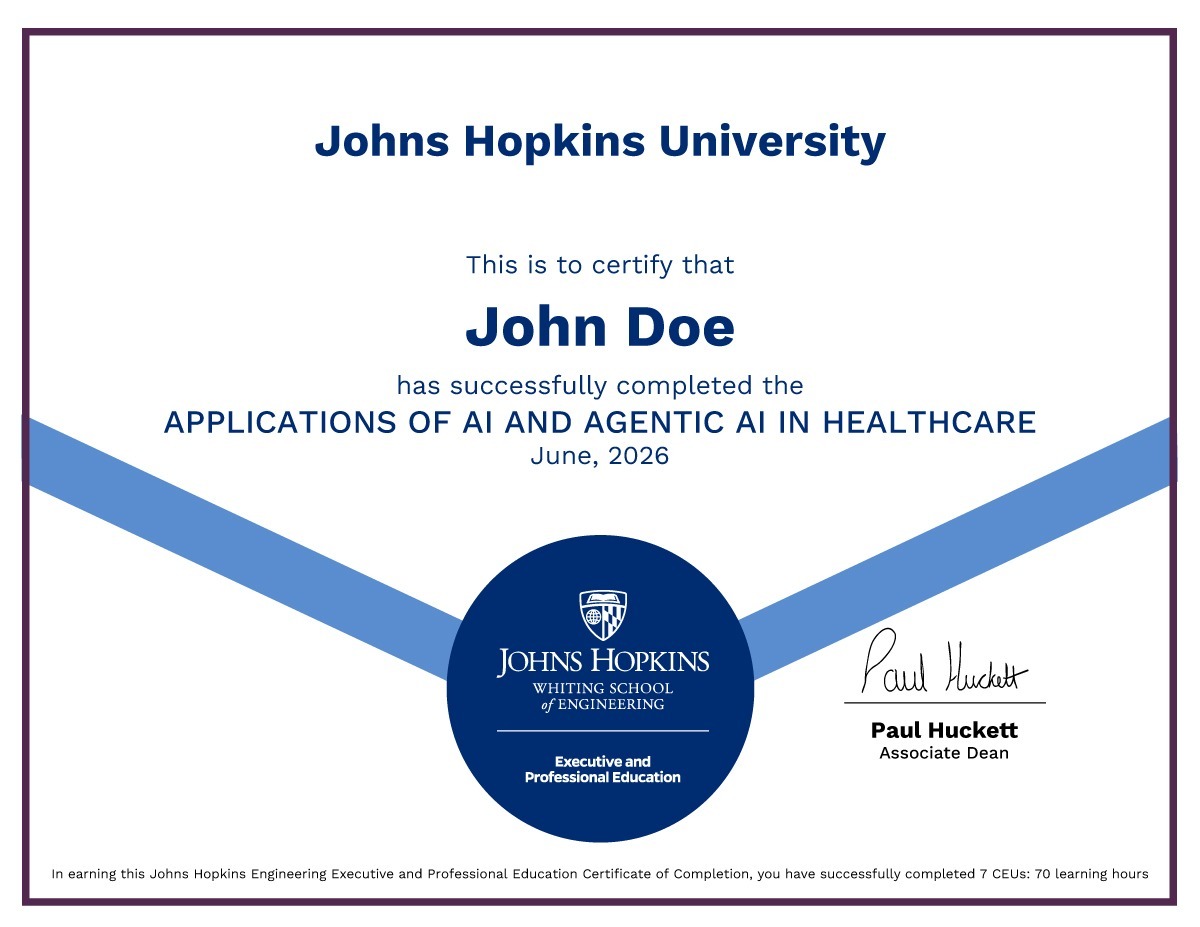
* Image for illustration only. Certificate subject to change.
Who are the faculty for the program?
Learn from renowned JHU faculty and apply AI across real-world clinical and operational settings.
-
Ian McCulloh, Ph.D.
Director, AI Executive & Professional Education, Johns Hopkins University
Served as Chief Data Science and MD of AI, Accenture Federal Services
Author of three books and over 100 peer-reviewed papers
Know More
-
Daniel Byrne
Award-winning author, Teacher, and Faculty member, Johns Hopkins University
40+ years in AI, predictive modeling, and healthcare.
Published 165+ scientific papers on AI and patient outcomes
Know More
-
Dr. Ahmed Hassoon
Assistant Research Professor, Johns Hopkins Bloomberg School of Public Health.
Fellow of the 2024 Institute for Healthcare Improvement (IHI)
Mentored Clinical Scientist Research Career Development Awardee
Know More
-
Dr. Robert Stevens, MD, MBA, FCCM
Associate Director, Johns Hopkins Precision Medicine Center of Excellence in Neurocritical Care
Founder, Laboratory of Computational Intensive Care Medicine at JHU
Author of over 230 peer-reviewed articles (h-index = 67)
Know More







 LinkedIn Profile
 University Link
Who are the mentors for weekly live sessions?
Learn from seasoned AI industry mentors to apply concepts and build practical skills.
-
G Anthony Reina
Head of Machine Learning, Stealth BioTech Startup
-
Sharath M S
Staff AI Engineer, GE HealthCare
-
Rishov Chatterjee
Director of Data Science and AI, Integra Connect





Note: The mentors listed above are indicative and subject to change based on availability and scheduling.
What is the fee for the program?
The program fee is USD 2,950
Invest in your career
-
Build hands-on capabilities in Generative AI and agentic AI in healthcare
-
Learn from AI experts in weekly live online sessions focused on real-world implementation
-
Explore leading AI tools that you can add to an industry-ready portfolio to showcase skills and proficiency
-
Receive a Certificate of Completion and 7 CEUs from Johns Hopkins University


Easy payment plans
Avail our EMI options & get financial assistance
-
discount available
USD 2,950 USD 2,750
USD 2,950 USD 2,600
Third Party Credit Facilitators
Check out different payment options with third party credit facility providers


*Subject to third party credit facility provider approval based on applicable regions & eligibility

Application process
Admissions close once the required number of participants enroll. Apply early to secure your spot
-
Fill application form
Apply by filling out a simple online application form.
-
Review process
A panel from Great Learning will review your application to determine your fit for the program.
-
Join program
Receive an offer for a seat in the upcoming cohort of the program post a final review.


No prerequisites
- No prior coding experience required
- Learn with AI-assisted coding tools
Batch start date
-
Online · To be announced
Admissions Open
Frequently asked questions
What learner support is available during the program?
The program includes end-to-end learner support from a dedicated Program Manager, live mentor sessions, access to the Great Learning community, project discussion forums, and peer learning groups to help you throughout your learning journey.
What are some real-world applications of AI in healthcare covered in the program?
The curriculum explores practical applications of AI in healthcare, including AI-assisted diagnosis and predictive decision support, clinical documentation, revenue cycle automation, prior authorization automation, readmission risk prediction, Electronic Health Record (EHR) integration via Epic sandbox, and AI governance and regulatory compliance. Learners also work on real-world use cases such as deploying Agentic AI for healthcare workflows and enterprise AI implementation, demonstrating how AI can improve both patient care and operational efficiency.
What are some examples of Agentic AI applications in healthcare?
Agentic AI can automate complex healthcare workflows by combining reasoning, memory, and external data sources to support both clinical and administrative tasks. Common applications include prior authorization automation, medical coding and revenue cycle management, payer policy interpretation, AI-assisted clinical documentation, and predictive clinical decision support such as readmission risk assessment. In this program, you'll also learn how to build and orchestrate AI-powered healthcare workflows using tools like n8n, Claude Code, and Codex, while integrating AI into healthcare systems with appropriate human oversight and governance.
How much time should I dedicate each week?
Most learners should plan for approximately 8–10 hours per week, including recorded lectures, live masterclasses, live mentorship sessions, and hands-on project work. The program is designed for busy healthcare professionals, and no prior coding experience is required—you'll learn through AI-assisted coding, guided exercises, and practical workflows that make the workload manageable for both technical and non-technical learners.
Will I receive a certificate after completing the program?
Yes. Upon successful completion, learners receive a Certificate of Completion and 7
Continuing Education Units (CEUs) from Johns Hopkins University.
Does the program include AI governance and responsible AI in healthcare?
Yes. Learners study healthcare AI governance and responsible AI practices, including HIPAA, the EU AI Act, FDA guidelines, GDPR, the HTI-1 Rule, and the CHAI Quality Framework. The curriculum also covers bias evaluation, model monitoring, algorithmic risk, and AI compliance to support the safe and responsible deployment of AI in healthcare settings.
What expert faculty and industry practitioners lead the masterclasses?
The live masterclasses are led by world-renowned Johns Hopkins University faculty with expertise in healthcare AI, clinical informatics, public health, engineering, and AI governance. You'll learn from Daniel Byrne, Faculty Member at the Whiting School of Engineering and Bloomberg School of Public Health; Dr. Ian McCulloh, Manager of Artificial Intelligence Continuing and Executive Education; Dr. Robert Stevens, Director of the Division of Informatics, Integration and Innovation and Precision Medicine; and Dr. Ahmed Hassoon, Assistant Research Professor in the Bloomberg School of Public Health.
In addition, industry practitioners such as Sharath M S, Staff AI Engineer at GE HealthCare; Rishov Chatterjee, Director of Data Science and AI at Integra Connect; and G. Anthony Reina, Head of Machine Learning at a stealth biotech startup, provide mentorship and practical insights into real-world healthcare AI applications.
Which AI tools for healthcare will I learn?
Learners gain hands-on experience with widely used AI tools including:
● ChatGPT
● Claude
● Gemini
● Python
● Google Colab
● Jupyter
● Codex
● n8n
● Epic Sandbox
● FHIR / CDS Hooks
● Claude Code
The program demonstrates how these tools support clinical documentation, AI-assisted
coding, workflow automation, and healthcare analytics.
Does the curriculum cover AI patient monitoring and clinical decision support?
Yes. The curriculum includes Clinical Decision Support Systems (CDSS), predictive modeling, patient risk assessment, survival analysis, healthcare data preparation, and AI evaluation frameworks that support safer clinical decision-making.
Will I learn how AI chatbots are used in healthcare?
Yes. The program begins by explaining how AI chatbots support conversational tasks such as clinical documentation, information retrieval, and administrative assistance. It then progresses to Agentic AI, where AI systems can reason, use external tools, access healthcare data, and orchestrate multi-step workflows.
You'll learn how Agentic AI goes beyond simple conversations to automate real-world healthcare processes such as clinical decision support, prior authorization, revenue cycle management, and EHR-integrated workflows using technologies like RAG, n8n, and AI agents, all while maintaining appropriate human oversight and governance.
Who should enroll in this program?
This program is designed for:
● Medical practitioners and clinicians
● Healthcare researchers
● Hospital administrators and healthcare leaders
● Healthcare consultants
● Healthcare technology professionals
● Compliance officers and policymakers
It is ideal for professionals looking to implement AI responsibly across healthcare organizations, and no software engineering or prior coding experience is required.
How can non-technical health system managers build practical AI tools without writing code from scratch?
Non-technical health system managers can build practical AI tools using AI-assisted coding, Vibe Coding, and no-code platforms instead of writing software from scratch. Through Vibe Coding—using natural language prompts to generate, explain, and debug Python code with AI—they can leverage tools like ChatGPT, Claude, Google Colab, Jupyter Notebooks, n8n, and Codex to prototype clinical AI workflows, automate healthcare processes, and develop practical AI solutions. The program provides guided, hands-on exercises that help learners build and implement AI workflows while focusing on clinical strategy and operational decision-making rather than programming.
What is the program fee?
Please contact a Program Advisor regarding fee structure, payment plans, available offers, and financial assistance options.
Are software licenses or AI tool subscriptions included?
Most learning activities use free versions of the required tools. API credits and paid tool access required for specific modules are provided at no additional cost. Learners require Claude subscription for the self-paced module.
How do AI agents help with medical coding?
AI agents assist with medical coding by automating complex administrative tasks within revenue cycle workflows. Specifically, multi-agent systems and Retrieval-Augmented Generation (RAG) frameworks are used to automate the assignment of ICD-10 and CPT codes, which streamlines broader processes like claims processing and payer policy interpretation. While these agentic frameworks significantly reduce manual effort, it is emphasized that human oversight remains critical to ensure accuracy and compliance.
How will this program prepare me to deploy multimodal models and Agentic AI in real-world clinical operations?
The program combines foundational AI concepts with hands-on projects to help you implement multimodal AI workflows and Agentic AI in healthcare settings. You'll learn how multimodal AI supports clinical decision-making across text and medical imaging, build AI agents using tools like n8n and Claude and automate workflows such as medical coding and revenue cycle management. The curriculum also covers integrating AI with EHR systems like Epic using FHIR and CDS Hooks, scaling AI safely across healthcare organizations, and applying governance frameworks such as HIPAA, the EU AI Act, and FDA guidance. You'll conclude with a capstone project that develops an implementation-ready AI solution for a real-world clinical use case.
How can I use n8n for healthcare automation?
You can use n8n as a low-code/no-code tool to build automated workflows that connect AI systems to external healthcare data sources and Electronic Health Record (EHR) systems. Through hands-on projects, you'll learn how to create agentic AI workflows that connect AI models to external healthcare data sources and explore integration with Epic testing environments using interoperability standards such as FHIR and CDS Hooks. These practical exercises show you how to automate clinical and administrative workflows in real-world healthcare environments.
How can practicing clinicians apply AI tools to improve clinical decision-making and patient care without disrupting daily workflows?
Practicing clinicians can integrate AI into existing clinical workflows by embedding AI-powered decision support within EHR systems like Epic, reducing administrative tasks such as documentation and prior authorization, and using explainable AI to support faster, more informed clinical decisions. The program also teaches clinicians how to build practical AI tools with ChatGPT, Claude, and AI-assisted coding, while applying human-in-the-loop practices to ensure AI augments clinical judgment rather than replacing it.
Delivered in Collaboration with:

Johns Hopkins University is collaborating with online education provider Great Learning to offer the Applications of AI and Agentic AI in Healthcare program. Great Learning is a professional learning company with a global footprint in 170+ countries. Its mission is to make professionals around the globe proficient and future-ready. This program leverages JHU's leadership in innovation, science, engineering, and technical disciplines developed over years of research, teaching, and practice. Great Learning manages the enrollments and provides industry experts, student counselors, course support and guidance to ensure students get hands-on training and live personalized mentorship on the application of concepts taught by the JHU faculty.
 Application closes
30th Sep 2026
Application closes
30th Sep 2026