Build Production-Grade AI Systems at Scale
Certificate Program in Artificial Intelligence and Agentic AI Engineering
 Application closes on
29th Oct 2026
Application closes on
29th Oct 2026

 Speak with our expert
+14109366066
Speak with our expert
+14109366066




Learn more about the course
Get details on syllabus, projects, tools, and more

Certificate Program in Artificial Intelligence and Agentic AI Engineering
Application closes 29th Oct 2026
Why should you join this program?
-

Hands on Agentic AI Curriculum for Tech Practitioners
Apply AI to real-world engineering challenges supported by access to OpenAI API keys and Cloud Labs from Great Learning. Work on hands-on projects and case studies across real-world workflows.
-
Learn from JHU, a Leading US Research University
Ranked #7 National University, #14 Best Global University, #2 in Computer Information Technology, reflecting JHU's leadership in research and innovation. (2026 Rankings)


PROGRAM OUTCOMES
What will you learn to build and apply?
Design, deploy, and operate AI systems in real-world production environments.
-
Design and implement production AI/ML systems on cloud platforms using end-to-end MLOps pipelines
-
Scale and deploy Generative and Agentic AI solutions in production using cloud-native LLMOps workflows
-
Evaluate, monitor, and secure Agentic AI systems using observability frameworks and continuous tracking
-
Integrate responsible AI practices, governance, privacy, and security across the entire system lifecycle
Earn a certificate of completion from Johns Hopkins University
-
#9 National University Rankings
U.S. News & World Report, 2027
-
#2 Computer Information Technology
U.S. News & World Report, 2027
-
#11 Most Innovative Schools
US News and World Report, 2027
-
#17 Best Global University
U.S. News & World Report, 2027
-
#1 Biomedical Engineering Program
US News and World Report, 2027


KEY PROGRAM HIGHLIGHTS
Why choose this program?
-
Learn from Johns Hopkins University faculty
Learn through recorded lectures and faculty-led masterclasses to apply AI across real-world clinical and operational settings.
-
Interactive mentorship by industry experts
Learn from AI experts through mentorship sessions focused on practical applications, implementation challenges, and industry best practices.
-
Hands-on learning
Build an industry-ready portfolio to showcase proficiency in leading AI-powered tools and technologies acquired through hands-on projects and real-world case studies.
-
Practical Agentic AI curriculum
Learn from a cutting-edge curriculum covering data management, model training and deployment, MLOps, monitoring, and LLMOps for production-grade AI applications
-
Dedicated support
Access a dedicated program support team throughout your learning journey, and Academic Learning Support, which includes discussion forums and peer groups
-
Elite credentials
Upon program completion, earn a globally recognized Certificate of Completion and 16 Continuing Education Units (CEUs) from Johns Hopkins University


Skills You Will Learn
CI/CD PIPELINES
Enterprise LLMOps
RETRIEVAL-AUGMENTED GENERATION (RAG)
Drift Detection & Monitoring
Agentic AI Orchestration
Production MLOps Pipelines
Advanced RAG Architecture
Adversarial Workflow Testing
Responsible AI Governance
Multi-Cloud AI Deployment
AI-Assisted Programming
Data Operationalization
Programmatic Prompt Patterns
CI/CD PIPELINES
Enterprise LLMOps
RETRIEVAL-AUGMENTED GENERATION (RAG)
Drift Detection & Monitoring
Agentic AI Orchestration
Production MLOps Pipelines
Advanced RAG Architecture
Adversarial Workflow Testing
Responsible AI Governance
Multi-Cloud AI Deployment
AI-Assisted Programming
Data Operationalization
Programmatic Prompt Patterns
view more
- Overview
- Learning Journey
- Curriculum
- Projects
- Tools
- Certificate
- Faculty
- Mentors
- Career Support
- Fees
- FAQ
Who is the program for?
Professionals with a foundation in AI, ready to transition from building models to production-grade AI systems
-
Software Development Engineers
Who want to add AI, machine learning, Generative AI, and Agentic AI capabilities to production systems using modern MLOps and LLMOps practices
-
DevOps, Platform, and Site Reliability Engineers
Who want to extend their expertise into model versioning, drift detection, observability, and AI system operations
-
Cloud Engineers and Architects
With Azure or AWS experience who want to specialize in deploying, monitoring, scaling, and governing AI and Agentic AI systems in cloud environments.
-
Data and AI Professionals
Who want to bridge the gap between model development and production deployment through end-to-end AI engineering
-
Technology Leaders and Architects
Who want a hands-on understanding of how to develop, scale, secure, and govern AI and Agentic AI systems in real-world enterprise environments
How is the program learning experience?
Our pedagogy is designed to ensure a holistic learning experience
-
Learn from world-renowned faculty
Learn critical concepts through live masterclasses and recorded video lectures by JHU faculty
-
Work on hands-on projects
Work on projects to apply the concepts & tools learnt in the module
-
Engage with your mentors
Clarify your doubts and gain practical skills during weekly live sessions with industry experts
-
Get personalized assistance
Our dedicated program support team will assist you through your learning journey




What will you learn in the program?
The curriculum is designed by faculty from Johns Hopkins University and leading industry practitioners. It covers key concepts to build robust, responsible, and scalable AI solutions for real-world business challenges leveraging key tools and technologies like Python, LangChain, LangGraph, Azure OpenAI, and Amazon Bedrock Agents.
Pre-Work
This course focuses on foundational concepts and introduces learners to cloud computing concepts and the cloud ecosystem, guides them through setting up a cloud environment, and provides an overview of real-world use cases for Artificial Intelligence applications on the cloud.
Concepts Covered:
Course 01: AI, Generative AI, and Agentic AI Foundations
This course builds the essential foundation in Artificial Intelligence, Machine Learning, and Generative Artificial Intelligence needed to engineer production Artificial Intelligence systems. It covers the Artificial Intelligence landscape, Python programming, Exploratory Data Analysis, core Machine Learning techniques, Large Language Models, Prompt Engineering, Retrieval-Augmented Generation, and an introduction to Agentic Artificial Intelligence.
Week 01: Artificial Intelligence, Generative AI, and Agentic AI Landscape
Week 02: AI-Assisted Python Programming
Week 03: AI-Assisted Exploratory Data Analysis
Week 04: AI-Assisted Machine Learning Workflows
Week 05: Prompt Engineering Using Large Language Models
Week 06: Retrieval-Augmented Generation-Based Large Language Model Workflows
Week 07: Introduction to Agentic AI
Week 08: Project Week | Health Insurance Approval Prediction
Course 02: AI Ops Foundations
This course builds on the foundational AI concepts introduced in the previous course and focuses on the operational aspects of AI and Machine Learning. It explores key AI operations (AIOps) concepts, methodologies, and frameworks, with an emphasis on operationalizing data, managing ML workflows, and understanding the model training, evaluation, and deployment lifecycle.
Week 09: Introduction to AI Ops and AI Engineering
Week 10: Operationalizing Data for AI
Week 11: Model Training and Evaluation
Course 03: Production-Grade Deployment with MLOps
This course is dedicated to the practical implementation of MLOps. It covers the architecture and components of MLOps pipelines, including continuous integration and continuous delivery principles and different deployment strategies. Key topics include model monitoring, model degradation, drift detection, and ensuring version management and reproducibility in production environments.
Week 12: MLOps Fundamentals and Model Deployment
Week 13: Building MLOps Pipelines
Week 14: Monitoring and Performance Analysis in AI Systems
Week 15: Learning Break
Week 16: Project Week | Credit Default Risk Scoring
Course 04: LLMOps and Responsible AI Usage
This course focuses on the operationalization and responsible use of Generative AI and Agentic AI. It introduces LLMOps fundamentals, implementing continuous integration and continuous delivery and monitoring for large language models, and the deployment of agentic AI systems. The critical component of evaluating and securing agentic AI systems and understanding responsible AI will also be covered.
Week 17: LLMOps Fundamentals
Week 18: LLMOps in Production
Week 19: Agentic AI in Production
Week 20: Evaluating and Securing Agentic AI Systems
Week 21: Responsible AI and AI Ops Adoption
Week 22: Project Week | Agentic AI-Powered Shopping Assistant
Self-Paced Module: Claude-Based AI Workflows
This module is designed to build practical capability in applying Generative AI and Agentic AI using the Claude ecosystem in real-world contexts. Participants build the ability to design, execute, and evaluate AI-driven workflows for real-world applications, supported by structured learning. *Disclaimer: Access to tools within the Claude ecosystem is not included as part of the program. Participants may choose to explore advanced capabilities independently.
Design and Execute AI Workflows
Note: The curriculum listed above are indicative and subject to updates as technology evolves.
What are the projects and case studies?
Apply AI to real-world challenges through hands-on projects and case studies

healthcare | sample project
Health Insurance Claim Approval Prediction
Description
Build a claim approval prediction system that combines machine learning on structured claim data with LLM-based extraction of diagnosis context from physician notes to support faster and more accurate claim adjudication.
Skills you will learn
- Python
- Pandas
- Exploratory Data Analysis
- Feature Engineering
- Classification Modeling
- Evaluation Metrics
- LLM APIs
- Prompt Engineering

finance | sample project
Credit Default Risk Scoring
Description
Build an automated MLOps pipeline that predicts borrower default risk from financial and behavioral data and supports scalable, production-ready lending workflows.
Skills you will learn
- Python
- Pandas
- Scikit-Learn
- MLflow
- Model Deployment
- MLOps
- CI/CD
- Experimentation Tracking

retail | sample project
Agentic AI-Powered Retail Shopping Assistant
Description
Develop a shopping assistant powered by Agentic AI that understands customer intent, retrieves relevant information, executes actions such as order tracking, and delivers personalized support through a production-ready LLMOps system.
Skills you will learn
- Python
- Large Language Models
- Prompt Engineering
- LangChain
- OpenAI APIs
- LangGraph
- Agentic AI

Healthcare | sample Case Study
Hospital Readmission Risk Prediction System
Description
Learn how production-oriented machine learning workflows can support healthcare teams by identifying patients at higher risk of readmission and enabling data-informed care decisions.
Skills you will learn
- Model Deployment
- MLOps Fundamentals
- Monitoring
- Production AI Workflows


Note: The projects listed above are indicative and subject to updates to the curriculum.
Which tools will you learn and apply?
Work with a comprehensive suite of modern, industry-standard tools, techniques, and algorithms
-
Python
-
OpenAI APIs
-
Scikit-Learn
-
LangChain
-
LangGraph
-
ChatGPT
-
ChromaDB
-
FAISS










Note: The tools listed above are indicative and subject to updates as technology evolves.
Earn a Certificate of Completion from Johns Hopkins University
Stand out in a competitive market with a Certificate of Completion that validates the expertise developed through rigorous, practical assessments.
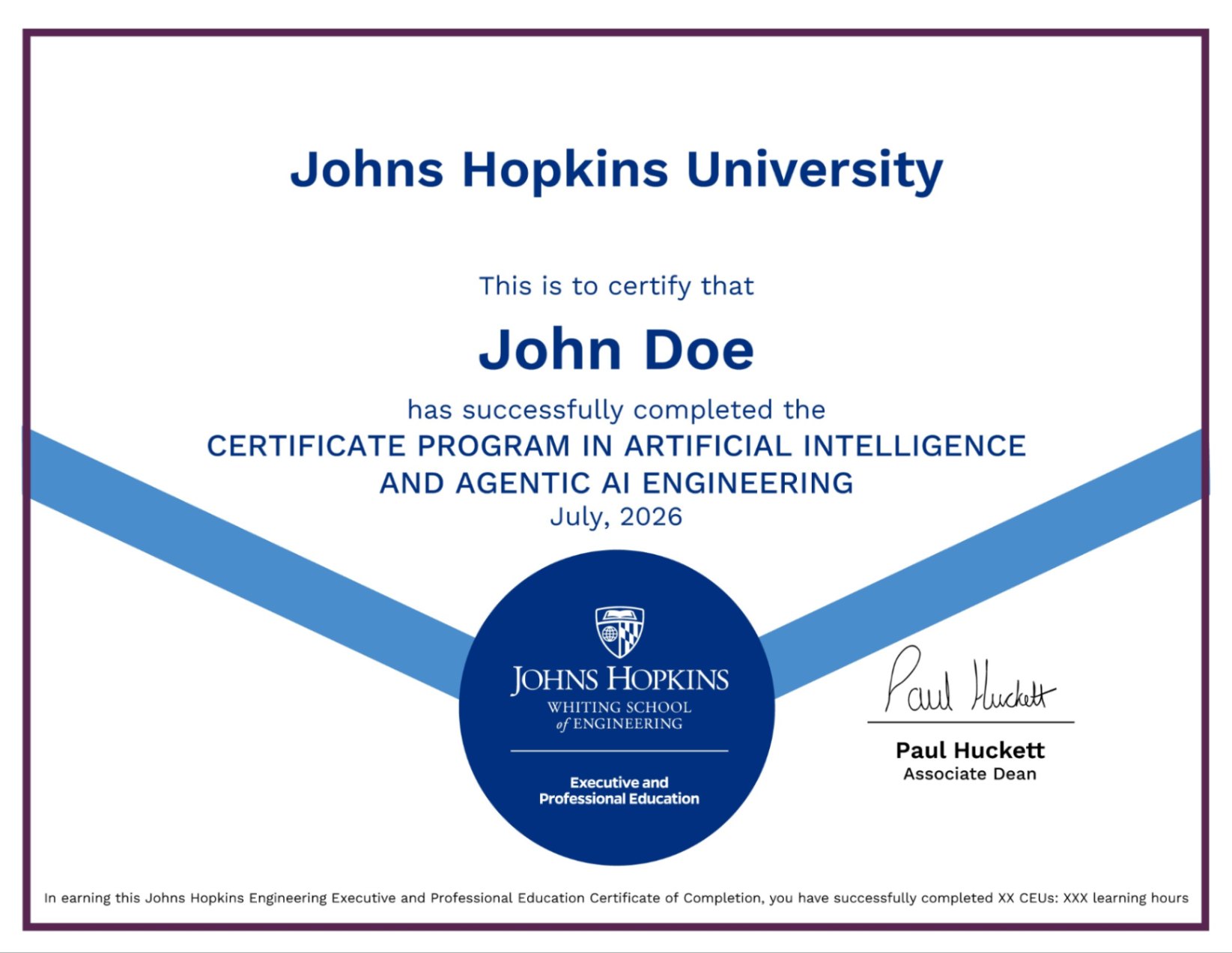
* Image for illustration only. Certificate subject to change.
Who are the faculty for the program?
Learn from renowned JHU faculty and build expertise in AI agents, autonomous systems, and AI implementation
-
Ian McCulloh, Ph.D.
Director, AI Executive & Professional Education, Johns Hopkins University
Served as Chief Data Scientist & MD of AI, Accenture Federal Services
Author of three books and over 100 peer-reviewed papers
Know More
-
Kiran Chittargi
Adjunct Faculty - Computer Science, Johns Hopkins University
Program Director at Microsoft
Global Expansion Lead for Azure
Know More
-
Dr. Shelby Wilson
Senior Data Scientist - The Johns Hopkins University Applied Physics Laboratory
Expert in applied mathematics, computational epidemiology, and ML.
Over a decade of experience solving real-world problems with mathematical and AI tools.
Know More
-
Dr. Pedro Rodriguez
Faculty, Johns Hopkins University AI Program
Leads the Information Science Branch at the JHU's Applied Physics Lab
20+ years of expertise in AI/ML algorithms
Know More
-
Dr. William Gray-Roncal
Principal Research Scientist - Johns Hopkins University Applied Physics Laboratory
Expert in data science, neuroscience, AI, and precision medicine.
Leads cutting-edge research in brain network mapping and analysis.
Know More
-
Dr. Iain Cruickshank
Faculty Member, Johns Hopkins University
ML expert applying AI to intelligence, cybersecurity, and social data
Ph.D., Carnegie Mellon University School of Computer Science
Know More








.png "Dr. William Gray-Roncal")



 LinkedIn Profile
 University Link
Who are the mentors for weekly live sessions?
Learn from seasoned AI industry mentors to apply concepts and build practical skills.
-
Hassan Ayman
Senior Data Scientist, IBM
-
Tina Kovacova
Data Advisor, Kaggle
-
Arooj Ahmed Qureshi
Senior Manager AI Engineering, Bell
-
Ishwor Bhusal
Data Scientist - Supply Chain Data Innovation, Nissan Motor Corporation






Note: The mentors listed above are indicative and subject to change based on availability and scheduling.
Dedicated Career Support
-
Resume Builder
Get access to an AI-powered resume builder to create professional, impactful resumes aligned with targeted roles.
-
Mock Interviews
Benefit from unlimited mock interviews powered by AI to practice and refine interview skills.


What are the fees for the program?
The course fee is USD 3,500
Advance your career
-
Learn to build, deploy, and operate AI and Agentic AI systems in real-world production environments
-
Add leading AI tools to an industry-ready portfolio to showcase skills and proficiency
-
Learn from AI experts in weekly live online sessions focused on real-world implementation
-
Receive a Certificate of Completion and 16 CEUs from Johns Hopkins University


Application Process
Admissions close once the requisite number of participants enroll. Apply now.
-
Fill application form
Apply by filling out a simple online application form.
-
Review process
A panel from Great Learning will review your application to determine your fit for the program.
-
Join program
Receive an offer for a seat in the upcoming cohort of the program post a final review.


Participant Eligibility
- This program is tailored for working professionals with a foundational knowledge of AI.
Batch start date
-
Online · 14th Nov 2026
Admission closing soon
Frequently asked questions
Who should enroll in the Artificial Intelligence and Agentc AI Engineering program?
This AI engineering certificate program is designed for software developers, DevOps engineers, cloud engineers, AI professionals, platform engineers, solution architects, and technology leaders with prior coding experience who want to build and operationalize enterprise AI applications.
What is the weekly time commitment, and are live sessions mandatory?
The program requires approximately 8 to 10 hours per week. Delivered in a flexible online format, you can watch recorded lectures at your own pace. While live faculty masterclasses and weekly industry mentorship sessions are highly recommended for interactive Q&A, recordings are made available if you cannot attend live.
What makes this program different from an AI engineer course online?
Unlike many AI engineering courses online that focus primarily on AI concepts or building basic models, this program prepares experienced technology professionals to engineer, deploy, and manage production-grade AI systems at enterprise scale.
Key differentiators include:
● Learn from Johns Hopkins University: Earn a Certificate of Completion and 16
Continuing Education Units (CEUs) from the Johns Hopkins University Whiting School of
Engineering upon successful completion.
● Go beyond AI prototypes: Learn to build, deploy, monitor, and secure enterprise AI and
Agentic AI applications using MLOps, LLMOps, CI/CD pipelines, observability, model
monitoring, vector databases, and responsible AI practices.
● Learn from leading experts: Benefit from recorded lectures and live masterclasses by
Johns Hopkins University faculty, along with weekly mentorship sessions led by industry
practitioners from leading technology organizations.
● Work with modern AI engineering tools: Gain hands-on experience using Python,
LangChain, LangGraph, OpenAI APIs, Azure AI Studio, Azure ML Studio, Amazon
Bedrock, AWS SageMaker, and other enterprise AI technologies.
● Build a job-ready portfolio: Complete three hands-on projects and more than 22
real-world case studies across industries such as healthcare, finance, retail, and CRM to
demonstrate production AI engineering skills.
This combination of academic rigor, enterprise-focused curriculum, hands-on cloud labs, and
real-world AI engineering projects makes the program well suited for professionals who want to
transition from experimenting with AI to building reliable, scalable production AI systems.
Why should I learn AI engineering from Johns Hopkins University?
Johns Hopkins University is recognized for its leadership in engineering, artificial intelligence, and applied research. The program, delivered by the Whiting School of Engineering, combines academic rigor with practical AI engineering across production AI, MLOps, LLMOps, and Agentic AI. U.S. News & World Report 2026 ranks Johns Hopkins #7 among National Universities, #2 in Computer Information Technology, and #10 among Most Innovative Schools in the U.S. Learners also earn a Certificate of Completion and Continuing Education Units (CEUs) from Johns Hopkins University upon successful completion.
What AI engineering skills will I gain from this program?
Learners develop AI engineering skills, including,
● Machine learning deployment
● Generative AI application development
● Agentic AI workflows
● MLOps and LLMOps
● Cloud AI deployment
● Model monitoring and evaluation
● AI security and enterprise security guardrails
● Jailbreak testing and prompt injection mitigation
● Retrieval-Augmented Generation (RAG) implementation
● Responsible AI practices
Can I learn AI engineering while working full time?
Yes. This program is specifically designed for working professionals who want to build AI engineering expertise without taking a career break. Its flexible online format combines self-paced learning with live mentorship sessions, faculty masterclasses, hands-on cloud labs, and industry projects, making it easier to balance learning with a full-time job. Beyond flexibility, the curriculum focuses on practical AI engineering skills that professionals can apply at work, including MLOps, LLMOps, Agentic AI, cloud deployment, AI security, and production AI systems.
Will I receive a certificate after completing the program?
Participants who successfully complete the program receive a Certificate of Completion and 16 Continuing Education Units (CEUs), representing 160 learning hours, issued by the Johns Hopkins University Whiting School of Engineering, validating their AI engineering skills for enterprise environments.
Will I build real AI projects that I can showcase to employers?
Yes. Throughout the program, you will complete 3 comprehensive hands-on projects, work through 22+ real-world case studies, and construct a shareable e-Portfolio.
Which tools and technologies will I use during the program?
The program includes practical experience with Python, OpenAI APIs, ChatGPT, MLflow, Scikit-Learn, Azure DevOps, LangChain, LangGraph, Azure AI Studio, Azure ML Studio, Amazon Bedrock, AWS, Amazon OpenSearch Service, AWS CodePipeline, Amazon EMR, ChromaDB, FAISS, Streamlit, GitHub Actions,
and modern cloud infrastructure.
Does this program cover production deployment?
Yes. Beyond building AI applications, participants deploy, monitor, secure, and scale production AI systems using enterprise engineering practices, including MLOps, LLMOps, CI/CD, observability, and model governance.
Do I need prior AI experience to enroll?
A foundational knowledge of AI is required. Familiarity with programming, particularly Python, and software development concepts will help participants successfully complete the hands-on engineering assignments.
Can cloud engineers and DevOps professionals benefit from this AI engineering program?
Absolutely. The program helps cloud and DevOps professionals extend their expertise into AI deployment, model operations, observability, governance, and enterprise AI infrastructure.
How much programming experience do I need before enrolling?
This program is designed for technology professionals with prior coding experience (preferably in Python or object-oriented languages) and a basic understanding of software development concepts.
What does the program fee include?
The program fee covers course content, cloud labs, project work, live mentorship sessions, faculty masterclasses, learning resources, assessments, and the Certificate of Completion upon meeting the graduation requirements. Claude API access is not included as part of the program. Learners may explore advanced usage independently.
Are flexible payment options available for this program?
Flexible payment options may be available depending on your location and enrollment terms.
Please speak to a Program Advisor for current financing options.
Can I use my company's tuition reimbursement or L&D budget for this program?
Yes. Many of our learners utilize corporate learning and development (L&D) budgets or education assistance programs to cover the program fee. Upon enrollment, our team can provide an official invoice and program syllabus to submit to your employer for approval.
Does the program provide career placement assistance or resume support?
Yes. Learners gain access to specialized career support features, including AI-assisted resume builders, AI-driven Mock Interview prep, an e-Portfolio to showcase your 3 hands-on projects to prospective employers, and access to the Great Learning professional community.
I'm already a software engineer. How do I transition into an AI engineering role?
Transitioning into AI engineering requires more than learning machine learning algorithms. Employers increasingly look for professionals who can build, deploy, monitor, and scale production AI systems. This program develops practical AI engineering skills through hands-on projects covering MLOps, LLMOps, Agentic AI, cloud deployment, AI security, and enterprise AI operations, helping experienced developers prepare for production-focused AI engineering roles.
What are the skills required for AI engineer roles today?
Modern AI engineers need programming skills, cloud computing knowledge, machine learning fundamentals, MLOps, LLMOps, API integration, AI deployment, monitoring, governance, and the ability to operationalize AI systems at scale. This program is designed to build these industry-relevant capabilities.
What are typical AI engineer responsibilities in enterprise organizations?
AI engineers build, deploy, monitor, optimize, and secure AI systems in production. Their responsibilities include developing AI pipelines, integrating large language models, implementing MLOps workflows, monitoring model performance, ensuring responsible AI practices, and collaborating with software and cloud teams.
Is this AI engineering program suitable for professionals moving into AI leadership?
Yes. In addition to technical implementation, the program covers governance, responsible AI, model lifecycle management, and enterprise deployment strategies, making it valuable for solution architects, engineering managers, and technology leaders overseeing AI initiatives.
Delivered in Collaboration with:

Johns Hopkins University is collaborating with online education provider Great Learning to offer the Certificate Program in AI and Agentic AI Engineering. Great Learning is a professional learning company with a global footprint in 170+ countries. Its mission is to make professionals around the globe proficient and future-ready. This program leverages JHU's leadership in innovation, science, engineering, and technical disciplines developed over years of research, teaching, and practice. Great Learning manages the enrollments and provides industry experts, student counselors, course support and guidance to ensure students get hands-on training and live personalized mentorship on the application of concepts taught by the JHU faculty.
 Application Closes
29th Oct 2026
Application Closes
29th Oct 2026