phone iconSpeak with our expert +1 410 584 3973

Delivered in collaboration with Great Learning

Learn more about the course

Get details on syllabus, projects, tools, and more

Name
Email
Mobile Number

By submitting this form, you consent to our Terms of Use & Privacy Policy and consent to be contacted via email, phone (including by AI-generated/pre-recorded voice calls), SMS, or WhatsApp.

Upskill Your Teams with Future-Ready Skills

Empower your workforce with programs from leading universities

  • Team Pricing

    Maximize ROI with exclusive cost-effective plans for group enrollments

  • Team Learning Dashboard

    Track progress & outcomes at the team level

  • Customized Learning Paths

    Tailor the program to align with your team's goals and drive meaningful outcomes.

Enter your organisation name

This will help us customise the proposal plans

Company Name
Applied Generative AI and Agentic AI

Applied Generative AI and Agentic AI

Application closes 30th Jun 2026

Why should you join this program?

  • List icon

    Hands-On GenAI & Agentic AI Program

    Learn from Johns Hopkins University faculty and industry experts to build practical skills in GenAI & Agentic AI through real-world case studies and hands-on projects using 10+ tools and technologies.

  • List icon

    Learn from JHU, a Leading US Research University

    Ranked #7 National University, #14 Best Global University, #2 in Computer Information Technology, reflecting JHU's leadership in research and innovation. (2026 Rankings)

overview icon

PROGRAM OUTCOMES

What will you learn to build and apply?

Through a structured learning journey, you will build the capability to:

  • List icon

    Build real AI tools, chatbots, classifiers, and summarizers, using Python and modern AI APIs

  • List icon

    Understand how LLMs, GenAI, and Agents work to make informed decisions

  • List icon

    Write, fix, and improve Python script using AI tools, focused on getting things working, not memorizing syntax

  • List icon

    Write reliable prompts and build systems where AI takes actions, uses tools, and coordinates across agents

  • List icon

    Select between prompting, RAG, and fine-tuning for a given problem, not just default to whatever's trending

  • List icon

    Identify where bias, hallucination, and legal exposure arise in AI systems, and apply steps to reduce them

Earn a Certificate of Completion from Johns Hopkins University

  • #7 National University Rankings

    #7 National University Rankings

    U.S. News & World Report, 2026

  • #2 Computer Information Technology

    #2 Computer Information Technology

    U.S. News & World Report, 2026

  • #14 Best Global University

    #14 Best Global University

    U.S. News & World Report, 2026

  • #1 Biomedical Engineering Program

    #1 Biomedical Engineering Program

    US News and World Report, 2026

Key program highlights

Why choose this program?

  • List icon

    Learn from a Top-Ranked University

    Learn from Johns Hopkins University faculty and industry experts through a structured curriculum focused on building and evaluating AI systems.

  • List icon

    Learn from JHU Faculty

    Learn through recorded lectures and attend faculty-led masterclasses covering key AI concepts, applications, and emerging trends.

  • List icon

    Weekly Mentorship by Industry Experts

    Learn from AI practitioners through interactive mentorship sessions focused on real-world AI implementation and practical problem-solving.

  • List icon

    Hands-On Curriculum in GenAI & Agentic AI

    Build practical expertise in Python, LLMs, Prompt Engineering, RAG, fine-tuning, agentic workflows, and responsible AI.

  • List icon

    Real-World Projects & Case Studies

    Build and evaluate AI applications through 3 hands-on projects and case studies spanning healthcare, finance, cybersecurity, e-commerce, and legal domains.

  • List icon

    Earn a Recognized Credential from JHU

    Earn a Certificate of Completion and 11 CEUs from Johns Hopkins University upon successful completion of the program.

Skills you will learn

Prompt Engineering

Building Generative AI Workflows

Python for Artificial Intelligence

Ethical AI Practices

Multimodal AI Foundation Models

Evaluating Generative AI Solutions

Fine-tuning LLMs

Agentic AI Development

Secure AI Development

Contrastive Learning

Cross-Modal Alignment

Natural Language Processing

Prompt Engineering

Building Generative AI Workflows

Python for Artificial Intelligence

Ethical AI Practices

Multimodal AI Foundation Models

Evaluating Generative AI Solutions

Fine-tuning LLMs

Agentic AI Development

Secure AI Development

Contrastive Learning

Cross-Modal Alignment

Natural Language Processing

view more

  • Overview
  • Learning Journey
  • Curriculum
  • Projects
  • Tools
  • Certificate
  • Faculty
  • Mentors
  • Reviews
  • Career Support
  • Fees
  • FAQ
optimal icon

Who is the program for?

Individuals looking to explore how Generative AI and Agentic AI can solve real-world business problems

  • Technology Professionals

    Who want to learn and apply Generative AI, enabling them to build and deploy AI-driven solutions at work or for personal projects

  • Data Professionals

    Who want to use GenAI to work smarter, extracting deeper insights, analyzing data more effectively

  • Technology Consultants and Technical Managers

    Seeking to understand GenAI, apply best practices, manage risks, and guide technical teams in developing AI solutions

  • STEM Graduates

    Who wish to upskill through hands-on training in Generative AI and become part of a cutting-edge industry with significant growth potential

How is the program learning experience?

Through a structured learning approach, develop the strategic judgment and intuition to scale AI

  • banner-image

    Learn from Experts

    Learn from JHU faculty and industry experts to build skills in Generative AI and Agentic AI

  • banner-image

    Learn By Doing

    Work on business problems using tools & build an e-portfolio of AI projects

  • banner-image

    Earn a University Credential

    Earn a certificate of completion and 11 CEUs from Johns Hopkins University

  • banner-image

    Get Support Throughout the Learning Journey

    Program managers will help you stay on track, navigate key milestones & complete the program

Elevate Your Skills with an Optional Paid Program

banner

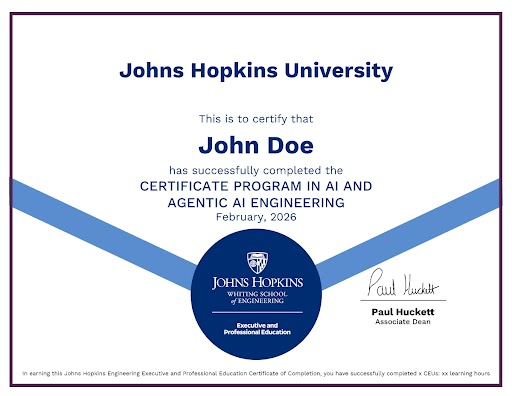
Certificate Program in AI and Agentic AI Engineering

  • Learn from world-renowned JHU faculty and experts
  • Deploy and manage AI systems with MLOps and LLMOps
  • Scale and lead AI initiatives with confidence
  • Earn Continuing Education units upon program completion

Reach out to program advisor for more details.

*image for illustration purposes only.

What will you learn in the program?

The curriculum, designed by the faculty of Johns Hopkins University, Great Learning, and leading industry practitioners, is taught by the best-in-class professors and practicing industry experts. The program aims to acquaint the learners with the skills needed to solve problems and deploy AI solutions for various business applications.

Pre-Work Module

This preparatory module builds a strong AI foundation through key concepts, Generative AI basics, and Python skills. It introduces Machine Learning models, real-world applications, and problem-solving approaches to prepare you for hands-on AI development and collaboration.

Concepts Covered

- Introduction to the World of AI - Overview of Generative AI - Python with GenAI and Learn with AI Mentor - Foundations of AI - Introduction to Python

Module 01 | AI, GenAI, and Agentic AI Foundations

This module explores the evolution of Generative AI and agents, and their real-world applications. It introduces vibe coding for rapid prototyping, using AI tools to build, test, and iterate Python and Machine Learning solutions efficiently while evaluating performance, accuracy, and reliability.

Week 1: Generative AI and Agentic AI Landscap

Understand the history of Generative AI, learn the evolution of AI agents, explore real-world Gen AI use cases across different sectors, and study key industrial applications of agents.

Week 2: AI-Assisted Python Coding

Understand the concept of ai-assisted coding and how it differs from traditional development, set up a rapid Python environment for experimentation, and use AI tools to generate and refine code effectively. Learn to prototype quickly without detailed planning, integrate APIs or datasets, create simple visualizations, and apply generative techniques in coding. Practice debugging and iterating using AI and intuition, and build and present a small end-to-end Python project while evaluating AI-generated code for correctness and limitations.

Week 3: AI-Assisted Coding for ML Workflows

Understand how vibe coding applies to machine learning workflows, set up an environment for rapid ML experimentation, and use AI tools to build ML pipelines and models. Learn to perform quick exploratory data analysis, prepare and preprocess datasets, build baseline models efficiently, and iterate through experimentation. Gain skills in evaluating model performance, debugging issues, automating parts of the ML workflow, and assessing models for bias, accuracy, and reliability.

Week 4: Hands-On Project

Work on a hands-on project building a Personal Finance Coach & Spending Analyzer using industry-relevant AI, Python, and agentic AI tools and technologies.

Week 05 | Learning Break

Learning breaks are structured pauses that allow you to consolidate concepts, complete pending work, and reinforce your understanding before progressing further.

Module 02 | Building and Evaluating GenAI Workflows

This module develops advanced LLM skills through Prompt Engineering, evaluation, and optimization techniques. Learn embeddings, RAG, and fine-tuning to build, improve, and deploy reliable AI applications with strong performance, accuracy, and scalability.

Week 6: Prompt Engineering for NLP Workflows

Understand the concept of prompt engineering and its role in refining LLMs into conversational assistants, and learn the key components of prompting, including templates and parameters. Explore advanced prompting techniques such as few-shot, chain-of-thought, tree-of-thought, self-consistency, and ReAct. Learn how to transform traditional NLP tasks into generative AI problems for more flexible solutions, including sentiment classification, transcription of audio or video into text, and generation of concise summaries. Gain the ability to generate new text outputs from given inputs to enhance a range of NLP applications.

Week 7: Evaluation of GenAI Workflows

Understand how to evaluate prompt stability by measuring consistency across multiple non-deterministic LLM runs and applying prompt versioning strategies. Learn how to assess LLM output quality using metrics such as accuracy, hallucination rates, and confidence scores like log probabilities. Apply programmatic prompt optimization techniques using frameworks such as DSPy to improve performance beyond manual prompting. Design scalable evaluation systems using LLM-as-a-Judge methods and gold-standard datasets with inter-annotator agreement for reliable human evaluation.

Week 8: Retrieval Augmented Generation (RAG) and Advanced RAG

Understand the roles and differences of embeddings and tokenization in large language models (LLMs), and learn how Byte-Pair Encoding manages vocabulary efficiently. Gain insights into sentence embeddings and how they improve contextual understanding in LLMs. Explore how Retrieval-Augmented Generation (RAG) enhances response accuracy and relevance using information retrieval, and understand the underlying algorithms and their impact on performance. Learn to differentiate between simple and advanced RAG implementations, build a basic fine-tuned RAG system, and evaluate RAG models effectively.

Week 9: Fine-Tuning Small Language Models

Understand the role and benefits of small language models and learn when fine-tuning is appropriate versus prompting or RAG. Learn to prepare and structure datasets for fine-tuning tasks and create effective instruction-based training data. Apply basic fine-tuning techniques to small language models using open-source tools and libraries, and run a complete end-to-end training pipeline. Evaluate model performance using appropriate metrics, optimize training for cost and efficiency constraints, and deploy a fine-tuned model in a simple application.

Week 10: Hands-On Project

Work on a hands-on project building a Clinical Decision Support System for hospitals using industry-relevant AI, RAG pipelines, fine-tuned small language models, and advanced evaluation techniques.

Week 11 | Learning Break

Learning breaks are structured pauses that allow you to consolidate concepts, complete pending work, and reinforce your understanding before progressing further.

Module 03 | Building Secure Agentic AI Workflows

This module equips you to design and run AI agents that complete tasks using tools, and to evaluate whether they actually work using clear, structured methods. You’ll understand when to use single vs multi-agent systems and how to coordinate them effectively. It also covers identifying bias and risk, staying within basic AI regulations, and making practical trade-offs to keep systems reliable and cost-efficient.

Week 12: Secure and Responsible GenAI Solutions

Understand how to identify sources of bias and risk in both human and AI systems, apply techniques to mitigate bias and risk, and gain awareness of current laws and regulations governing the responsible use of AI.

Week 13: Building Single Agent Systems

Understand AI memory structures by differentiating between short-term, long-term, episodic, and semantic memory. Explain agentic behavior with a focus on reasoning, planning, and tool calling in autonomous agents. Identify and categorize different types of AI agents based on their capabilities and use cases. Apply ReAct and the Model Context Protocol (MCP) to improve reasoning and external tool integration. Design and deploy autonomous single-agent systems for end-to-end task execu

Week 14: Evaluating Agentic AI Systems

Understand key evaluation dimensions for agentic AI, including task success, reasoning trajectories, tool execution, and system efficiency using DeepEval. Apply evaluation methodologies such as LLM-as-a-Judge, deterministic rule-based testing, and Human-in-the-Loop (HITL) reviews. Use neuro-symbolic AI approaches to shift from probabilistic evaluation to deterministic, rules-based judgin

Week 15: Multi-Agent Systems and Orchestration

Understand the fundamentals of Multi-Agent Systems (MAS) and the unique challenges they present compared to single-agent setups. Compare architectural models, including hierarchical and conversational team structures, and analyze the role of communication, coordination, and strategic interaction within MAS. Learn to implement Agent-to-Agent (A2A) communication protocols for seamless data exchange. Design collaborative multi-agent systems, such as writer-critic setups, to solve complex problems end-to-end, and apply Small Language Models (SLMs) for sub-agents to improve speed and optimize costs.

Week 16: Project Week

Work on a hands-on project building an Enterprise Cybersecurity Threat Detection & Response Agent using multi-agent systems, secure and responsible AI, and industry-relevant cybersecurity tools and frameworks.

Self-Paced Module | Claude-Based AI Workflows

This module is designed to build practical capability in applying Generative AI and Agentic AI using the Claude ecosystem in real-world contexts. Participants build the ability to design, execute, and evaluate AI-driven workflows for real-world applications, supported by ~5 hours of structured learning.

Design and Execute AI Workflows

- Model selection and prompt engineering using Claude Chat - Agentic workflow design and orchestration using Claude CoWork - Plan → Approve → Execute → Iterate framework - Designing workflows with reasoning, tools, and multi-step execution - Applying concepts through real-world case studies

Build and Deploy AI Systems at Scale

- API integration and model usage using Claude Code - Tool integration using the Model Context Protocol - Designing agentic systems with memory, tools, and orchestration - Performance optimization, cost considerations, and system reliability - Responsible AI principles, including alignment approaches such as Constitutional AI

Self-Paced Module | NLP Foundations and Transformers

These self-paced modules are designed for you to progress at your own pace, build practical AI skills, explore key concepts, and gain hands-on experience across a wide range of AI applications.

Live Masterclasses Led by JHU Faculty

Gain firsthand industry perspectives and expert insights through engaging masterclasses

Challenges on Implementing LLMs/LLM Grounding

Learn how to design modular, graph-based LLM systems, explore clinical applications of AI-driven decision support, and understand best practices and common pitfalls when using generative AI in software development.

DeepSeek, Low-Cost LLM, Bias

Learn how DeepSeek’s mixture-of-experts architecture enables cost-efficient, high-performance models, understand how low-cost LLMs achieve strong results, explore sources of bias and how to manage them, and see how model distillation makes advanced AI more efficient and accessible.

Model Context Protocol (MCP)

Learn how the Model Context Protocol (MCP) standardizes interactions between models and tools, understand its architecture and workflow, and explore how it enables portable, composable, and efficient tool integration across AI systems.

Context, Attention, and Change

Understand the dynamic nature of context and its impact on team behavior, the role of attention in innovation and informal leadership, and how to engage informal leaders using Social Network Analysis for change management. Learn to integrate AI while maintaining human touchpoints and use the “Voice of the Member” approach for continuous performance improvement.

Live Masterclasses Led by Industry Experts

Gain firsthand industry perspectives and expert insights through engaging masterclasses

Multi-Modal AI Applications

Learn what multimodal AI is and where it is applied, how to work with different data types such as text, images, audio, and video, and how models align and combine multiple modalities. Gain hands-on experience in preparing datasets, building simple multimodal applications, designing effective prompts, and developing end-to-end systems, while also understanding key limitations, risks, and ethical considerati

Anthropic

Learn about Anthropic’s role in the AI landscape, the capabilities of Claude models, and the principles of Constitutional AI and its importance for safety and alignment. Gain hands-on experience with effective prompting, generating structured outputs, and using the Claude API for basic tasks and integrations. Explore how to build simple Claude-powered applications, compare Claude with other AI models, and evaluate ethical considerations in deploying AI systems.

Sample Case Studies

Apply your learning through real-world case studies guided by global industry experts. Please note: All case studies and projects outlined are indicative and subject to change.

Address Resolution

Industry: Logistics Description: Covers problem definition, solution approach, and outcomes for an address resolution use case. Learners implement the solution using a synthetic dataset, applying and comparing classification algorithms such as Decision Trees, Random Forests, Neural Networks, and Logistic Regression. The case explores model performance differences and demonstrates deployment using simple web-based tools for stakeholder use. Skills You Will Learn: Machine Learning, Classification, Model Evaluation

Credit Eligibility Analysis

Industry: Finance Description: Focuses on evaluating customer eligibility for credit cards by organizing and analyzing datasets containing customer demographics and financial attributes. Learners apply a foundational Python workflow, progressing from basic data structures to DataFrames, while using conditional logic, loops, and functions to transform data and generate meaningful business insights. Skills You Will Learn: Python, Data Analysis, Data Processing

Customer Support Automation With Generative and Agentic AI

Industry: E-Commerce Description: Explores the automation of customer support using Generative AI to handle responses, summarization, and multilingual interactions, followed by a transition to Agentic AI systems that can reason, plan, and execute tasks such as retrieving order data and processing requests. The case highlights the shift from content generation to autonomous task execution, along with associated challenges in reliability and risk management. Skills You Will Learn: Generative AI, Agentic AI, Automation

AI-Assisted Production Code Development

Industry: Information Technology Description: Explores how AI-assisted coding accelerates end-to-end development by translating natural language into functional Python code for rapid prototyping, debugging, and optimization. The case highlights the shift toward structured workflows that combine prompt refinement, validation, and engineering best practices to ensure reliable, production-ready systems. Skills You Will Learn: Generative AI, Python, Code Generation

AI-Assisted End-to-End Machine Learning Workflows

Industry: Information Technology Description: Explores how AI-assisted tools accelerate machine learning development by translating high-level ideas into end-to-end pipelines covering data preprocessing, feature engineering, model training, and evaluation. The case highlights early challenges around reproducibility and pipeline quality, followed by a shift toward structured workflows with validation, versioning, and best practices such as experiment tracking and modular design. Skills You Will Learn: Machine Learning, MLOps, Generative AI

Customer Reviews Analysis Using Prompt Engineering

Industry: E-Commerce Description: Explores how large language models are used to analyze customer reviews for sentiment analysis, feedback summarization, issue detection, and feature extraction through prompt engineering instead of traditional model training. The case highlights early gains in rapid deployment, followed by challenges in consistency and robustness at scale, addressed through structured prompt templates, few-shot examples, and evaluation frameworks with guardrails for reliable outputs. Skills You Will Learn: Prompt Engineering, Generative AI, NLP

Clinical-Grade Generative AI Evaluation for Medical Insights

Industry: Healthcare Description: Explores the deployment of Generative AI across clinical workflows such as patient chatbots, clinical note summarization, and medical content generation, highlighting the limitations of traditional software testing in high-stakes healthcare environments. The case introduces a structured, clinical-grade evaluation framework combining automated metrics, clinician-in-the-loop validation, benchmark datasets, and scenario-based testing to detect hallucinations, unsafe outputs, and edge-case failures, ensuring alignment with medical guidelines and regulatory standards. Skills You Will Learn: Generative AI, Model Evaluation, Healthcare AI

Intelligent Knowledge Assistant Using Advanced RAG

Industry: Financial Services Description: Explores the use of Retrieval Augmented Generation (RAG) to enhance large language models with domain-specific, up-to-date information for enterprise use cases such as customer support and internal knowledge search. The case highlights improvements in accuracy through grounded responses and addresses challenges in retrieval quality and latency using advanced techniques such as hybrid search, re-ranking, query rewriting, multi-hop retrieval, and context compression for more precise and context-aware outputs. Skills You Will Learn: Retrieval Augmented Generation, Information Retrieval, Generative

Specialized Clinical AI Using Fine-Tuned Small Models

Industry: Healthcare Description: Explores the use of fine-tuned small language models to deliver cost-efficient, domain-specific AI solutions for healthcare workflows such as customer support, document classification, and internal knowledge retrieval. The case highlights performance improvements through training on curated datasets, alongside challenges in data quality, overfitting, and maintenance, addressed through structured pipelines, evaluation benchmarks, and continuous model updates for reliable deployment. Skills You Will Learn: Model Fine-Tuning, Machine Learning, Healthcare AI

Responsible AI for Automated Customer Support

Industry: E-Commerce Description: Explores the transition from manual customer support to an AI-powered chatbot system designed to reduce response time and operational costs. The case implements a Responsible AI framework focused on transparency, fairness, and data security, incorporating techniques such as reasoning-based prompting, input/output sanitization, and PII masking. Moderation systems are used to ensure safe, scoped, and compliant responses while enabling scalable 24/7 customer support automation. Skills You Will Learn: Responsible AI, Generative AI, AI Safety

AI Legal Research and Analysis Agent

Industry: Legal Technology Description: Explores an AI-powered legal research agent that automates case analysis by combining historical case retrieval, real-time legal updates, and argument evaluation. The system uses Retrieval Augmented Generation (RAG) for case law, web search integration for current precedents, and structured reasoning to identify gaps in legal arguments. Performance is evaluated using DeepEval across tool correctness, task completion, and answer relevance to ensure reliable legal decision support. Skills You Will Learn: Agentic AI, Retrieval Augmented Generation, Model Evaluation

Multi-Agent AI Research and Evaluation System

Industry: Artificial Intelligence / Research Description: Explores a LangGraph-powered multi-agent system that retrieves research papers from arXiv, enriches findings with web data, and synthesizes insights on emerging AI trends. The system is evaluated using a multi-layer framework covering reasoning quality, tool selection accuracy, and execution efficiency. It combines LLM-as-a-Judge approaches with neuro-symbolic evaluation methods to ensure reliable, structured, and validated research outputs. Skills You Will Learn: Multi-Agent Systems, Model Evaluation, Generative AI

What projects will you work on?

Work on real-world projects focused on applying AI to business challenges

  • 3

    Hands-on projects

  • Emerging

    Tools and technologies

project icon

FINANCE

Personal Finance Coach and Spending Analyzer

Description

Build a GenAI-powered app that analyzes bank statements, auto-categorizes transactions, and visualizes spending patterns. The system detects anomalies and acts as a conversational financial coach, offering personalized insights and budgeting guidance.

Skills you will learn

  • GenAI
  • NLP
  • Data Analysis
project icon

HEALTHCARE

Clinical Decision Support System

Description

Develop a RAG-based clinical assistant that processes medical knowledge bases to deliver accurate, cited responses to clinical queries. The system improves decision-making by integrating protocols, patient data, and medical literature.

Skills you will learn

  • RAG
  • Prompt Engineering
  • Model Evaluation
project icon

CYBERSECURITY

Threat Detection and Response Agent

Description

Create a multi-agent system that monitors security logs, detects threats, and automates investigation workflows. The solution prioritizes alerts, generates response playbooks, and escalates incidents with detailed evidence.

Skills you will learn

  • Agentic AI
  • Security Analytics
  • System Design

Which tools will you learn and apply?

Learn tools like VS Code, Google Colab, Claude, OpenAI APIs, and more to build AI agents and workflows

  • tools-icon

    Python

  • tools-icon

    ChatGPT

  • tools-icon

    LangChain

  • tools-icon

    LangGraph

  • tools-icon

    VS Code (Visual Studio Code)

  • tools-icon

    Google Colab

  • tools-icon

    Hugging Face

  • tools-icon

    Claude Code

  • tools-icon

    DeepEval

  • tools-icon

    MCP

  • tools-icon

    A2A

  • tools-icon

    CrewAI

  • tools-icon

    RAG (Retrieval Augmented Generation)

  • tools-icon

    Reasoning + Acting

  • tools-icon

    Codex

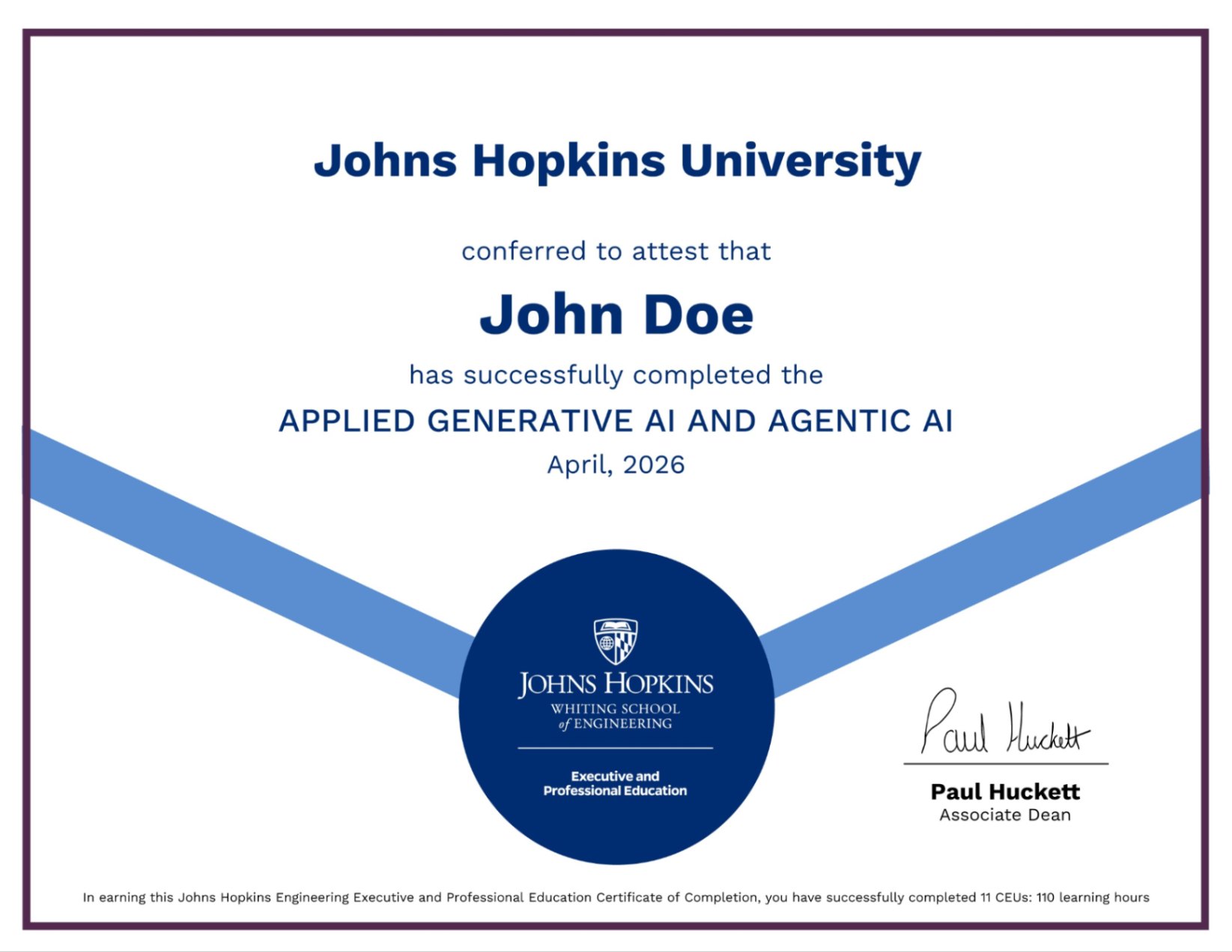
Earn a certificate of completion from Johns Hopkins University

Stand out in a competitive market with a Certificate of Completion in Applied Generative AI and Agentic AI that formally recognizes the expertise developed through rigorous, practical assessments.

certificate image

* Image for illustration only. Certificate subject to change.

Who are the faculty for the program?

Learn from renowned JHU faculty and build technical intuition to make credible, strategic decisions.

  • Dr. Ian McCulloh  - Faculty Director

    Dr. Ian McCulloh

    Director of AI Executive & Professional Education, Johns Hopkins University

    Served as Chief Data Science and MD of AI, Accenture Federal Services

    Author of three books and over 100 peer-reviewed papers

    Know More
    Company Logo
  • Dr. Abhinanda Sarkar  - Faculty Director

    Dr. Abhinanda Sarkar

    Senior Faculty & Director Academics, Great Learning

    30+ years of experience in data science, ML, and analytics.

    Ph.D. from Stanford, taught at MIT, ISI, and IIM Bangalore.

    Know More
    Company Logo

Who are the mentors for weekly live sessions?

Learn from seasoned AI industry mentors to apply concepts and build practical skills.

  •  Dr. Sunil Kumar Vuppala  - Mentor

    Dr. Sunil Kumar Vuppala

    AI Partner, ArisGlobal
    Company Logo
  •  Randhir Agarwal  - Mentor

    Randhir Agarwal

    Director, Data Science & Data Engineering, Samsung Electronics
    Samsung Electronics Logo
  •  Balachandra Deshpande  - Mentor

    Balachandra Deshpande

    Head of Data Science, Enterprise Minds, Inc
    Enterprise Minds, Inc Logo
  •  G Anthony Reina  - Mentor

    G Anthony Reina linkin icon

    Head of Machine Learning, Stealth BioTech Startup
    Company Logo
  •  Jeremy Samuelson  - Mentor

    Jeremy Samuelson

    Executive VP, AI and Innovation, Integrated Quantum Technologies
    Company Logo

What support will you receive to advance in your career?

  • banner-image

    Resume Review

    Optimize your resume to highlight your best skills and experience, ensuring it stands out to recruiters.

  • banner-image

    LinkedIn Profile Review

    Enhance your LinkedIn profile to increase visibility and showcase your expertise.

  • banner-image

    Interview Preparation

    Gain insider perspectives to understand what recruiters look for and learn strategies to excel in interviews.

  • banner-image

    E-Portfolio Development

    Create an e-portfolio to showcase your projects and skills. Share easily to stand out to recruiters.

Course Fees

The program fee is USD 3,450

Advance your career

  • benifits-icon

    Build practical expertise in LLMs, RAG, fine-tuning, and agentic workflows through hands-on learning

  • benifits-icon

    Dedicate 8-10 hours weekly to faculty-led learning, industry mentorship, projects, and case studies

  • benifits-icon

    Learn from AI experts in weekly live online sessions focused on real-world implementation and business impact

  • benifits-icon

    Receive a Certificate of Completion and 11 CEUs from Johns Hopkins University

project icon

Easy payment plans

Avail our EMI options & get financial assistance

  • INSTALLMENT PLANS

    Upto 12 months Installment plans

    Explore our flexible payment plans

    View Plans

Third Party Credit Facilitators

Check out different payment options with third party credit facility providers

affirm splitit

*Subject to third party credit facility provider approval based on applicable regions & eligibility

Take the next step

timer
00 : 00 : 00

Apply to the program now or schedule a call with a program advisor

Unlock exclusive course sneak peek

Application Closes: 30th Jun 2026

Application Closes: 30th Jun 2026

Talk to our advisor for offers & course details

Application process

Our application process close once the requisite number of participants enroll for the upcoming batch

  • steps icon

    1. Fill application form

    Apply by completing the online application form.

  • steps icon

    2. Application screening

    A panel from Great Learning will review your application to determine your fit for the program.

  • steps icon

    3. Join the Program

    After a final review, you will receive an offer for a seat in the upcoming cohort of the program.

Batch start date

  • Online · 25th Jul 2026

    Admission closing soon

Frequently asked questions

Program Details
Faculty, Curriculum, and Projects
Eligibility & Admission
Fee & Payment
Other Queries
Program Details

What is the Applied Generative AI and Agentic AI Program offered by Johns Hopkins University?

The Applied Generative AI and Agentic AI is a 16-week online program offered by Johns Hopkins University. It equips professionals with hands-on expertise in Generative AI, Agentic AI, multi-agent systems, and AI workflows, combining foundational theory with real-world applications such as LLM optimization, RAG systems, and intelligent agents.

What are the highlights of this course?

The Applied Generative AI and Agentic AI from Johns Hopkins University is a comprehensive online learning experience designed to equip professionals with advanced skills in Generative AI and Agentic AI. Here are some of the highlights of the program: • Flexible Online Format - Delivered through recorded video lectures, 12+ live sessions with industry mentors, and live masterclasses, including 4 by JHU faculty and 2 by industry experts on multi-modal AI applications and Anthropic • World-Class Faculty - Learn from renowned faculty and industry experts with experience leading AI initiatives at Fortune 500 companies • Research-Driven Curriculum - Covers Generative AI and Agentic AI with 3 hands-on projects and 12+ real-world case studies for practical, industry-relevant learning • In-Demand Tools and Libraries - Gain proficiency in Python, ChatGPT, LangChain, LangGraph, VSCode, Google Colab, DeepEval, Cursor, Agentic RAG, MCP, ReAct, DeepEval for Agents, Neuro-symbolic AI, A2A, CrewAI, Autogen, and Agents with SLMs • Certificate from Johns Hopkins University - Earn a certificate upon successful program completion • GL Labs - Get OpenAI API access to experiment, prototype, and build AI applications without complex setup or billing

What are the key outcomes of the Applied Generative AI and Agentic AI course online?

By the end of the course, you will be able to: • Define AI terms, concepts, and capabilities across machine learning, deep learning, and generative AI • Build Python skills for AI, including coding, debugging, and rapid prototyping • Apply machine learning and generative AI to solve problems, build models, and evaluate performance • Use prompt engineering, embeddings, and RAG to improve LLM outputs • Design, fine-tune, and evaluate AI systems, agents, and multi-agent workflows • Assess AI ethics, bias, safety, and real-world applications across domains

What is the duration of this Applied Generative AI and Agentic AI program ?

The duration of the Applied Generative AI and Agentic AI program is 16 weeks.

What is the structure and format of this program?

The Applied Generative AI and Agentic AI program is offered in a flexible online format that includes recorded video lectures, 12+ Live Sessions with Industry mentors, 4 masterclasses by JHU faculty, 2 masterclasses by industry experts, and a hands-on lab environment.

Will I receive a certificate from Johns Hopkins University upon completing this program?

You will receive a Certificate of Completion from Johns Hopkins University upon successful completion of the program. This is a certificate and not a certification.

Will I receive any learning and Academic support in JHU’s Generative AI and Agentic AI course?

Yes, the Applied Generative AI and Agentic AI program offers comprehensive learning support, including: • Personalized Assistance - Dedicated program manager support to help you stay on track and manage your learning journey effectively • Academic Support - Access to the GL community, project discussion forums, and peer groups for collaborative learning

What is the expected weekly time commitment for this program?

The weekly commitment will be 8-10 hours per week.
Faculty, Curriculum, and Projects

What topics are covered in the curriculum of this Generative AI and Agentic AI course by JHU?

The curriculum follows a modular structure, and the topics in the curriculum of this Applied Generative AI and Agentic AI program include • Pre-Work - Python, AI fundamentals, and Generative AI basics • Module 1 - AI, Generative AI, and Agentic AI foundations, including AI-assisted Python coding and ML workflow development • Module 2 - Building and evaluating GenAI workflows, including prompt engineering, RAG, and fine-tuning • Module 3 - Secure agentic AI workflows, including single-agent systems, evaluation, and multi-agent orchestration • Self-Paced Module - Build practical AI skills with NLP foundations and transformers

Is there any project included?

Yes, the program includes 3 hands-on projects and 12+ case studies focused on applying Generative AI and Agentic AI models to real-world business scenarios. • Finance | Personal Finance Coach and Spending Analyzer - Build a GenAI-powered application that analyzes financial data, categorizes transactions, and delivers personalized budgeting insights through a conversational interface • Healthcare | Clinical Decision Support System - Develop a RAG-based clinical assistant that processes medical knowledge and patient data to provide accurate, evidence-backed responses for decision-making • Cybersecurity | Threat Detection and Response Agent - Design a multi-agent AI system that monitors security logs, detects threats, and automates investigation workflows. The solution prioritizes alerts, generates response playbooks, and escalates incidents with detailed evidence.

Who will be teaching this course?

This course is taught by renowned academicians and leading AI experts with real-world experience in leading AI practices at Fortune 500 companies. Here are some of the faculty and industry mentors teaching this course: Dr. Ian McCulloh Faculty Leader in AI and Strategy, Johns Hopkins University Dr. Pedro Rodriguez Faculty Member, Johns Hopkins University Dr. Iain Cruickshank Faculty Member, Johns Hopkins University Dr. Pavankumar Gurazada Senior Faculty, Academics, Great Learning Dr. William Gray-Roncal Principal Research Scientist, Johns Hopkins University Applied Physics Laboratory Dr. Shelby Wilson Senior Data Scientist, Johns Hopkins University Applied Physics Laboratory Note: This is an indicative list and is subject to change based on the availability of faculty and mentors
Eligibility & Admission

What are the rankings of JHU?

JHU is a world-renowned university, which is ranked #7 in National University Rankings (U.S. News & World Report, 2026). #14 Best Global University (U.S. News & World Report, 2026) and #2 Computer Information Technology (U.S. News & World Report, 2026)

What is the role of Great Learning in this program?

The Applied Generative AI and Agentic AI program at Johns Hopkins University is delivered in collaboration with Great Learning. Great Learning is a professional learning company with a global footprint impacting 15 million+ learners across 170+ countries. Its mission is to make professionals around the globe proficient and future-ready. This program leverages JHU's leadership in innovation, science, engineering, and technical disciplines developed over years of research, teaching, and practice. Great Learning manages the enrollments and provides industry experts, student counselors, course support, and guidance to ensure students get hands-on training and live personalized mentorship on the application of concepts taught by the JHU faculty.

How does this course help in transitioning to GenAI roles?

This Applied Generative AI and Agentic AI Program offers a practical, hands-on approach to mastering Generative AI and Agentic AI. You will • Learn from JHU faculty and industry leaders • Build real-world generative AI applications and workflows • Work on projects and case studies aligned with business needs • Gain expertise in LLMs, RAG systems, and workflow automation • Earn a certificate and 11 CEUs from Johns Hopkins University Together, these elements equip you with the skills, portfolio, and credibility needed to confidently transition into GenAI roles across industries.

Who is this program for?

This Applied Generative AI and Agentic AI Program is designed for individuals who are looking to explore how Generative AI and Agentic AI can address real-world business problems, and is ideal for: • Technology Professionals • Data Professionals • Technology Consultants and Technical Managers • STEM (Science, Technology, Engineering, and Mathematics) Graduates

Can I pursue this program while working full-time?

Yes. The program is designed for working professionals. Classes are scheduled on weekends, allowing you to balance your coursework with full-time professional commitments.

What is the admission process for the program?

The admissions for the program close once the required number of participants enroll. Apply early to secure your spot. Here are the steps for admissions: • Apply by completing the online application form • Your application will be reviewed by a panel from Great Learning to assess program fit • Receive an offer after final review for a seat in the upcoming cohort

Do I need prior experience to join this AI course?

You don’t need deep prior experience in AI to get started. The Pre-Work Module is designed to help you build the basics before moving into advanced topics like Generative AI, Agentic AI, and AI workflows. This program is especially suitable for learners exploring beginner Agentic AI courses with project work, as it combines foundational concepts with hands-on projects and real-world case studies. It introduces you to Python, core AI concepts, and the fundamentals of Generative AI, along with guided practice using AI-assisted coding tools. This ensures you not only understand the basics but also learn how to use AI effectively in building LLM-powered applications, RAG systems, and multi-agent workflows.
Fee & Payment

What is the total fee for the program?

The total fee for the Applied Generative AI and Agentic AI Program is USD 3450.

Are payment plans or financing options available?

Yes, flexible EMI options and financial assistance may be available to eligible candidates. Please check with the admissions team during your application process.

Does the fee include the certificate and all learning materials?

The program fee includes access to all course materials, live masterclasses, mentorship, and a certificate of completion from Johns Hopkins University.

What are the different types of Generative AI models covered in this program?

The program introduces learners to key types of generative AI models, including Large Language Models (LLMs) and transformer-based models. You will also explore how these models are applied in real-world use cases such as content generation, automation, and AI agents.
Other Queries

What are CEUs, and how are they useful?

Upon successful completion of the program, you will earn 11 Continuing Education Units (CEUs) along with a certificate of completion from Johns Hopkins University. CEUs are a measure of instructional time and reflect the estimated time an average student will spend completing the mandatory components of a course. CEUs are awarded upon successfully completing all course requirements, which may include assessments, assignments, evaluations, or a final project. Earning CEUs allows professionals to demonstrate their commitment to continuous learning and skill advancement

How is Generative AI being used across industries?

Generative AI has become essential in almost every sector to automate processes and drive innovation. By learning how to use AI effectively, professionals can contribute to these industry shifts: • Healthcare - Generate medical summaries, improve patient communication, and support drug discovery insights • Finance - Automate reporting, enable fraud detection, and deliver personalized financial advice • Marketing - Create ad copy, product descriptions, and targeted campaigns • Technology - Power AI copilots, code generation, and virtual assistants • Retail & E-commerce - Enable personalized recommendations and chatbot support • Media & Entertainment - Generate scripts, music, visual assets, and game narratives

Got more questions? Talk to us

Connect with our advisors and get your queries resolved

Speak with our expert +1 410 584 3973 or email to office-appl-genai-gl@jhu.edu

career guidance
chat icon chat icon
🚀 Have Questions?
Chat and get instant answers with our AI assistant

chat-icon

GL-AI

Your 24*7 AI Assistant

Setting up your chat…
Just a moment.

Hello,
I am GL· AI, your AI-powered assistant, designed to answer queries about the program.

If you need more information or guidance

Learn more about the course

Get details on syllabus, projects, tools, and more

Name
Email
Mobile Number

By submitting this form, you consent to our Terms of Use & Privacy Policy and consent to be contacted via email, phone (including by AI-generated/pre-recorded voice calls), SMS, or WhatsApp.

Phone Icon

Thanks for your interest!

An advisor will be reaching out to you soon.

Not able to view the brochure?

View Brochure