AI Security Program for LLMs, RAG, AI Agents, and AI Governance
Certificate Program in AI Security
 Application closes on
24th Nov 2026

 Speak with our expert
+14109365774




Learn more about the course
Get details on syllabus, projects, tools, and more

Certificate Program in AI Security
Application closes 24th Nov 2026
Why should you join this program?
-

Flexible Learning Paths
This program offers learners the flexibility to learn with or without code, featuring dynamic variations of activities suited for technology professionals and strategy leaders alike.
-
Learn from JHU, a Leading US Research University
Ranked #2 in Computer Information Technology, #9 National University, and #17 Best Global University, reflecting JHU's leadership in research and innovation. (2027 Rankings)


LEARNING OUTCOMES
What will you learn to build and apply?
Through a structured learning journey, you will build the capability to:
-
Analyze the AI threat landscape and design secure architectures to resist misuse and multimodal attacks
-
Understand AI security frameworks and address prompt injection, jailbreaks, adversarial inputs and model abuse
-
Understand AI data pipeline security through data lineage, privacy controls, integrity, and attack mitigation
-
Understand alignment techniques, trust boundaries, tool abuse, and multi-agent risks in agentic AI systems
-
Assess AI models for safety, fairness, and robustness, and explore runtime guardrails and jailbreak testing
-
Explore AI governance for secure delivery, compliance monitoring, human oversight, and regulatory requirements
Earn a Certificate of Completion from Johns Hopkins University
-
#9 National University Rankings
U.S. News & World Report, 2027
-
#2 Computer Information Technology
U.S. News & World Report, 2027
-
#11 Most Innovative Schools
US News and World Report, 2027
-
#17 Best Global University
U.S. News & World Report, 2027
-
#1 Biomedical Engineering Program
US News and World Report, 2027


KEY PROGRAM HIGHLIGHTS
Why choose this program?
-
Learn from Johns Hopkins University Faculty
Learn through recorded lectures and attend monthly faculty-led masterclasses to secure AI systems across their entire lifecycle.
-
Interactive Mentorship by Industry Experts
Learn from experts through weekly live mentorship sessions focused on industry best practices to secure AI and Agentic AI systems.
-
Comprehensive Curriculum
Learn from an in-depth curriculum that covers security across the entire AI development lifecycle, from data and model design through deployment and monitoring.
-
Dynamic Hands-On Activities
Learn to secure modern AI agents and LLM-based architectures through dynamic code, no-code, and low-code projects, lab activities, tools, and technologies.
-
Earn a Recognized Credential from Johns Hopkins University
Earn a Certificate of Completion and 6.3 CEUs from Johns Hopkins University upon successful completion of the program.
-
Personalized Program Support
Get personalized assistance from a dedicated Program Support Team and AI-assisted learning support through Great Learning.


Skills you will learn
Agentic AI Security
Runtime Guardrail Integration
Tool Abuse Testing
Guardrail Implementation
AI Threat Modeling
Automated Agentic Workflow
AI Governance & Compliance
Model Card Analysis
AI Security Forensics
Multi-Agent Trust Boundary & Message Verification
Agentic AI Security
Runtime Guardrail Integration
Tool Abuse Testing
Guardrail Implementation
AI Threat Modeling
Automated Agentic Workflow
AI Governance & Compliance
Model Card Analysis
AI Security Forensics
Multi-Agent Trust Boundary & Message Verification
view more
- Overview
- Learning Journey
- Curriculum
- Projects
- Tools
- Certificate
- Faculty
- Mentors
- Fees
- FAQ
Who is the program for?
This program is exclusive to learners in eligible JHU AI Certificate Programs, in roles such as:
-
AI and Data
Professionals building or deploying AI solutions who want to develop system-level risk awareness and skills to secure AI across its lifecycle.
-
Cybersecurity and Tech
Professionals who want to expand their security expertise to LLMs, RAG architectures, AI agents, model supply chains, and AI workflows.
-
Leadership and Governance
Professionals who need to govern risk, ensure compliance, and evaluate secure architectures without writing code.
How is the program learning experience?
Our pedagogy is designed to ensure a holistic learning experience
-
Learn from Experts
Learn from JHU faculty and industry experts to secure AI and Agentic AI systems
-
Learn By Doing
Apply Agentic AI concepts through hands-on projects and real-world case studies
-
Earn a University Credential
Earn a certificate of completion and 6.3 CEUs from Johns Hopkins University
-
Get Support Throughout the Learning Journey
Program managers will help you stay on track, navigate key milestones & complete the program




Comprehensive curriculum
The curriculum for the Certificate Program in AI Security, crafted by expert faculty at Johns Hopkins University and leading industry experts, covers security across the AI development lifecycle, from data and model design through deployment and monitoring, equipping you with the skills to secure AI systems at every stage.
-
Code & No-Code
Tools and Techniques
-
Dynamic
Projects and Activities
-
Monthly
Faculty-Led Masterclasses
PREPARATORY MODULE
This preparatory module ensures that learners have the technical foundations required to begin the program. They will build proficiency in Python programming, understand the fundamentals of AI systems, and gain foundational knowledge of cybersecurity principles.
MODULE 01: SECURE AI DESIGN AND THREAT LANDSCAPE
In this module, learners will build a strong foundation in the different types of attacks that target AI systems. Learners will be introduced to the CIA Triad, which is the DNA of cybersecurity. They will explore different approaches to building secure architecture for AI applications, and examine why strict trust boundaries and airlocks are essential. Learners will also shift from reactive patching to privacy by design, containing the blast radius early in the AI lifecycle.
WEEK 01: AI SECURITY BY DESIGN
MODULE 02: SECURING THE AI BUILD LIFECYCLE
In this module, learners will secure the data pipeline, protecting the crown jewels of an AI system against hidden backdoors and compromised training inputs. They will implement these controls to build systemic resilience across every stage of development and deployment, moving step-by-step through the hands-on engineering phase of the AI lifecycle. Learners will also verify data sources, precisely align model behavior, and deploy runtime guardrails to keep AI applications safe, compliant, and under control.
WEEK 02: DATA INTEGRITY AND SUPPLY CHAIN SECURITY
WEEK 03: MODEL EDITING – ABLATION, ALIGNMENT, AND SUPERVISED FINE-TUNING
WEEK 04: LEARNING BREAK
WEEK 05: SECURE DEVELOPMENT OF MODELS AND AGENTS
WEEK 06: MODEL RESILIENCE AND GUARDRAILS
WEEK 07: LEARNING BREAK
MODULE 03: DEPLOYMENT, OPERATIONS, AND GOVERNANCE
In this module, learners will unpack what it truly means to own a model in production, where performance can drift, integrations can crack, and compliance rules shift without warning. Continuous governance transforms compliance from a static checklist into an active, scalable defense against performance drift and operational risk. From monitoring real-time model behavior to managing third-party risk and building human oversight that scales, this module prepares learners to keep enterprise AI trustworthy long after it goes live.
WEEK 08: INFRASTRUCTURE SECURITY AND AI SECURITY OPERATIONS
WEEK 09: AI GOVERNANCE AND MONITORING
SELF-PACED MODULE: CLAUDE-BASED AI WORKFLOWS
This module is designed to build practical capability in applying Generative AI and Agentic AI using the Claude ecosystem in real-world contexts. Participants build the ability to design, execute, and evaluate AI-driven workflows for real-world applications, supported by structured learning. *Disclaimer: Access to tools within the Claude ecosystem is not included as part of the program. Participants may choose to explore advanced capabilities independently.
Design and Execute AI Workflows
Build and Deploy AI Systems at Scale
MASTERCLASSES
Learn through monthly live masterclasses from Johns Hopkins University faculty
ATTACK ON AI
SECURE ARCHITECTURE AND DEPLOYMENT OF AI AGENTS
ANTHROPIC
SAMPLE CODE-BASED PROJECTS
Note: This is an indicative list of projects and is subject to change.
BACKDOOR IMPLANTATION VIA DATA POISONING: DETECTION, REMOVAL, AND INCIDENT RESPONSE
ABLATION AND DISTILLATION ON A TABULAR FRAUD-DETECTION MODEL FOR SECURITY AND BIAS REMEDIATION
EXPLORING TOOL ABUSE SCENARIOS IN AGENTIC AI AND RECORDING RESULTS
SAMPLE NO-CODE / LOW-CODE PROJECTS
Note: This is an indicative list of projects and is subject to change.
BUILDING AND SECURING AN AI WORKFLOW USING A LOW-CODE PLATFORM
GENERATING AN AI BILL OF MATERIALS (AI-BOM) USING NO-CODE TOOLS
MANAGING SUPPLY CHAIN RISKS BY ANALYZING MODEL CARDS
Note: The curriculum listed above is indicative and subject to updates as technology evolves.
What activities will you learn from?
Build hands-on AI security skills through immersive labs, and real-world case studies.

SAMPLE LAB ACTIVITY
Threat Modeling and Attack Testing on an LLM Application
Description
Build a threat model for a provided LLM-based application by mapping its attack surface and data flows. Design and execute a set of prompt injection and jailbreak attacks to validate identified risks, referencing established LLM security frameworks.
Skills you will learn
- LLM Threat Modeling
- Prompt Injection Testing
- Attack Surface Mapping
- Risk Assessment

SAMPLE LAB ACTIVITY
Implementing Runtime Guardrails on an LLM Application
Description
Apply runtime guardrails to a baseline LLM application to enforce topic boundaries, block adversarial inputs, and prevent data leakage. Run a simulated incident to test detection and response capabilities.
Skills you will learn
- NVIDIA NeMo Guardrails
- Guardrail Implementation
- Input/Output Validation
- AI Monitoring
- Incident Simulation

SAMPLE LAB ACTIVITY
Building an AI Compliance Mapping Matrix
Description
Construct a comparative matrix mapping major AI regulations and frameworks against common control areas such as risk, transparency, and accountability. Use the matrix to identify compliance gaps and overlaps relevant to real-world AI deployments.
Skills you will learn
- AI Governance and Compliance (GRC)
- Regulatory Analysis
- Control Mapping
- Compliance Assessment

SAMPLE LAB ACTIVITY
Prompt Airlines: AI Security CTF Challenge
Description
Participate in a guided Capture the Flag challenge focused on interacting with and exploiting LLM-based applications. Practice identifying vulnerabilities and applying adversarial thinking in a safe, gamified environment.
Skills you will learn
- Prompt Injection
- Jailbreak Techniques
- LLM Red Teaming
- Guardrail Bypass Analysis


This is an indicative list of lab activities and case studies and is subject to change.
What no-code and code tools will you explore?
Work with a comprehensive suite of modern code-based or no-code tools
-
Claude
-
OpenAI
-
Gemini Notebook
-
Teachable Machine
-
n8n
-
KNIME
-
Zapier
-
Google Colab












This is an indicative list, and relevant tools are reviewed for inclusion periodically. Access to certain tools may require additional subscriptions or fees.
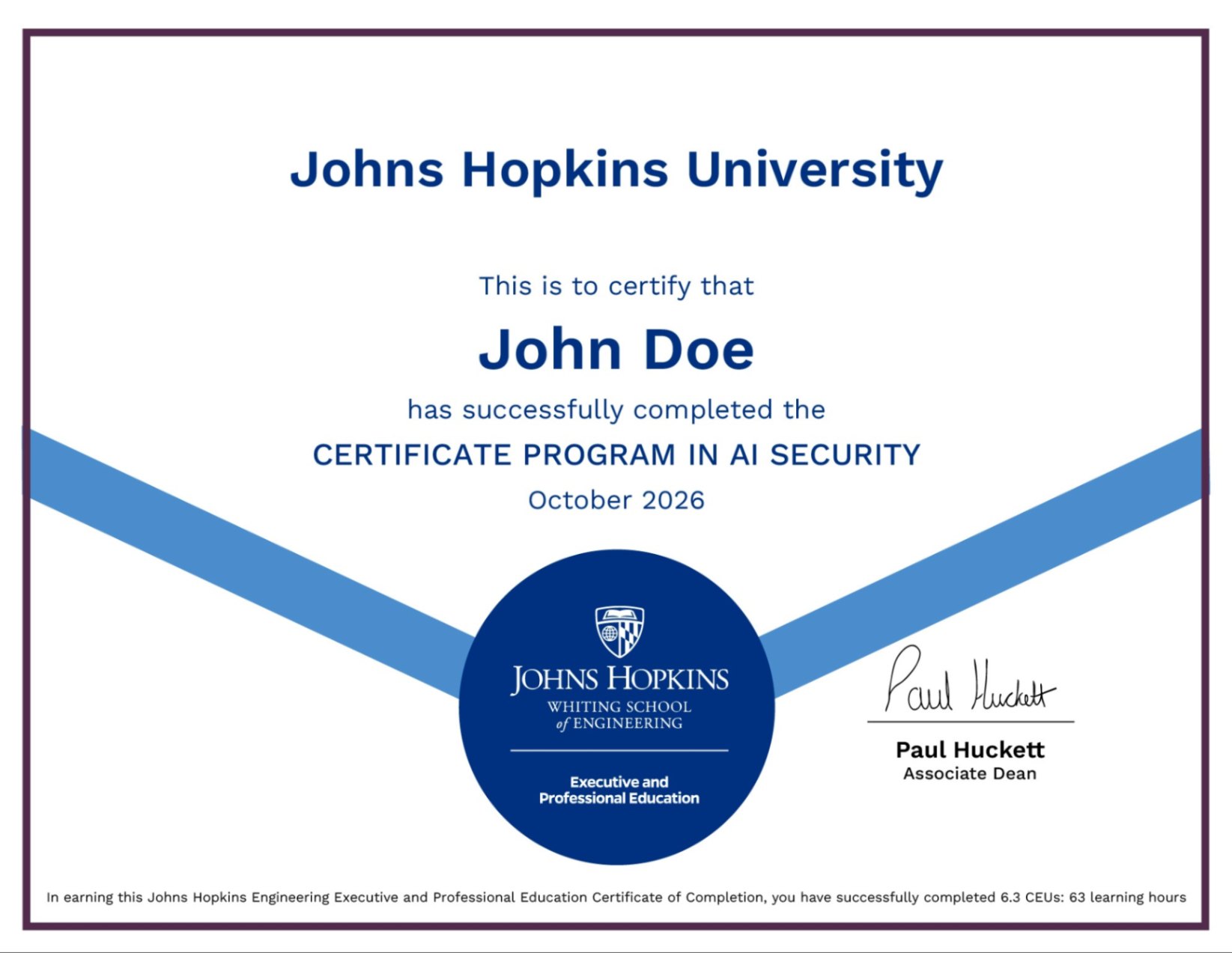
Earn a Certificate of Completion from Johns Hopkins University
Earn a globally recognized credential from a top U.S. university and showcase it to your network.
* Image for illustration only. Certificate subject to change.
Who are the faculty for the program?
Learn from renowned JHU faculty and build the intuition and strategic judgment to secure modern AI systems
-
Ian McCulloh, Ph.D.
Director, AI Executive & Professional Education, Johns Hopkins University
Served as Chief Data Scientist & MD of AI, Accenture Federal Services
Author of three books and over 100 peer-reviewed papers
Know More
-
Kiran Chittargi
Adjunct Faculty - Computer Science, Johns Hopkins University
Program Director at Microsoft
Global Expansion Lead for Azure
Know More
-
Dr. Pedro Rodriguez
Faculty, Johns Hopkins University AI Program
Leads the Information Science Branch at the JHU's Applied Physics Lab
20+ years of expertise in AI/ML algorithms
Know More
-
Dr. Art Sedighi
Adjunct Faculty, Johns Hopkins University
Ph.D. in Systems Engineering and in Cybersecurity/Cryptography
AI and security expert focused on LLM security, & cloud architectures
Know More








 LinkedIn Profile
 University Link
Who are the mentors for weekly live sessions?
Learn from seasoned AI industry mentors to apply concepts and build practical skills
-
Aniket Amdekar
General Manager - Cyber Defence Education Great Learning
-
Ivan Marchany
Cyber Threat Engineer, Raymond James





Note: This is an indicative list and is subject to change based on the availability of mentors.
Program Fee
The program fee is USD 1,800
Invest in your career
-
Build hands-on expertise in operationalizing responsible AI practices across the enterprise
-
Dedicate 8-9 hours weekly to faculty-led learning, industry mentorship, projects, and case studies
-
Learn from AI experts in weekly live online sessions focused on real-world case studies
-
Receive a Certificate of Completion and 6.3 CEUs from Johns Hopkins University


Application process
Applications close once the required number of participants enroll. Apply early to secure your spot
-
Fill application form
Apply by filling out a simple online application form.
-
Review process
A panel from Great Learning will review your application to determine your fit for the program.
-
Join program
Receive an offer for a seat in the upcoming cohort of the program post a final review.


Exclusive to JHU AI Certificate Program learners
- This program is exclusively available to learners enrolled in AI certificate programs offered in collaboration with Johns Hopkins University.
- Contact your Program Advisor to understand which programs are eligible for enrollment.
Frequently Asked Questions
What does the Johns Hopkins University Certificate Program in AI Security cover?
The nine-week online program covers AI threat modeling, secure AI architecture, data integrity, model alignment, adversarial testing, runtime guardrails, AI security operations, monitoring, and governance. It combines hands-on labs, real-world case studies, and practical projects to help participants develop skills in securing AI systems across their development lifecycle. Participants can choose code-based or no-code/low-code learning activities. Note: The curriculum topics listed above are indicative and subject to updates as technology evolves.
What certificate do participants receive after completing the program?
Participants who successfully complete the program receive a Certificate of Completion from Johns Hopkins University and 6.3 Continuing Education Units (CEUs). They also build a shareable e-portfolio showcasing their AI security skills and practical project work.
How is the JHU AI Security Program different from other AI security courses?
The Johns Hopkins University (JHU) Certificate Program in AI Security stands out for its features like:
● Flexible learning formats: Code-based and no-code/low-code options cater to technical professionals and business leaders.
● Advanced AI security coverage: Topics include LLM security, MCP trust boundaries, model alignment, AI supply chain security, and agentic AI threats.
● Structured mentorship: Participants benefit from weekly mentored learning sessions, monthly JHU faculty masterclasses, discussion forums, and AI-assisted learning support through Great Learning.
● University credential and practical experience: Successful participants earn a Certificate of Completion and 6.3 CEUs from JHU, while building a shareable e-portfolio through hands-on projects and a capstone.
Who should consider this AI security program?
The program is designed for AI and data professionals who want to secure the systems they build, Cybersecurity and technology professionals who want to expand their expertise to AI-specific threats, and AI leadership and strategy professionals who need to manage AI risks, governance, and compliance.
Who teaches the Johns Hopkins University AI Security program?
The program features Johns Hopkins University faculty and industry experts. The brochure identifies Dr. Ian McCulloh, Kiran Chittargi, Dr. Pedro Rodriguez, and Dr. Art Sedighi among the faculty. Participants also benefit from monthly faculty-led masterclasses and weekly mentored learning sessions with industry experts.
Does the program cover LLM security, prompt injection, and jailbreak attacks?
Yes. The program covers LLM security, prompt injection, jailbreak assessments, adversarial inputs, model extraction, and defenses against AI misuse. Participants also explore frameworks such as MITRE ATLAS and the OWASP Top 10 for LLMs to understand and assess AI-specific threats.
What projects can I work on in the AI security program?
The program includes code-based and no-code/low-code project options. Examples include detecting and removing backdoors introduced through data poisoning, using model ablation and distillation for security and bias remediation, testing tool-abuse scenarios in Agentic AI, and building and securing automated AI workflows. Note: The projects listed above are indicative and subject to updates to the curriculum.
What practical tools and frameworks are covered?
The program introduces a range of tools and technologies across its code-based and no-code/low-code learning formats. No-code tools: Claude, OpenAI API, Gemini Notebook, Teachable Machine, Amazon CloudWatch, n8n, KNIME, Zapier, and Trello. Code-based tools: Python, Google Colab, VS Code, Jupyter, OWASP Threat Dragon, Hugging Face, Databricks, DSPy, Garak, LangChain, LlamaIndex, and NVIDIA. The program also explores security frameworks and techniques, including MITRE ATLAS, OWASP Top 10 for LLMs, threat modeling, prompt injection assessments, and runtime guardrails. Note: This is an indicative list, and relevant tools are reviewed for inclusion periodically. Access to certain tools may require additional subscriptions or fees.
Do I need coding skills to learn AI security?
The program offers both code-based and no-code/low-code learning formats, catering to technology professionals as well as strategy and leadership professionals. The code-based format covers tools and technologies such as Python, Jupyter, LangChain, and Hugging Face, while the no-code/low-code format includes visual workflow tools such as n8n, KNIME, and Zapier. The preparatory module covers Python programming fundamentals, foundations of AI, and foundations of cybersecurity. The program does not specify prior coding experience as an eligibility requirement.
Can non-technical managers learn AI security without coding?
Yes. The program is designed for senior leaders, CXOs, and governance professionals who want to govern AI risks, ensure compliance, and evaluate secure AI architectures without writing code.
How do I enroll in the AI security program?
The enrollment involves a three-step process: complete an online application, have the application reviewed by a Great Learning panel, and receive an offer letter if selected. Contact Great Learning for current application requirements and available enrollment dates.
What is the fee for the Johns Hopkins University Certificate Program in AI Security?
The program fee is USD 1,800.
Are payment plans or financial assistance available for the AI security program?
Please contact a Program Advisor for information about payment plans, promotional offers, and financial assistance eligibility. Availability and applicable terms should be confirmed directly with the advisor.
What career opportunities can AI Cybersecurity skills support?
AI cybersecurity skills can support career development in areas such as AI security engineering, AI security assessment, application security, AI red teaming, AI risk management, and AI governance. Relevant opportunities depend on your existing experience, technical skills, and individual employer requirements.
Is AI security training relevant for professionals working with generative AI and AI agents?
Yes. Generative AI applications and AI agents can introduce risks through prompts, connected tools, external data sources, and autonomous actions. AI security training helps professionals identify these vulnerabilities, test defenses, establish access controls, and implement safeguards for LLM, RAG, and agentic systems.
How can AI security training help technology leaders manage AI risk?
AI security training can help technology leaders evaluate AI use cases, understand system-level vulnerabilities, assess third-party AI risks, establish human oversight, and align security practices with regulatory frameworks. The JHU AI Security program includes strategic risk assessment and no-code/low-code activities for leaders who oversee AI adoption.
How is AI security different from traditional Cybersecurity?
Traditional cybersecurity focuses on protecting networks, applications, infrastructure, and data. AI security also addresses AI-specific risks, including jailbreaks, adversarial inputs, model manipulation, retrieval-augmented generation (RAG) vulnerabilities, and misuse of autonomous AI agents.
What is the difference between AI security and LLM security?
AI security covers the broader protection of AI systems, including models, data pipelines, infrastructure, applications, and autonomous workflows. LLM security focuses on risks specific to large language models, such as prompt injection, jailbreaks, sensitive data exposure, model misuse, and unsafe outputs. LLM security is an important part of the wider AI cybersecurity landscape.
How can AI and data professionals learn to secure the AI systems they build?
AI and data professionals can develop AI security skills by learning threat modeling, secure LLM and RAG architecture, data integrity controls, model alignment, and runtime defense. The Johns Hopkins University program helps AI practitioners extend their expertise from building and deploying AI systems to identifying and mitigating vulnerabilities across the AI lifecycle.
What should Cybersecurity professionals learn to protect LLMs and AI agents?
Cybersecurity professionals should understand prompt injection, jailbreaks, data poisoning, model extraction, AI supply chain risks, and agentic tool abuse. They should also learn secure deployment, adversarial testing, runtime guardrails, and AI incident response. These topics are covered in the Johns Hopkins University Certificate Program in AI Security.
How can CTOs and CISOs evaluate AI security risks without coding?
CTOs and CISOs can evaluate AI security risks by assessing business value against security and privacy risks, reviewing AI architectures and third-party dependencies, establishing governance controls, and defining human oversight. The program's no-code/low-code activities are designed to help technology leaders make informed decisions about secure AI adoption.
How can AI leadership and strategy professionals ensure secure AI adoption?
AI leadership and strategy professionals can integrate security into AI planning by identifying risks early, assessing model and vendor dependencies, establishing responsible AI requirements, and defining appropriate oversight for automated systems. The program addresses these needs through strategic risk assessment, AI governance, secure architecture concepts, and practical no-code/low-code learning activities.
How can governance, risk, and compliance professionals prepare for AI regulations?
Governance, risk, and compliance professionals can develop relevant skills in AI risk assessment, responsible AI, supply chain governance, monitoring, and regulatory compliance. The program covers AI governance, global regulatory requirements, compliance monitoring, third-party risk management, and human oversight to help professionals understand and address AI-related governance responsibilities.
Delivered in Collaboration with:

Johns Hopkins University is collaborating with online education provider Great Learning to offer the Certificate Program in AI Security. Great Learning is a professional learning company with a global footprint in 170+ countries. Its mission is to make professionals around the globe proficient and future-ready. This program leverages JHU's leadership in innovation, science, engineering, and technical disciplines developed over years of research, teaching, and practice. Great Learning manages the enrollments and provides industry experts, student counselors, course support and guidance to ensure students get hands-on training and live personalized mentorship on the application of concepts taught by the JHU faculty.
 Application closes
24th Nov 2026