Build AI-Powered Workflows and Intelligent Agents Without Coding from JHU
No-Code Generative AI and Agentic AI
 Application closes on
22nd Oct 2026
Application closes on
22nd Oct 2026

 Speak with our expert
+14104988288
Speak with our expert
+14104988288




Receive Your Brochure Copy
Get details on syllabus, projects, tools, and more
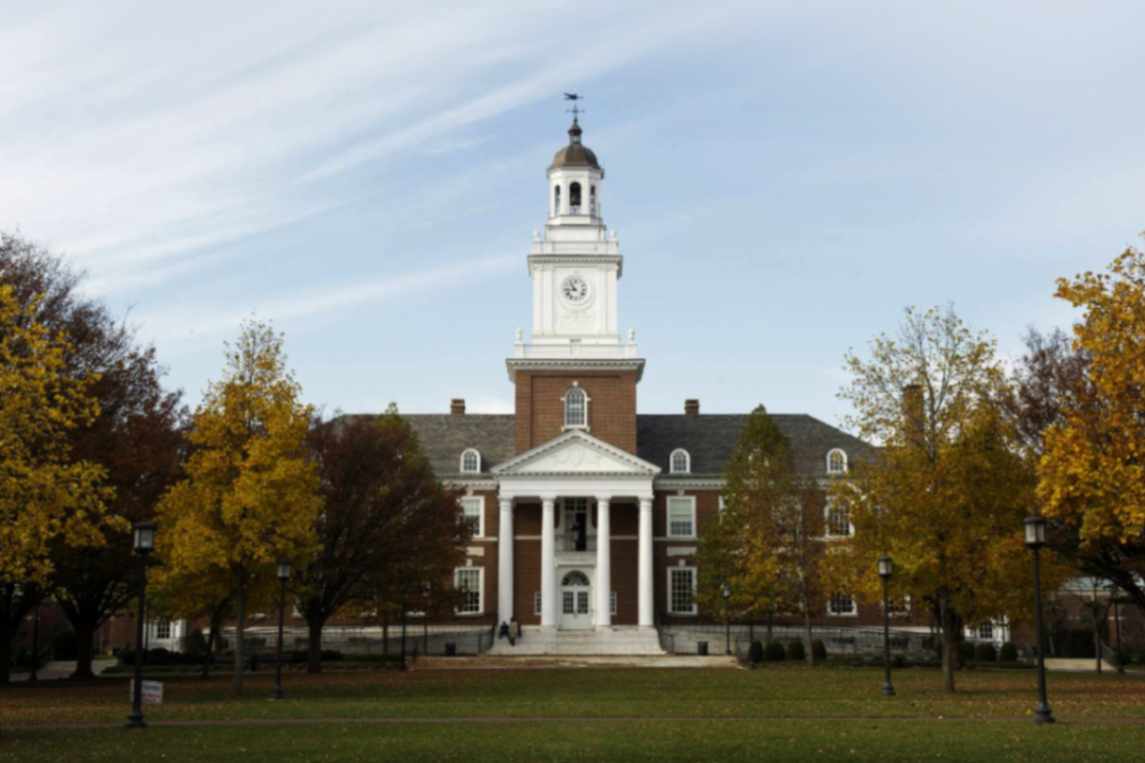
No-Code Generative AI and Agentic AI
Application closes 22nd Oct 2026
Why should you join this program?
-

No-Code Program to Build AI Agents and Intelligent Workflows
Build practical expertise in Generative AI and Agentic AI with Johns Hopkins University faculty and industry experts through real-world projects and case studies using no-code tools.
-
Learn from JHU, a Leading US Research University
Ranked #7 National University, #14 Best Global University, #2 in Computer Information Technology, reflecting JHU's leadership in research and innovation. (2026 Rankings)


PROGRAM OUTCOMES
What will you learn to build and apply?
Through a structured learning journey, you will build the capability to:
-
Understand key concepts in NLP, Generative AI, and Large Language Models (LLMs) through a no-code approach
-
Understand the fundamentals of creating effective AI prompts in business scenarios
-
Identify strategic business opportunities and industry use cases of GenAI and smart AI agents across sectors
-
Understand Responsible AI principles, risks, ethics, and compliance challenges
-
Understand AI agents, their evolution, and how they reason, act, use tools, and memory with real examples
-
Understand how no-code tools and RAG enable AI workflows and connect AI with business data
Earn a Certificate of Completion from Johns Hopkins University
-
#9 National University Rankings
U.S. News & World Report, 2027
-
#2 Computer Information Technology
U.S. News & World Report, 2027
-
#11 Most Innovative Schools
US News and World Report, 2027
-
#17 Best Global University
U.S. News & World Report, 2027
-
#1 Biomedical Engineering Program
US News and World Report, 2027


KEY PROGRAM HIGHLIGHTS
Why Choose This Program?
-
Learn from Johns Hopkins University Faculty
Learn through recorded lectures and attend faculty-led masterclasses covering Generative AI, Agentic AI, AI governance, emerging AI trends.
-
Interactive Mentorship by Industry Experts
Learn from AI experts through mentorship sessions focused on practical applications, implementation challenges, and industry best practices.
-
No-Code AI Curriculum
Build practical expertise in Prompt Engineering, RAG, AI workflows, intelligent agents, and AI evaluation, without programming.
-
Real-World Projects & Case Studies
Work on projects and case studies across sales, healthcare, finance, HR, logistics, customer support, and operations using AI workflows and agents.
-
Earn a Recognized Credential from Johns Hopkins University
Earn a Certificate of Completion and 9 CEUs from Johns Hopkins University upon successful completion of the program.
-
Personalized Program Support
Receive guidance from a dedicated Program Manager and academic support from subject matter experts.


Skills you will learn
Retrieval-Augmented Generation (RAG)
Prompt Engineering
Natural Language Processing (NLP)
Multi-Agent Systems
Agent Orchestration
Agentic AI Systems
GenAI Workflow Automation
Sentiment Analysis
LLM Applications
Classification Modeling
Data Preprocessing
Exploratory Data Analysis
Rule-Based Validation
Retrieval-Augmented Generation (RAG)
Prompt Engineering
Natural Language Processing (NLP)
Multi-Agent Systems
Agent Orchestration
Agentic AI Systems
GenAI Workflow Automation
Sentiment Analysis
LLM Applications
Classification Modeling
Data Preprocessing
Exploratory Data Analysis
Rule-Based Validation
view more
- Overview
- Learning Journey
- Curriculum
- Projects
- Tools
- Certificate
- Faculty
- Mentors
- Reviews
- Fees
- FAQ
Who is the program for?
Professionals aiming to automate workflows and drive business impact with GenAI & Agentic AI via no-code tools
-
Business Leaders and Functional Heads
Who need to automate enterprise-wide workflows, implement Agentic AI strategies, and drive organizational productivity without deep coding expertise.
-
Technology Professionals and Team Leads
Who need to rapidly prototype, evaluate, and orchestrate complex multi-agent systems and RAG pipelines using no-code platforms.
-
Subject Matter Experts
Looking to ground AI in proprietary data, build specialized AI assistants, and enhance data-driven decision-making in high-stakes internal settings.
How is the program learning experience?
Our pedagogy is designed to ensure a holistic learning experience
-
Learn from Experts
Learn from JHU faculty and industry experts to build skills in Generative AI and Agentic AI
-
Learn By Doing
Apply Generative AI and Agentic AI concepts through hands-on projects and case studies
-
Earn a University Credential
Earn a certificate of completion and 9 CEUs from Johns Hopkins University
-
Get Support Throughout the Learning Journey
Program managers will help you stay on track, navigate key milestones & complete the program




What will you learn in the program?
The curriculum for the No-Code Generative AI and Agentic AI program is designed by the faculty of Johns Hopkins University and leading industry practitioners. It requires no prior programming experience and focuses on the architecture and orchestration of complex, trustworthy Agentic AI systems using no-code platforms and cutting-edge tools.
-
Masterclasses
By JHU Faculty
-
Live Mentorship
By Industry Experts
-
Self-Paced
Modules
Pre-Work
This preparatory course introduces the role of no-code platforms such as n8n in building AI-powered workflows without programming. You will explore key components of n8n, including nodes, triggers, and integrations used to connect applications and services. The module also guides you in designing simple automated workflows to orchestrate tasks and integrate AI capabilities into business processes.
Concepts Covered
Course 1 | Gen AI and Agentic AI Foundations
This course introduces the fundamentals of Generative AI and Agentic AI, highlighting their evolution and real-world applications. Learners will explore practical frameworks and prompting techniques to effectively interact with AI systems and improve output quality, with a focus on accessible, no-code implementation.
Week 1 | Gen AI and Agentic AI Landscape
Case-Study | Retail
Week 2 | Prompt Engineering 101
Case Study | Human Resources
Course 2 | Building No-Code Gen AI Workflows
This course focuses on applying Generative AI to analyze and extract insights from unstructured business data. Learners will develop skills in prompt engineering, evaluating AI outputs, and building context-aware systems that integrate external knowledge sources. The course also covers techniques to improve reliability and connects AI models to real-world business data for practical applications.
Week 3 | Prompt Engineering and NLP Tasks
Case Study | Finance
Week 4 | Evaluation of Gen AI Workflows
Case Study | Finance
Week 5 | Building Workflows on Proprietary Data with RAG
Case Study | Healthcare
Week 6 | Hands-On Project
Week 7 | Learning Break
Course 3 | AI Agents for Productivity
This course focuses on designing and managing autonomous AI agents to achieve defined goals. Learners will explore agent frameworks, build workflows with human oversight, and develop multi-agent systems for complex tasks. The course also covers performance optimization, cost efficiency, and implementing guardrails to ensure responsible and secure AI deployment.
Week 8 | Introduction to Agents
Case Study | Finance
Week 9 | Evaluating Agentic AI Workflows
Case Study | Logistics
Week 10 | Multi-Agent Systems and Collaboration
Case Study | Customer Support
Week 11 | Responsible AI
Case Study | Telecommunications
Week 12 | Hands-On Project
Anthropic Masterclass
This self-paced masterclass introduces the role of Anthropic and the capabilities of Claude models. You will explore concepts such as Constitutional AI, safety, and alignment, and apply effective prompting techniques to generate structured outputs. The masterclass also covers basic API usage, simple application development, model comparisons, and key ethical considerations in deploying AI systems.
Concepts Covered
Self-Paced Module | Claude-Based AI Workflows
This module is designed to build practical capability in applying Generative AI and Agentic AI using the Claude ecosystem in real-world contexts. Participants build the ability to design, execute, and evaluate AI-driven workflows for real-world applications, supported by ~5 hours of structured learning.
Design and Execute AI Workflows
Build and Deploy AI Systems at Scale
Note: The curriculum listed above are indicative and subject to updates as technology evolves.
What projects will you work on?
Work on projects covering Prompt Engineering, RAG, AI agents, workflow automation, and AI governance

Operations
PolicyBot: Private Document RAG Assistant
Description
Create a “chat with your PDF” system to query internal manuals, connecting AI to company information and grounding responses in private data to address knowledge gaps.
Skills you will learn
- Retrieval-Augmented Generation (RAG)
- GenAI Workflow Automation
- Document Extraction
- Querying

Sales
Autonomous Multi-Agent Sales Intelligence System
Description
Orchestrate a virtual multi-agent system to automate B2B lead qualification, leveraging specialized agents to manage hand-offs, conduct research, and ensure secure approvals within an AI-driven workflow.
Skills you will learn
- Multi-Agent Systems
- Workflow Automation
- Agent Orchestration
Note: The projects listed above are indicative and subject to updates to the curriculum.
Which tools will you learn and apply?
Learn no code tools like Claude, Gemini, NotebookLM, and n8n to build AI workflows and intelligent agents
-
ChatGPT
-
n8n
-
Gemini Notebook
-
Gemini
-
Claude





Note: The tools listed above are indicative and subject to updates as technology evolves.
Earn a Certificate of Completion from Johns Hopkins University
Stand out in a competitive market with a Certificate of Completion in No-Code Generative AI and Agentic AI that validates the expertise developed through rigorous, practical assessments.
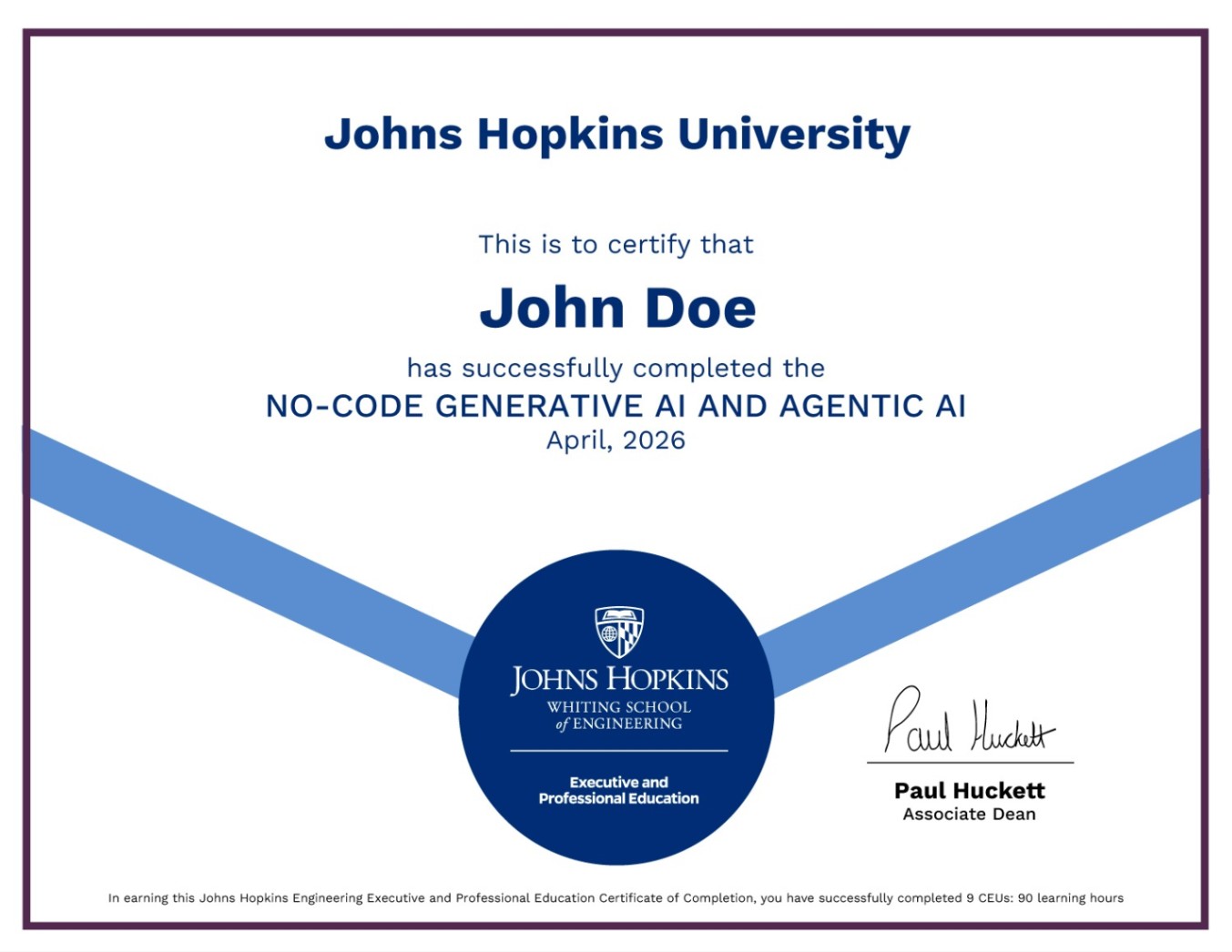
* Image for illustration only. Certificate subject to change.
Who are the faculty for the program?
Learn from renowned JHU faculty and build the expertise to implement and scale AI solutions across functions
-
Dr. Christophe Morin
Co-Founder and Chief Persuasion Scientist, SalesBrain
Aauthor of The Persuasion Code, and expert in AI-driven marketing.
Developed the NeuroMap™ model and persuasion tools used globally.
Know More
-
Dr. Jane Pinelis
Expert in artificial intelligence assurance and governance
Chief AI Engineer at Johns Hopkins University's APL
AI specialist in high-stakes ethical deployment systems
Know More
-
Ian McCulloh, Ph.D.
Director, AI Executive & Professional Education, Johns Hopkins University
Served as Chief Data Scientist & MD of AI, Accenture Federal Services
Author of three books and over 100 peer-reviewed papers
Know More
-
Dr. William Gray-Roncal
Principal Research Scientist - Johns Hopkins University Applied Physics Laboratory
Expert in data science, neuroscience, AI, and precision medicine.
Leads cutting-edge research in brain network mapping and analysis.
Know More
-
Dr. Shelby Wilson
Senior Data Scientist - The Johns Hopkins University Applied Physics Laboratory
Expert in applied mathematics, computational epidemiology, and ML.
Over a decade of experience solving real-world problems with mathematical and AI tools.
Know More






.png "Dr. William Gray-Roncal")



 LinkedIn Profile
 University Link
Who are the mentors for weekly live sessions?
Learn from seasoned AI and data science industry mentors to apply concepts and build practical skills
-
Michael Lively
Founder, QuantumAI
-
Dr. Srinivas Telukunta
Global Director, AI Solutions & Platforms, PepsiCo




Note: The mentors listed above are indicative and subject to change based on availability and scheduling.
Course Fees
The course fee is USD 2,850
Invest in your career
-
Build practical skills in Generative AI, RAG, AI workflows, and intelligent agents through hands-on learning
-
Dedicate 8-10 hours weekly to faculty-led learning, industry mentorship, projects, and case studies
-
Learn from AI experts in weekly live online sessions focused on real-world implementation and business impact
-
Receive a Certificate of Completion and 9 CEUs from Johns Hopkins University


Application Process
Applications close once the required number of participants enroll. Apply early to secure your spot
-
Fill the application form
Apply by completing the online application form.
-
Application screening
A panel from Great Learning will review your application to determine your fit for the program.
-
Join the program
Receive an offer for a seat in the upcoming cohort of the program after a final review


Batch Start Date
-
Online · 21st Nov 2026
Admission closing soon
Frequently asked questions
What is the No-Code Generative AI and Agentic AI?
The No-Code Generative AI and Agentic AI is a 12-week online program from Johns Hopkins University. It is designed for professionals across business functions and technical leaders who want to build practical skills in Generative AI and Agentic AI.
The program assumes no technical background and offers a clear, structured learning path to build a solid foundation in Generative AI, its practical applications, Prompt Engineering, and Agentic AI. Learners engage with real business scenarios through projects and case studies, join weekly live sessions with global industry experts, and attend masterclasses led by Johns Hopkins University faculty. The curriculum blends core concepts, hands-on activities, and a final assessment to help professionals apply their learning across roles and industries.
What will I learn in this program?
In this program, you will:
Understand key concepts in NLP, Generative AI, and Large Language Models (LLMs).
Understand the fundamentals of creating effective AI prompts in business situations, including advanced ways to guide AI to produce better results.
Identify strategic business opportunities and industry use cases of Generative AI and smart AI agents across sectors.
Understand the principles of Responsible AI (fairness, transparency, accountability) and recognize the risks, ethical considerations, and compliance challenges of Generative AI.
Understand the evolution and key ideas behind AI agents, including how they can act independently, remember information, reason, and use tools, with real-world examples.
Understand how no-code platforms and techniques such as Retrieval-Augmented Generation (RAG) can be used to build AI-powered workflows and connect AI to business data.
What are the key features of this course on No-Code Generative AI and Agentic AI?
The No-Code Generative AI and Agentic AI by Johns Hopkins University offers the following key features:
12-week online learning format.
Recorded video lectures, live expert mentorship sessions, and faculty-led masterclasses.
Hands-on practice with 2 real business projects and 9+ case studies using tools like n8n, ChatGPT, NotebookLM, Gemini + OpenAI API.
Personalized support from a dedicated Program Manager
Academic support through the GL community, project discussion, forums, and peer groups
AI-assisted learning tools to strengthen understanding
Industry-aligned curriculum focused on Generative AI, Prompt Engineering, AI agents, and Responsible AI
Weekly graded quizzes and a final assessment
A Certificate of Completion with 9 Continuing Education Units from Johns Hopkins University
How is the No-Code Generative AI and Agentic AI delivered?
The No-Code Generative AI and Agentic AI is delivered online through a structured 12-week format that includes:
Self-paced video modules
Weekly live sessions with industry experts
Faculty-led masterclasses from Johns Hopkins University
Hands-on activities and real-world case studies
Weekly graded quizzes
A final assessment and reflection
Personalized assistance from a dedicated Program Manager, and academic support through the GL community, project discussion forums, and peer groups.
Will I get any learning support in JHU’s No-Code Generative AI and Agentic AI Course?
Yes, learners receive dedicated support throughout the program. A Program Manager guides learners through the 12-week journey, offering help with scheduling, progress, and access to resources.
Learners also engage with the GL community, project discussion forums, and peer groups for academic support. Live mentorship sessions and faculty-led masterclasses are designed to offer added clarity and help reinforce key concepts.
What is the duration of this No-Code Generative AI and Agentic AI?
The program runs for 12 weeks. Learners spend 8 to 10 hours per week on self-paced modules, live expert sessions, masterclasses, and hands-on activities.
What is the weekly commitment for this program?
Learners are expected to dedicate 8-10 hours per week to complete the Generative AI and Agentic AI courses, participate in live sessions, and work on hands-on assignments and case studies.
Who are the faculty and mentors for this program?
The program is led by world-class faculty from Johns Hopkins University with deep expertise in Artificial Intelligence, neuroscience, and applied analytics. The core faculty includes:
Dr. Christophe Morin, Co-Founder and Chief Persuasion Scientist, SalesBrain
Dr. Jane Pinelis, Chief AI Engineer, Applied Information Sciences Branch, Johns Hopkins University Applied Physics Laboratory
Dr. Ian McCulloh, Director, AI Executive & Professional Education, Johns Hopkins University
Dr. William Gray-Roncal, Principal Research Scientist - Johns Hopkins University Applied Physics Laboratory
Dr. Shelby Wilson, Senior Data Scientist - The Johns Hopkins University Applied Physics Laboratory
Learners also receive guidance from industry mentors with experience in leading technology and AI-driven organizations. The mentor group includes
- Dr. Srinivas Telukunta - Global Director, AI Solutions & Platforms, PepsiCo
- Michael Lively, Founder, QuantumAI
Note: This is an indicative list and may change based on faculty and mentor availability.
How do I earn the certificate? What is the value of this No-Code Generative AI and Agentic AI?
Upon successful completion of the program, learners will receive a Certificate of Completion from Johns Hopkins University. This certificate demonstrates proficiency in Generative AI, Agentic AI, and their practical applications in business.
In addition to the certificate, learners will earn 9 Continuing Education Units (CEUs), which contribute to ongoing professional development. This credential adds value to your resume, showcasing your expertise in Generative AI and Agentic AI, enhancing career prospects, and positioning you as a leader in AI innovation.
How can I contact the program team for more information?
For any queries or assistance, you can reach out to us at office-gaaf-gl@jhu.edu or call us at +1 410 498 8288.
Who is this program for?
The program requires no programming knowledge and will be especially relevant to:
Knowledge professionals in sales, marketing, operations, research and consulting, finance, legal, product, and related functions
Anyone new to Generative AI who wants to boost productivity and drive business value
Professionals interested in understanding AI and applying it at work
Business analysts and strategy professionals seeking actionable insights from AI
Team leads and managers looking to integrate AI into workflows and guide their teams
What is the enrollment process for the program?
The enrollment process of this Generative AI and Agentic AI course includes several steps:
APPLY
Fill out an online application form
REVIEW
Eligible applications will be reviewed by a panel from Great Learning
JOIN PROGRAM
An offer letter will be sent to the selected candidates
Please note: The enrollment process is conducted on a rolling basis and will be closed once the requisite number of candidates are enrolled.
What is the program fee?
For the total program fee for No-Code Generative AI and Agentic AI, refer to the program page. Flexible payment options are available, and you can contact the Program Advisor for more details on payment plans and potential financial assistance.
Is financial assistance available?
Yes, financial assistance is available through various partners, offering options to pay the program fee in installments. For more information on payment plans and eligibility, please contact our program advisors.
What are CEUs, and how are they useful?
Upon successful completion of the program, you will earn 9 Continuing Education Units (CEUs) along with a certificate of completion from Johns Hopkins University. CEUs are a measure of instructional time and reflect the estimated time an average student will spend completing the mandatory components of a course. CEUs are awarded upon successful completion of all course requirements, which may include assessments, assignments, evaluations, or a final project. Earning CEUs enables professionals to demonstrate their commitment to ongoing learning and professional development.
How do Generative AI and AI Agents help businesses?
Generative AI and AI Agents help businesses enhance productivity, automate tasks, and drive innovation. They enable businesses to make data-driven decisions, improve customer experiences, and optimize operations across various functions.
What is the difference between Generative AI and Agentic AI?
Generative AI focuses on creating new content, such as text, images, or code, based on user prompts. Agentic AI goes a step further by acting autonomously. While a Generative AI program teaches you how to prompt for information, an Agentic AI course teaches you how to build systems that can plan, execute multi-step workflows, use external tools, and make decisions to achieve a specific goal without constant human intervention.
What is No-Code Generative AI, and do I need programming skills?
No-code Generative AI refers to building and deploying AI-powered workflows using visual, drag-and-drop platforms rather than writing traditional code. This Generative AI course is online, and it requires absolutely no prior programming experience. You will use intuitive orchestration tools to build powerful AI agents, making advanced AI implementation accessible for professionals across all business functions.
How will an Agentic AI certificate course help Product Managers and Business Analysts?
The certificate in no-code Agentic AI empowers strategic roles like Product Managers, Business Analysts, and Operations leaders to move beyond basic ChatGPT prompting. You will learn to build autonomous multi-agent systems that can automate competitive research, qualify leads, and query internal data through Retrieval-Augmented Generation (RAG). This allows you to generate actionable business insights and streamline operations without waiting on engineering teams.
Delivered in Collaboration with:

Johns Hopkins University is collaborating with online education provider Great Learning to offer the No-Code Generative AI and Agentic AI program. Great Learning is a professional learning company with a global footprint in 170+ countries. Its mission is to make professionals around the globe proficient and future-ready. This program leverages JHU's leadership in innovation, science, engineering, and technical disciplines developed over years of research, teaching, and practice. Great Learning manages the enrollments and provides industry experts, student counselors, course support and guidance to ensure students get hands-on training and live personalized mentorship on the application of concepts taught by the JHU faculty.
 Application closes
22nd Oct 2026
Application closes
22nd Oct 2026